- Place
- Ukmergė District Municipality
- Region
- Ukmergė
- Type
- central exhibition of the municipal local-history museum inside a former cinema built in 1959
- Address
- 9 Kęstučio Square, Ukmergė
- Coordinates
- 55.25024, 24.76565
Ukmergės kraštotyros muziejus, Ukmergės muziejus, Ukmergė Regional Museum, Former Draugystė cinema
The central museum occupies the former Draugystė cinema on Kęstučio Square
Ukmergė Local History Museum stands at 9 Kęstučio Square, coordinates 55.2502401, 24.7656463, on the south side of the town's principal square. This is the central display, not a shared address for every branch: Siesikai Castle, President Antanas Smetona's Manor, Užugiris School-Museum, Vepriai Regional Museum, and the Tolerance Centre are visited elsewhere.
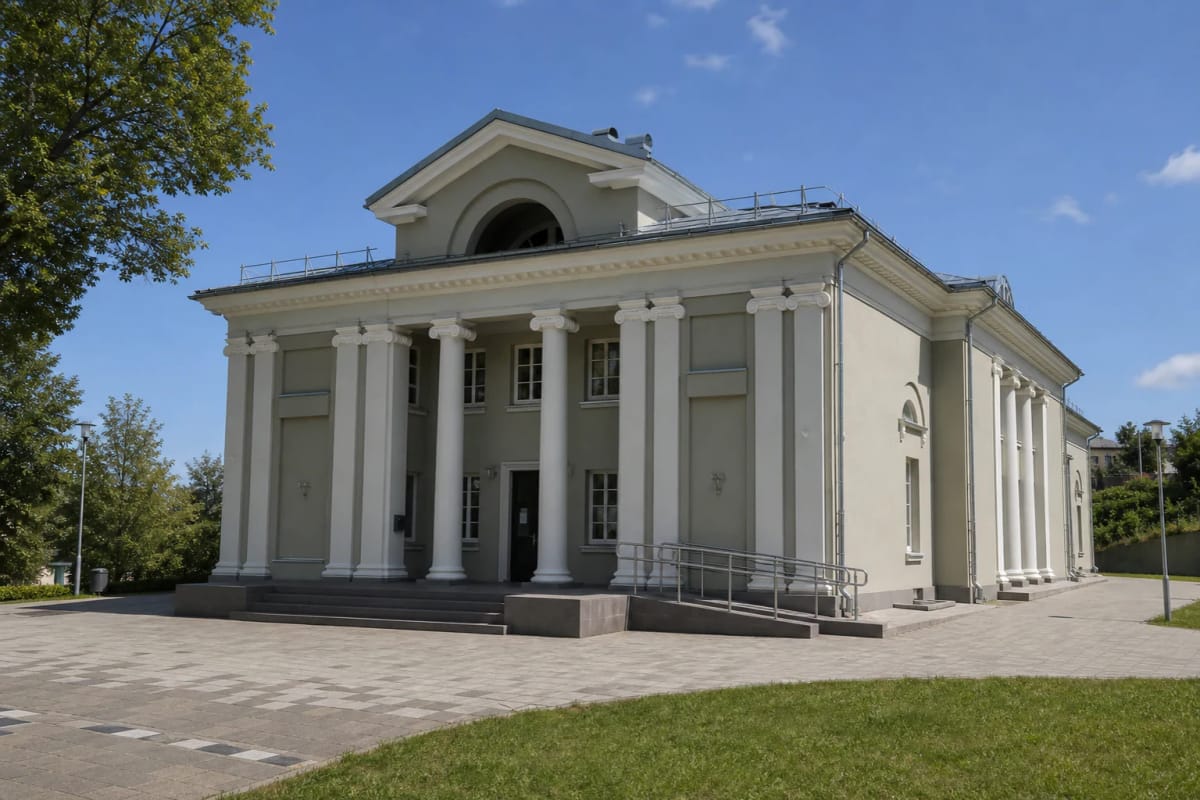
The symmetrical building opened in 1959 as Draugystė, a 330-seat widescreen cinema that operated until spring 1997. Ionic columns and pilasters divide its pale-grey historicising front, while a low triangular pediment with a large semicircular recess rises above them. The access ramp to the right of the entrance belongs to its later museum adaptation.
The renovated former cinema was transferred to the museum in 2016, and work then began on the present display. A renewed interpretation launched in 2020 joined historic objects to spatial scenes and interactive media, converting the volume of the old auditorium into a chronological route rather than a warehouse of disconnected things.
A Scout museum began the story in 1933, but the present institution opened on 6 May 1944
Teachers and Scouts from the Ukmergė gymnasium opened the town's first museum at the Scout headquarters on 2 April 1933 under artist and teacher E. Kulvietis. The Eastern Lithuania Local History Society assembled by Vladas Čižiūnas took over the growing collection in 1940, but Soviet occupation, arrests of members, and war stopped the project. Most antiquities disappeared after the gymnasium became a military hospital.
During the German occupation, artists Petras and Domicelė Tarabilda worked with the teacher-training seminary community to begin again almost from nothing. The museum formally opened on 6 May 1944 in four rooms, with art and history departments and approximately 3,500 objects. Contemporary reporting claimed more than 2,000 visitors in its first two weeks.
The Tarabildas were forced to leave after the Red Army returned, and the museum lost about 80 percent of its holdings by 1946. The institution nevertheless survived. Its display moved to the former House of Culture at 5 Kęstučio Square in 1975; the present home in the former cinema at number 9 followed only after the conversion begun in 2016.
Archaeology connects hillforts and burial grounds to the Battle of Pabaiskas in 1435
The route begins with natural history and prehistory. A mammoth tusk appears alongside Stone and Iron Age tools, weapons, and jewellery, while finds from the fifth to fifteenth centuries introduce local burial, trade, and everyday life. A dedicated archaeology playroom turns part of this material into hands-on discovery for children.
Material from the Obeliai burial ground and sites at Berzgainiai, Antatilčiai, Samantonys, Sukiniai, Bečiai, and elsewhere forms an important part of the collection. Holdings are not identical to objects currently on display: VLE recorded approximately 48,800 museum objects in 2024, including the unique Žemaitkiemis meteorite and nineteenth-century figures by local folk sculptors.
The medieval section explains the development of Ukmergė Castle and the town, armed conflict, and the Battle of Pabaiskas in 1435, when Sigismund Kęstutaitis's forces defeated the army of Švitrigaila and the Livonian Order. Archaeological finds from Pabaiskas tie an event of national importance to a specific landscape in the district.
The nineteenth- and twentieth-century rooms show the town through photographs, objects, and political ruptures
After the Middle Ages, the display divides into three principal periods: the late nineteenth and early twentieth centuries, the First World War and interwar republic, and 1940-1990. Historic photographs show Ukmergė's architecture from the late nineteenth century, while documents and print culture address education, crafts, business, the army, and the town's multicultural life.
Occupation, deportation, and resistance appear as part of one town's history rather than as a detached wartime appendix. One of the strongest late-twentieth-century objects is the original tricolour raised above Ukmergė's House of Culture on 12 November 1988, the first public appearance of the national flag in the town for almost fifty years.
Ethnography returns the story to everyday life. Wrought-iron crosses, carved saints, wayside-shrine posts, tools, vessels, rural household equipment, and handmade textiles reveal the materials and aesthetics of local makers as well as practical function. In 2026, the display gained a pair of silk shoes presented to a lady of Vaitkuškis Manor for her wedding in 1848.
The permanent route, temporary exhibitions, and district branches are three different levels of visiting
The principal ticket covers the permanent central display. Changing art, photography, and history exhibitions occupy a 148 sq m room on the ground floor and a 66 sq m room upstairs; the official tariff allows visitors to see only these temporary shows, without entering the permanent collection, free of charge. A room may close during an exhibition changeover.
The museum offers 1.5-hour guided visits to the display, separate educational sessions, and town routes. A guide is particularly useful for the Battle of Pabaiskas, the town's ethnic communities, and the occupations of the twentieth century, subjects too complex to exhaust in short labels. Tours require advance booking.
Siesikai Castle, the Užugiris complex, and Vepriai Museum are not extra rooms in this building. Each requires a separate journey, and a common price list does not by itself mean a single combination ticket. The old fire-observation tower is also visited separately with a museum employee and carried a EUR 1 ticket in the 2026 tariff.
Summer and cold-season opening days differ, while standard admission cost EUR 4
For 1 June-30 September 2026, the official site listed Wednesday-Saturday 10:00-18:00 and Sunday 10:00-17:00, with Monday and Tuesday closed. From 1 October to 31 May, it lists Tuesday-Friday 09:00-17:00 and Saturday 09:00-16:00, with Sunday and Monday closed. No new visitors are admitted during the final 15 minutes.
Standard admission on the research date cost EUR 4 and the concession EUR 2. A 1.5-hour Lithuanian tour for up to 20 people cost EUR 30 per group; a tour in English or Russian for up to 15 cost EUR 40, with participants also buying admission. The museum advertises free permanent displays on the last Sunday of each month, but the cold-season schedule lists Sunday as closed, so confirm the specific date directly.
The municipality's gallery description confirms a lift to the upper floor, and a ramp serves the main entrance. Contact the ticket desk about the full permanent route or individual assistance. On 13 July 2026, the Google Maps entry carried 206 reviews averaging 4.7 out of 5; these figures change.