- Place
- Ukmergė, Ukmergė District Municipality
- Region
- Ukmergė
- Type
- urban hillfort with foothill settlement
- Address
- Piliakalnio g. 5, Ukmergė
- Coordinates
- 55.24973, 24.76872
Vilkmergė Castle Site
City hill by two waters
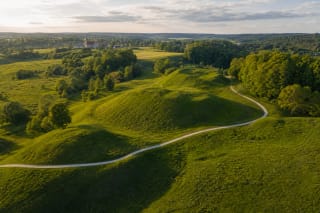
Ukmergė Hillfort stands not outside the city but in its historical core. VLE describes it as a hillfort with foothill settlement in Ukmergė, by the confluence of the Ukmergėlė and Šventoji.
Because of that position, it works as a short but concentrated Ukmergė history route: from river-valley and hillfort relief to the old-town panorama from the top.
Site of Vilkmergė Castle
The hillfort is linked with Vilkmergė Castle; until the First World War the town itself was officially called Vilkmergė. VLE dates the hillfort to the fourteenth-mid-fifteenth century and places it by the Ukmergėlė and Šventoji confluence, a useful defensive point on the Šventoji route.
The site was near major late medieval conflict. VLE states that on 1 September 1435, about 10 km south of Ukmergė near Lake Žirnajai, the Battle of Pabaiskas or Vilkmergė took place between the armies of Žygimantas Kęstutaitis and Švitrigaila, a decisive Grand Duchy civil-war clash that badly weakened the Livonian Order.
Hillfort form
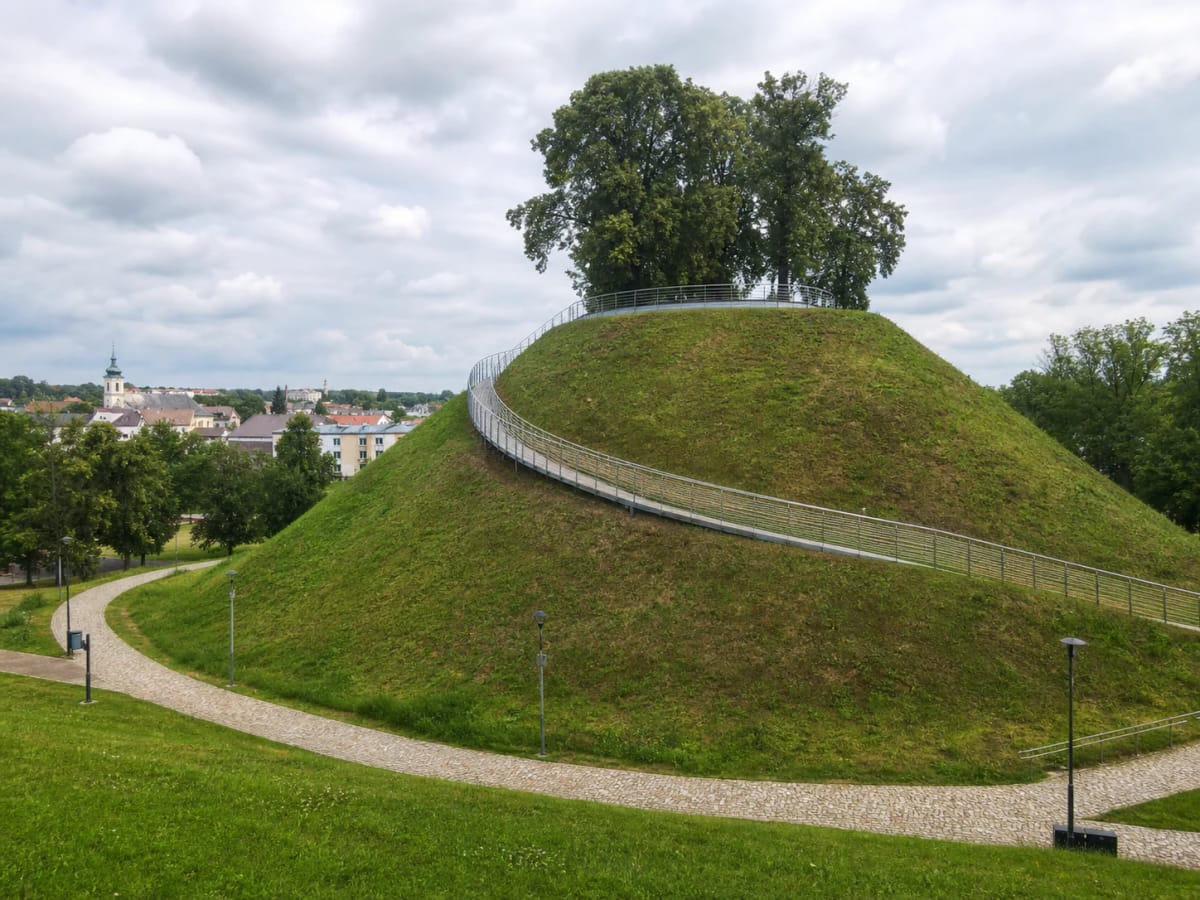
VLE gives precise features: slopes are steep, up to 16 m high; the platform is round, 26 x 30 m. Around it runs an 85 m long rampart, up to 4 m high and up to 24 m wide.
It is small but readable as an urban hillfort. Its archaeological appearance is not untouched: VLE notes that it was damaged by residents' economic activity, so today's landscape is both a historic object and a restored city public space.
Foothill settlement and outer bailey
Do not look only at the summit. VLE states that there is about 0.5 ha of foothill settlement by the hillfort, and about 200 m south-west, on a highland spur, there was an outer bailey.
In 2003 an expedition of the Lithuanian Institute of History found fragments of wheel-thrown pottery in the foothill settlement. These finds show a wider inhabited and defensive zone, not an isolated lookout.
Modern visiting
In 2013 paths, stone-paved stream slopes, and a footbridge were arranged near the hillfort. At the same time, the ruins of the oldest surviving masonry building in Ukmergė, a Jewish bathhouse, were adapted as an outdoor stage space.
In 2018 a serpentine metal path with lighting was installed, adapted for visitors with mobility impairments. Ukmergė Hillfort is therefore one of the more convenient urban hillforts for a short stop, panorama, and local-history introduction.