- Place
- Vilnius City Municipality
- Region
- Vilnius
- Type
- family-focused toy and game heritage museum combining originals, copies, reconstructions, and hands-on displays
- Address
- 2 Šiltadaržio Street, Vilnius
- Coordinates
- 54.68492, 25.29168
- Visit duration
- about 1 hour; allow 1-1.5 hours for slower exploration and more time with the hands-on displays
- Best time
- a weekday afternoon with advance registration; in July and August the longest public hours are Tuesday-Thursday
Žaislų muziejus, Vilnius Toy Museum, VšĮ Žaislų muziejus
A museum of toy heritage, not a children's playroom
Toy Museum Vilnius is at 2 Šiltadaržio Street in the Old Town, between Cathedral Square and Bernardine Garden. The coordinates 54.684923, 25.291684 mark the museum site within the building, not a verified step-free entrance or vehicle drop-off point. The venue is the non-profit public institution VšĮ Žaislų muziejus and should not be confused with Vilnius's separate teddy-bear museum, a toy shop, or a childcare facility.
The institution defines itself as a memory institution that collects, researches, and interprets Lithuanian cultural heritage through toys, games, and childhood. Its family-focused format does not mean that the content is only for children. Adults are visitors in their own right, and memories shared across generations are an important part of the twentieth-century displays.
Hands-on access follows a clear distinction. Only designated exhibits may be picked up and tested, including copies, reconstructions, and active objects; visitors should not assume that an original is a general-use toy. The rooms contain small parts, and some historical pieces do not meet present-day toy manufacturing standards, so children must stay with an adult and follow the educators' guidance.
From a 2010 idea to a 2012 opening in a historic house
Archaeologist Dr Povilas Blaževičius and Indrė Jovaišaitė-Blaževičienė established the public institution in 2010. The museum opened to visitors on 8 December 2012. Its first exhibition grew from archaeological research into toys, gaming pieces, and amusement equipment summarised in Blaževičius's doctoral dissertation, while its communication model was designed around children and adults exploring together.
LIMIS describes it as Lithuania's first family-oriented education centre dedicated to the heritage of toys and games. That definition matters: this is not simply a collection of old dolls and model cars. Play becomes evidence through which the museum examines daily life, technology, work, learning, and changing ideas of childhood.
The museum occupies municipally owned rooms in the protected Rodkevičiai House, Cultural Property Register code 1086. LIMIS associates the building with approximately the late seventeenth century. Vilnius City Municipality's 2022 competition specified 229.05 square metres on the ground floor and a ten-year lease for museum, educational, and related cultural activity. Older descriptions sometimes use B. Radvilaitės Street for this corner building, but the current visitor address is 2 Šiltadaržio Street.
The oldest Lithuanian toys are interpreted through copies and reconstructions
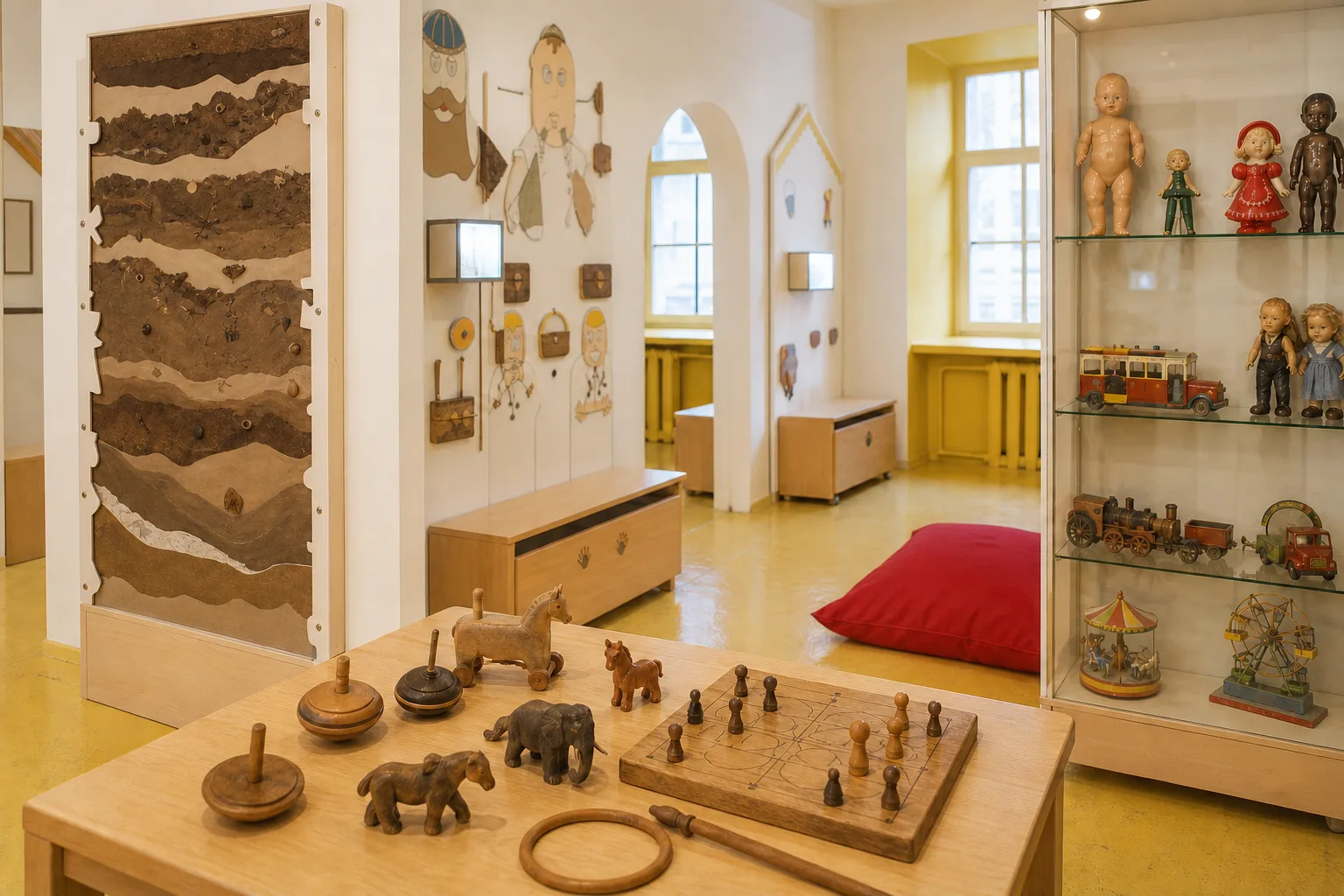
The permanent Oldest Toys in Lithuania section has been part of the museum since opening day. Original archaeological toys and pieces of gaming equipment are held by eleven museums across Lithuania, so visitors on Šiltadaržio Street see copies and reconstructions. They are not presented as substitutes pretending to be originals; they make it possible to test form, material, movement, and a plausible method of play.
This display also explains how archaeologists identify traces of childhood and amusement. A small find does not automatically reveal whether it was a toy, a ritual object, a model of an adult tool, or one element of a game. Context, comparison, and cautious reconstruction are therefore central to the interpretation, rather than an attractive but unsupported medieval story.
Journey to the Stone Age, introduced on 8 December 2013, is built around fourteen active objects. The museum explicitly acknowledges that Lithuanian archaeology has not produced objects proving exactly how Stone Age children played. The gallery is therefore an evidence-informed learning interpretation using stone, wood, leather, sand, water, fire-making, and practical skills, not a supposed collection of authentic Stone Age toys.
Ethnographic childhood and more than 5,000 nineteenth- and twentieth-century originals
The exhibition It Was 100 Years Ago was developed from 2017 and opened in 2018 for the centenary of the restoration of Lithuanian statehood. It connects children's play to the adult environment of the period: children learned by observing work, imitating tools, and using wool, wood, and other available materials. The point is not simply that the objects are old, but that play trained movement and prepared children for everyday life.
Twentieth-Century Memories has expanded since 2012. According to the museum, its stores contain more than 5,000 original objects from the late nineteenth and twentieth centuries, about 90 per cent donated by visitors. Shop-bought and homemade toys, together with gaming machines, allow visitors to compare one-off wooden or textile objects with industrial plastic, metal, and increasingly standardised forms.
The stored collection is much larger than the compact galleries can display. Objects rotate, some rest or go to conservators, and two cases are used for temporary collectors' exhibitions. Dolls, model vehicles, or a temporary show visible in an older photograph may therefore be absent on the day of your visit; check the latest official programme before travelling.
How to explore the museum with children or without them
The museum recommends a visit of about one hour. A coherent route begins with a short explanation from an educator, continues through the archaeology and Stone Age sections, and finishes by comparing ethnographic and twentieth-century toys. If a child becomes absorbed in one activity, there is little reason to rush through every object; 1-1.5 hours gives more room for testing and conversation.
The official FAQ sets no minimum age when a family explores together. A toddler who can walk may already test suitable objects, but the history, materials, and mechanisms of toys generally become clearer from around age three; registered children's groups are accepted from that age. This is not a place to leave a child alone, and an accompanying adult is not treated as a free supervisor. Both take part in the museum visit.
No more than 60 visitors can be admitted at once, so advance registration is officially recommended by calling +370 604 00449. Groups larger than ten should always announce their visit. The museum FAQ says an arranged introduction or guided explanation does not carry an extra fee, but a particular time and language should not be assumed without confirming them in advance.
Verified summer 2026 hours, admission, and access limits
On 19 July 2026, the official July-August timetable for independent visitors was Tuesday-Thursday noon-6 pm, Friday noon-4 pm, and Saturday 11 am-4 pm; the museum was closed on Monday and Sunday. It also closes on Lithuanian public holidays. Public hours differ during parts of the school year, so use the official visitor page rather than an old directory listing before setting out.
On the same date, full admission was €8. The published €6 concession applied to children, school pupils, students, seniors, and disabled visitors with appropriate evidence, while children under one entered free. Families visiting together with at least three children paid €6 each. An organised education session cost €6 per participant with a stated minimum of ten participants. Prices can change, so confirm the final group charge when booking.
The museum asks visitors to arrive at least one hour before closing and stops admitting new visitors for the final 45 minutes. Food and drink are not allowed in the displays. Although the municipal record describes ground-floor rooms, the official visitor page does not provide enough detail to promise a step-free entrance, an adapted toilet, pushchair storage, or hearing and visual support. Call before buying tickets if a mobility or sensory requirement will determine whether the visit is workable.