- Place
- Vilnius City Municipality
- Region
- Vilnius
- Type
- poet's memorial museum in historic rooms on Bernardinų Street
- Address
- Bernardinų g. 11, LT-01124 Vilnius
- Coordinates
- 54.68334, 25.29175
- Visit duration
- currently closed; check the official reopening notice before planning a visit
- Best time
- only after the official reopening; recheck Vilnius University Museum visitor information
A. Mickevičiaus memorialinis muziejus, Vilnius University Adam Mickiewicz Museum, Adomo Mickevičiaus muziejus
The Bernardinų Street rooms and a carefully defined link to Grażyna
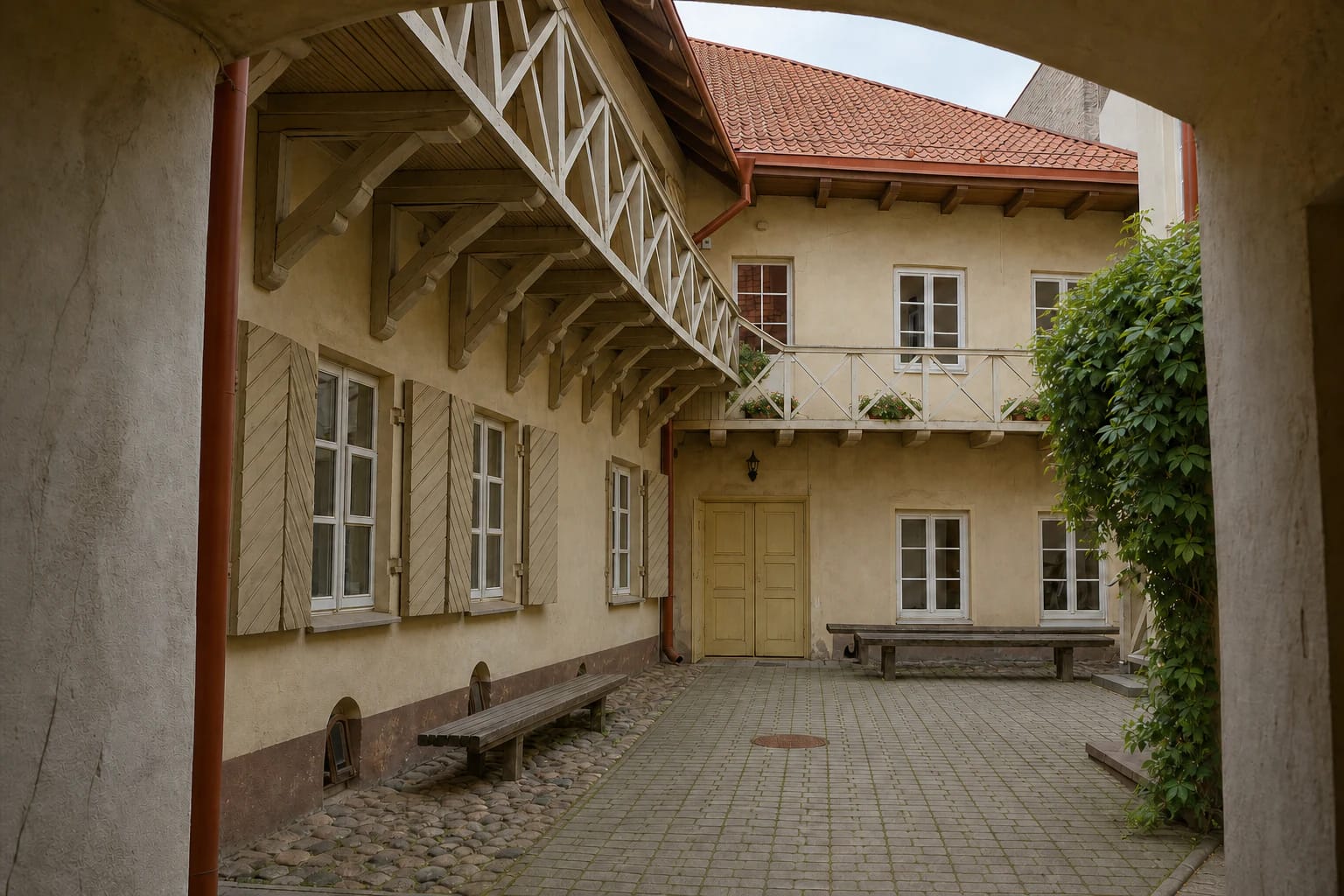
The museum occupies an inner courtyard at 11 Bernardinų Street, in a house bought by Ignacy and Teresa Byczkowski in 1812. The family rented out rooms on the ground and first floors; their tenants included Adam Mickiewicz and his friends Ignacy Domeyko, Józef Jeżowski, and Antoni Edward Odyniec. The site's principal link to the poet rests on Odyniec's recollection: in 1822 Mickiewicz edited here the poem Grażyna, which he had written in Kaunas. It is therefore more accurate to say that he revised and prepared the work for publication in these rooms, not that he wrote the whole poem here from the beginning.
The Bernardinų Street rooms are not the site of the poet's university studies, teaching career, or imprisonment. Mickiewicz studied at Vilnius University in 1815-1819, taught in Kaunas in 1819-1823, and after his 1823 arrest was imprisoned in the former Basilian monastery. The museum marks a narrower, more precise episode in his Vilnius life in 1822, before Grażyna was published in 1823.
From traces of fifteenth-century masonry to an eighteenth-century courtyard
The oldest surviving part of the building is its seventeenth-century cellar. Archaeological work in 2011 found fragments of green-glazed roof tiles, evidence suggesting that a masonry building stood here as early as the fifteenth century. The present complex reached its final form at the end of the eighteenth century and carried number 147 under the old numbering system.
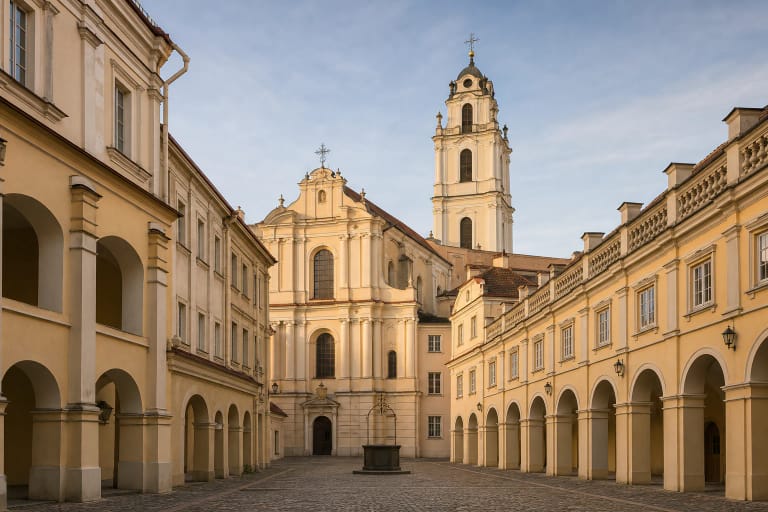
A small arched passage leads from Bernardinų Street into the compact paved courtyard. Its recognisable features are restrained warm-yellow plaster façades, wooden shutters, and a gallery carried on timber brackets. This was not a grand poet's residence but the setting of rented Old Town rooms, a scale that helps keep the memorial story grounded.
The 1911 museum and the transfer of the property to the university
Jan Konrad Obst and his wife Róża acquired the house in the early twentieth century. A previous owner, Jan Życki, had marked the room associated with Grażyna with a memorial plaque, which Obst found beneath wallpaper. In 1911 he established the Adam Mickiewicz Museum here and displayed his collection. The plaque and Obst's installation reveal how the poet's memory was deliberately shaped in the house, but they are not in themselves proof of what happened in 1822.
In 1938 Obst donated the entire building, museum, and accumulated collection to Stefan Batory University, now Vilnius University. During the Second World War the museum room became an ordinary flat and most exhibits disappeared. Vilnius University created a new display after the war, formally reopened the restored museum on 27 November 1955, and since 1 January 2021 the institution has operated as a branch of Vilnius University Museum.
Authentic objects and a later memorial reconstruction
The collection's principal authentic objects are a table and chair used by Mickiewicz in Kaunas and an armchair from Paris. Dr Kazimierz Jaworowski donated the first two to the Society of Friends of Polish Science in 1908, while the poet's grandson Ludwik Górecki donated the Paris armchair in 1929. LIMIS also highlights a Kaunas district school graduation diploma issued to Simon Martiševski and signed by Mickiewicz. These are genuine objects connected with the poet, but they did not survive as the original furnishings of the Bernardinų Street room.
Most of Obst's display was lost during the war, the room plaque associated with Grażyna disappeared during the 1979 renovation, and a 1987 fire caused further damage. The later Poetry Hall, Philomath Hall, and Women in Adam's Life display were museum interpretations. The pre-renovation setting therefore combined authentic objects, a historic house, and later memorial reconstruction; the composition of the new exhibition will need to be checked after reopening.
Closed for renovation: what to verify before going
On 2026-07-15, official Vilnius University Museum visitor information listed the Adam Mickiewicz Museum as temporarily closed. A second renovation phase begun in 2025 covers the rooms and courtyard, followed by installation of the exhibition; reopening is planned for late 2026. This is a plan, not a guaranteed date, so there are currently no valid public opening hours or admission prices. Recheck the official Vilnius University Museum page before travelling.
Before closure, Lithuanian- and Polish-language tours and educational activities were documented, with advance registration required for some programmes. Languages, group arrangements, reservations, and prices for the reopened museum have not yet been published. No confirmed specification for a step-free post-renovation route or other access provisions was found either, so visitors should discuss individual requirements with the museum through its official contacts.
The Google Maps card is named A. Mickevičiaus memorialinis muziejus. On 2026-07-15 it showed an exact rating of 4.5 out of 5, and its place ID was ChIJ4eTZNRaU3UYRVZH635MWx3I. The card's entrance point corresponds to the courtyard access at 11 Bernardinų Street; no review count is stated here.