- Place
- Vilnius City Municipality
- Region
- Vilnius
- Type
- museum of the restored rulers' residence in Vilnius Lower Castle
- Address
- Katedros a. 4, Vilnius
- Coordinates
- 54.68620, 25.28898
Valdovų rūmai, Palace of the Grand Dukes, Palace of the Grand Dukes of Lithuania
Why the Palace is more than a museum on Cathedral Square
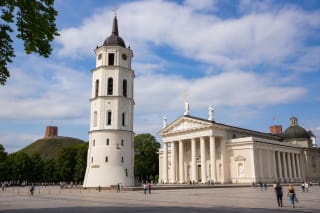
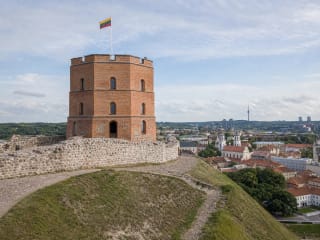
The Palace of the Grand Dukes stands where the view of Vilnius Old Town becomes a layer of state history: beside the cathedral, Castle Hill, and the former Lower Castle. This is not only restored representative architecture. Visitors walk through a place where, for several centuries, the power, diplomacy, ceremonies, art, and everyday life of the Grand Duchy of Lithuania were concentrated.
VLE describes the palace as the historical residence of the rulers of the Grand Duchy of Lithuania, restored in the early twenty-first century in the territory of the Lower Castle and belonging to the Vilnius Castles Reserve. This place lets visitors see three levels in one route: archaeological foundations, the restored volume of the residence, and a museum narrative about the rulers' era.
Vilnius Lower Castle and the logic of the palace architecture
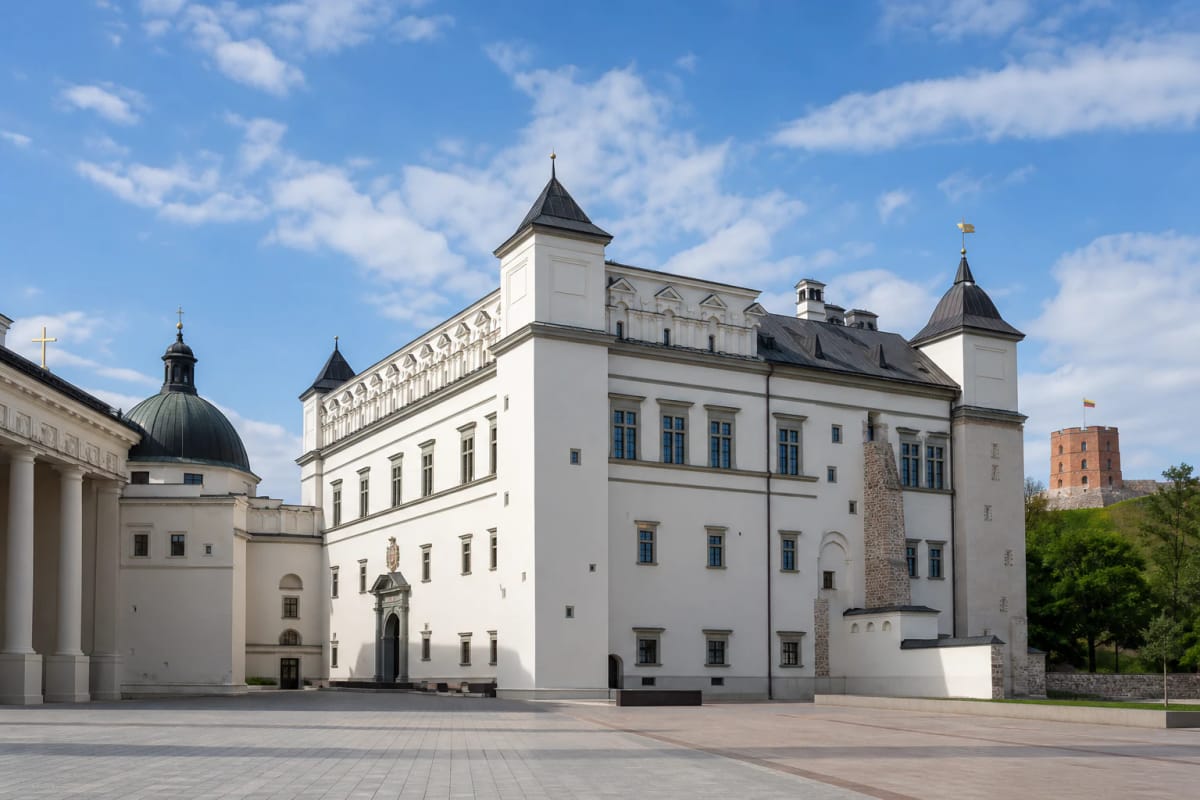
The present palace is formed around a closed courtyard with four wings. VLE states that the facades were restored in Renaissance style based on the sixteenth-century palace that once stood here, iconographic material, and archaeological data. From the outside the building appears unified, but its real value becomes clearer inside, where different historical stages can be recognized.
The official exhibition description assigns the first route to history, archaeology, and architecture. It presents authentic masonry from different periods, finds, models, maps, and iconographic material. This is important: the Palace of the Grand Dukes is not only a scenographic reconstruction of the past, because the museum narrative begins with research into the place itself.
From wooden settlement to Renaissance rulers' residence
The official palace chronology connects the beginning of the site with a fortified wooden settlement of the second to thirteenth centuries. In the second half of the thirteenth century and the early fourteenth century, part of it became a castle, and early masonry buildings connected with the Gediminid environment appeared in the territory. By the mid-fourteenth century, the Lower Castle was already enclosed by masonry defensive fortifications.
The palace flourished especially in the sixteenth century. The official timeline states that after a fire in the late fifteenth and early sixteenth centuries, Sigismund the Old rebuilt and expanded the residence in 1514-1530, beginning the stage of a modern Renaissance palace. VLE adds that in 1544-1548, on Sigismund Augustus' initiative, arcaded galleries and a staircase were installed, the west and north-west wings were built with architect G. Cini involved, and in 1536 an Italian-type garden with alleys and sculptures was created beside the palace. Rulers lived here, envoys were received, treasuries were kept, and dynastic ceremonies took place.
Baroque halls, opera, and the rupture of 1655
In the seventeenth century the palace gained features of an early-Baroque residence. The official chronology emphasizes development under the Vasa dynasty, the scale of diplomatic receptions, and music culture. One of the most striking facts is that in 1636 the first opera in Lithuania, The Abduction of Helen, was staged in the palace, connected with the Vilnius court theatre tradition.
In 1655, Muscovite and Cossack armies occupied Vilnius, and the palace was devastated and looted. VLE states concisely that after the 1655-1661 war with Moscow the palace was not rebuilt, and at the turn of the eighteenth and nineteenth centuries it was demolished on the initiative of the Russian imperial administration. This explains why today's visit is not to an uninterruptedly preserved castle, but to a residence memory restored through archaeology and reconstruction.
Archaeology, restoration, and the 2009-2018 openings
Systematic archaeological research in the palace territory began in 1987. VLE mentions complex investigations and researchers, while the official timeline shows how the idea of reconstruction grew from this work. In 2000 and 2001, the Seimas and Government adopted decisions on restoring the palace, and construction works followed.
On January 1, 2009, the National Museum Palace of the Grand Dukes of Lithuania was established, and on July 6, 2009, during the celebration of the millennium of Lithuania's name, a symbolic opening took place. The first restored part of the palace was formally opened on July 6, 2013, and on July 6, 2018, the museum announced the completion of restoration and opened all spaces to visitors.
What to see: four museum routes
The official museum offers visitors four exhibition routes. The first leads through the development of the site, archaeology, and architecture; the second presents restored historical interiors, rulers' representative and private spaces, and the treasury and financial-administration setting; the third brings together weaponry, everyday life, and music; and the fourth operates as the museum's exhibition centre.
Because of this structure, it is worth deciding before you enter what matters most to you. If you are interested in authentic masonry and research, start with the first route. If you want the strongest visual palace experience, choose the historical interiors. If you are travelling with children or visitors who prefer concrete objects, the third route with weaponry, kitchen, and music themes is often the easiest to read.
How to plan a visit
The palace stands at the edge of Cathedral Square, at Katedros a. 4. At the time of research, the museum stated that it was closed on Mondays and most public holidays, except February 16, March 11, and July 6. From September to May, opening hours were shorter, while in summer, June to August, they were extended on some days until 20:00. At that time, a standard visitor ticket cost about 3 EUR, schoolchildren, students, and seniors received a 50 percent discount, and disabled visitors and their companions entered free.
Because exhibitions, restrictions, opening hours, and prices can change, check the museum's opening-hours and ticket pages before travelling rather than relying on old information.
A good visit here takes from one and a half to three hours. For a short visit, one or two routes may be enough; to understand the palace's development from foundations to restored halls, allow more time. After the museum, the natural continuation is Vilnius Cathedral and bell tower, Gediminas Castle Tower, or a walk toward Bernardine Garden and the Hill of Three Crosses.