- Place
- Raseiniai District Municipality
- Region
- Samogitia
- Type
- Marian pilgrimage shrine with basilica and Apparition Chapel
- Address
- M. Jurgaičio a. 2 and Jono Pauliaus II g. 2, Šiluva
- Coordinates
- 55.53000, 23.22500
Šiluva, Šiluva Marian Shrine
What you see at Šiluva Shrine
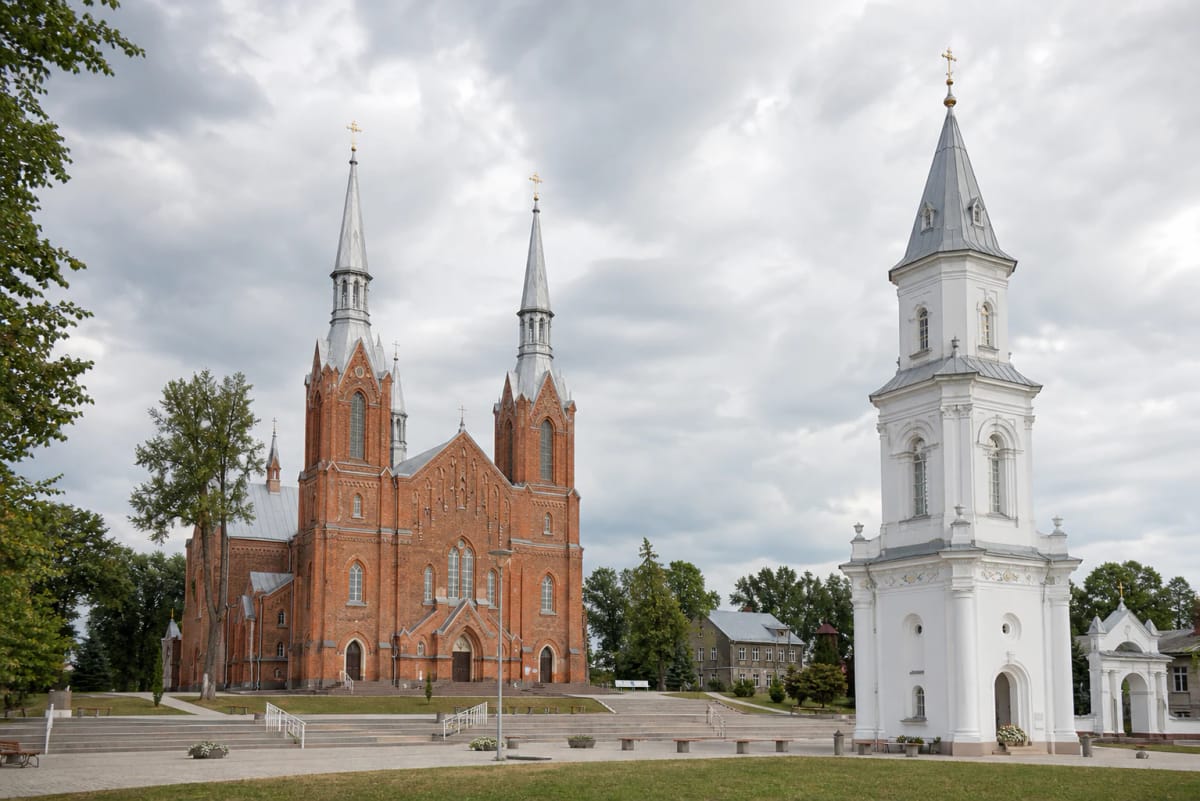
Šiluva Shrine consists of several clear elements: the Basilica of the Nativity of the Blessed Virgin Mary, the Apparition Chapel, the pilgrims' square, the Rosary, and other prayer spaces. A visit here is therefore more than a look inside one church.
Visually the place is easy to recognize from two contrasting accents: the red-brick basilica and the separate white Apparition Chapel. The square between them creates an open pilgrimage space that can hold both quiet prayer and large indulgence gatherings.
The Šiluva apparition tradition
The centre of Šiluva's identity is the 1608 Marian apparition tradition. VLE states that, according to legend, the Blessed Virgin Mary with the Child appeared to shepherds at the site of the former Catholic church. It is described as the earliest apparition in Europe officially recognized by the Catholic Church.
For this reason Šiluva became one of Lithuania's most important Catholic pilgrimage sites. VLE notes that thousands of pilgrims, including people from Lithuania Minor, were already coming to the Šilinės indulgence days in the first half of the seventeenth century. Even if you travel as a cultural visitor rather than a pilgrim, the apparition story explains why a small town became a sacred site of this scale.
The late-Baroque Šiluva Basilica
The Basilica of the Nativity of the Blessed Virgin Mary is a late-Baroque building constructed in 1760-1775, with stucco sculptural decoration. VLE states that it contains eight wooden altars and a pulpit with ten sculptures, all from 1762-1778 by sculptor M. Podhaiskis, as well as the image of the Blessed Virgin Mary with the Child, regarded as miraculous and thought to date from the 1620s.
This image was crowned in 2007 with crowns blessed by Pope Benedict XVI. When visiting, note that the basilica is not a metropolitan cathedral; its impact comes from its relationship with the square, the small town, and the pilgrimage tradition.
Šiluva Apparition Chapel
The Apparition Chapel is a separate and central sign of Šiluva Shrine. VLE states that the first wooden chapel at the apparition site was built in 1663, while the present chapel, combining Gothic forms with a modernized reading of Lithuanian wooden bell towers, was built in 1912-1924 according to architect Antanas Vivulskis's design.
Inside the chapel, an altar stands on the apparition stone, with a statue of the Blessed Virgin Mary above it. The white vertical volume stands out from the low scale of the town, so many visitors stop here not only for photographs but for a short time of silence.
Šilinės and the rhythm of pilgrimage
Every year in early September, according to VLE from September 8 to 15, Šiluva hosts Šilinės, one of Lithuania's largest indulgence celebrations. At that time the scale of the shrine changes: pilgrims arrive, services, processions, and community meetings are organised. In 2009 the areas between the chapel and basilica were joined into one M. Jurgaitis Square with stations of the Rosary mysteries.
If you want a quieter architectural and historical visit, avoid the indulgence days. If you want to understand why Šiluva is a living pilgrimage centre, Šilinės is the strongest time, but plan more time and transport carefully.
Šiluva Shrine and the trace of John Paul II
Pope John Paul II visited Šiluva in 1993 during his apostolic journey to Lithuania. VLE mentions the Pope John Paul II House in Šiluva, and in M. Jurgaitis Square a sculpture of him by Polish sculptor Czesław Dźwigaj was erected in 2008. These signs point to the broader return of Lithuanian Catholic public life after the Soviet period.
Šiluva can therefore be paired with other late-twentieth-century memory sites. It helps explain not only old devotional tradition but also how religion returned to public life after occupation.
Practical advice
The pilgrims' information centre, basilica, and chapel may have different hours depending on season and events, so check the official Šiluva website before travelling. Special arrangements apply during indulgence days.
Respect services and prayer spaces. If you photograph, do so discreetly, especially in the chapel and basilica. One quiet hour is enough for a basic walk, but prayer or events can easily extend the visit.