- Place
- Raseiniai District Municipality
- Region
- Samogitia
- Type
- writer's birthplace memorial reserve and childhood homestead museum
- Address
- Pasandravys and Bernotai villages, Pagojukai Eldership, Raseiniai District
- Coordinates
- 55.43400, 23.32100
Maironis childhood home, Poet Maironis childhood homestead-museum, Pasandravys Historical Reserve
Maironis Birthplace: where the national poet was born
Maironis Birthplace is a memorial landscape in Raseiniai District, where the childhood of Lithuania's national poet Maironis unfolded. The place is protected as Pasandravys Historical Reserve and includes two neighbouring homesteads: Pasandravys, where the poet was born, and Bernotai, where he grew up and where a memorial museum now operates.
It is important to distinguish the terms. Pasandravys is the birthplace; Bernotai is the childhood home. The two are linked by the roughly one-kilometre Maironis Oak Trail, so a visit is not only a museum stop but a walk through the fields of the poet's youth.
Maironis, poet of the national revival
Maironis, born Jonas Mačiulis, was born on November 2, 1862, in Pasandravys, in a family of free peasants. He became a priest, prelate, doctor of theology, and long-serving rector of Kaunas Priest Seminary, while also becoming the central poet of the Lithuanian national revival.
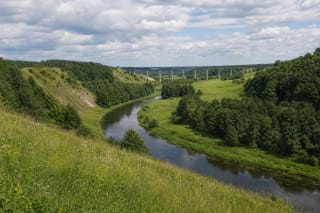
His poetry collection Pavasario balsai, published in 1895, is considered a manifesto of the national revival and the beginning of modern Lithuanian lyric poetry. Maironis died in Kaunas in 1932 and is buried in the crypt of Kaunas Cathedral Basilica. The fields of his native region, the Sandrava and Luknė streams, and the Dubysa valley fed his writing.
Pasandravys: the birth site
The Pasandravys manor where Maironis was born burned during the First World War. Today the birth site is marked by surviving manor foundations, a sweep well with a large stone curb, and a restored stone carriage-house building.
In 2020 the reserve was adapted for visitors: at the birth homestead site, the exact outline of the birth house was recreated and artistic installations and video projections were installed to evoke the homestead that once stood here.
Bernotai: childhood home and homestead museum
Nearby Bernotai was the homestead of Maironis's parents and later his sister; this is where the poet spent his childhood. His beloved old orchard, apple trees, icehouse, and a pine associated with his youth survive.
A memorial museum was opened in the surviving sister's homestead in 1989 as a branch of Raseiniai Regional History Museum, with an exhibition devoted to Maironis. It shows the environment in which the future poet was formed.
Maironis Oak Trail and the 1863 rebel graves
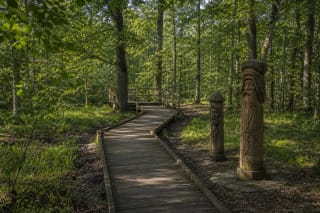
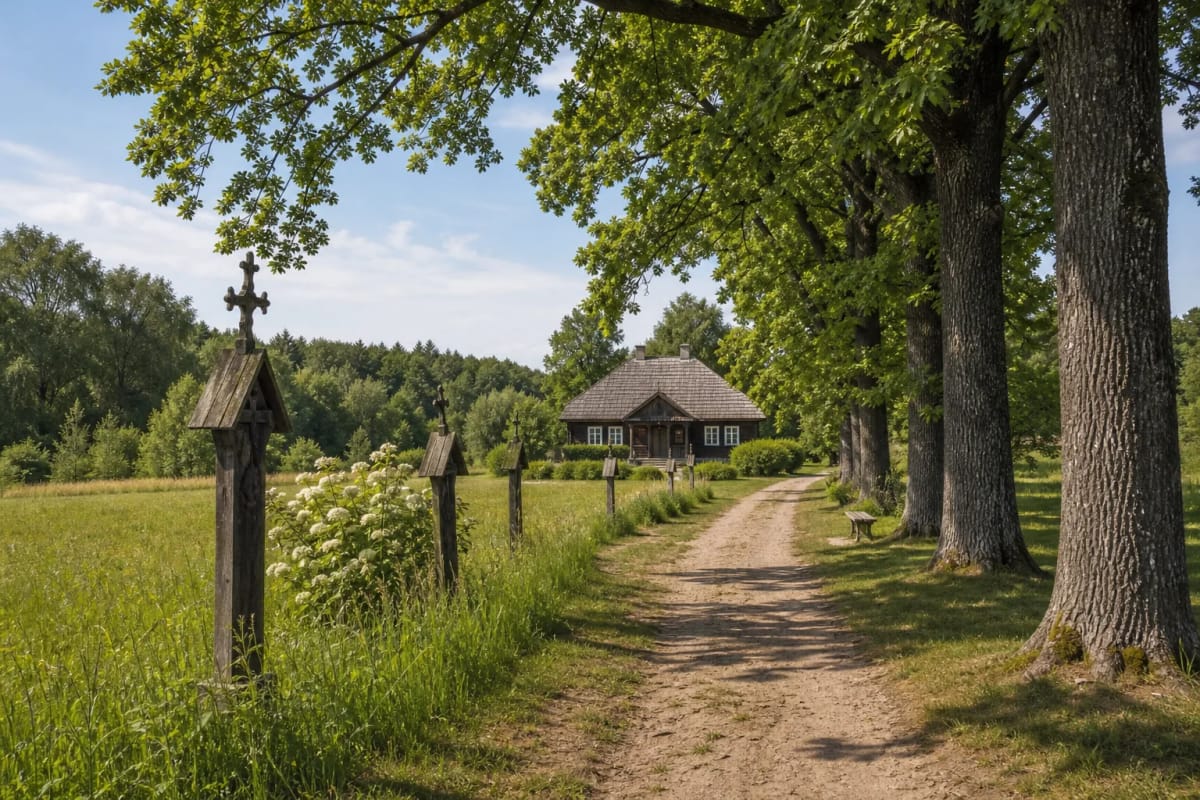
In 1987, marking the 125th anniversary of the poet's birth, the Maironis Oak Trail was laid between Pasandravys and Bernotai. It is an approximately one-kilometre footpath planted with oaks on both sides from the Luknė to the Sandrava stream and decorated with Lithuanian wayside shrines. The oaks were planted by noted Lithuanian cultural and scientific figures and by the poet's relatives; about 150 are now counted.
By the Luknė are small 1863 uprising rebel graves, marked by a memorial cross; Maironis's godmother is also buried there. The rebel graves are among the values protected by the reserve.
Pasandravys Historical Reserve and visiting
Pasandravys Historical Reserve was established in 1996 and, according to protected-area data, covers about 537 ha. It protects the natural and cultural environment of the poet's birthplace and childhood home, as well as the 1863 rebel graves. The reserve lies in Dubysa Regional Park.
During research, the museum worked on weekdays and Saturdays; an adult ticket cost about 2 EUR and children/student tickets about 1 EUR. Opening hours differ between sources, and the place is rural, so it is worth calling before arrival. The visit combines well with the Maironis Lithuanian Literature Museum in Kaunas or with Dubysa Valley.