- Place
- Alytus, Alytus City Municipality
- Region
- Dzūkija
- Type
- active late-Classicist Catholic church in historic First Alytus
- Address
- 7 Panemuninkėlių Street, LT-62260 Alytus
- Coordinates
- 54.40458, 24.05788
- Visit duration
- 30-60 minutes for the facade, churchyard, and interior when open; longer during worship or an event
- Best time
- in daylight for the architecture; during an advertised Mass if you want to enter without a separate appointment
First Alytus St Louis Church, First Alytus Church, Alytaus Šv. Liudviko bažnyčia, St Ludwig's Church in Alytus
The church stands in the historic core of First Alytus, not beside today's main square
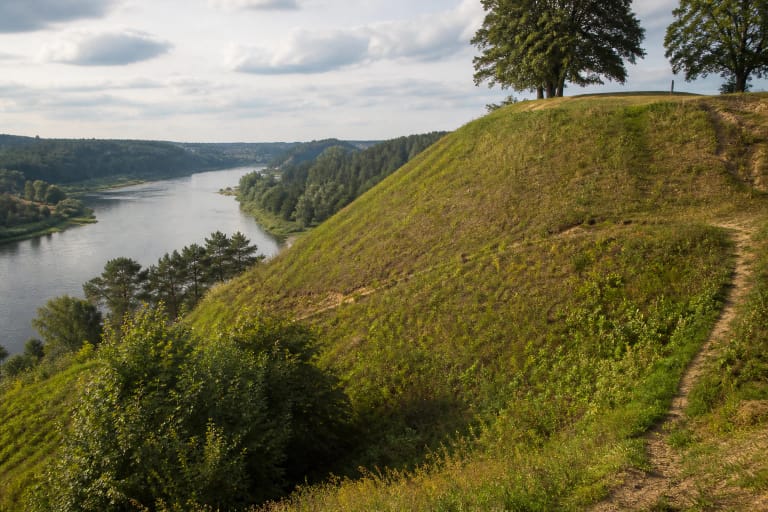
St Louis Church stands at 7 Panemuninkėlių Street on the right bank of the Nemunas. This is historic First Alytus, where the town plan developed around a widened street-like space and the old church. The present administrative and commercial centre lies across the river, so navigation should use the exact address rather than a general search for central Alytus.
Coordinates 54.404577, 24.057877 mark the church building itself. The pinType is site because this is not a verified point for the principal door, gateway, parking, or an accessible drop-off. The sanctuary occupies a hill within a fieldstone-walled churchyard, making the slope and the actual route through the grounds more important than metre-level precision of the map pin.
This is an active parish church in Alytus Deanery of the Diocese of Kaišiadorys. It is not a ticketed museum or an exhibition with fixed tourist opening hours every day. Treat it first as a place of worship: Mass, a funeral, a wedding, or a rehearsal always takes precedence over sightseeing.
More than a century separates the masonry church of 1818 from its present facade
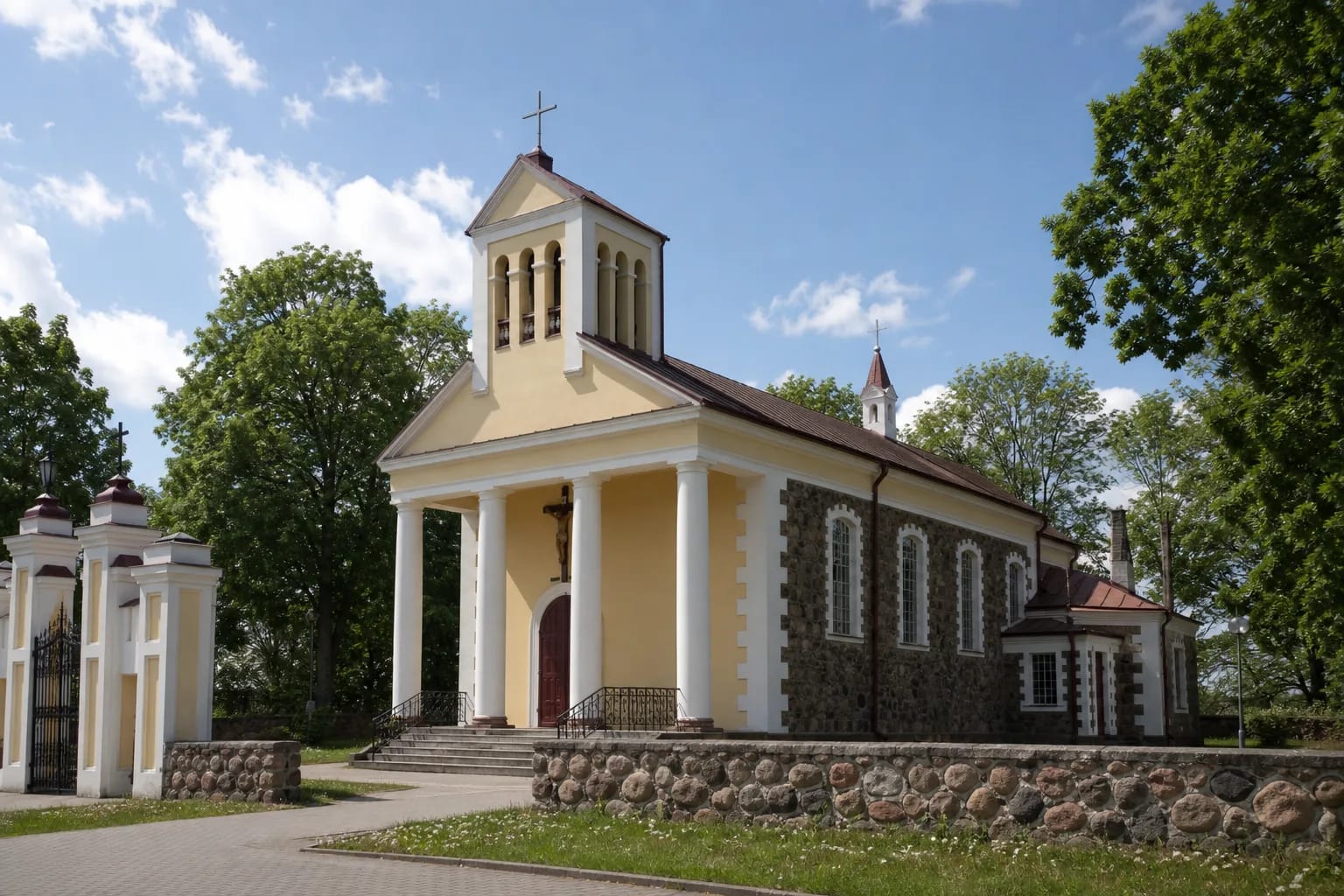
VLE dates the present church to 1818 and identifies it as a late-Classicist masonry sanctuary. Brick and fieldstone are both used in its fabric: rough stone remains exposed along the long elevations, while the rendered pale-yellow front, white surrounds, and restrained symmetry create the Classicist impression. This material contrast makes the building recognisable even without its tower.
The four white columns and bell tower above the pediment are not an unchanged facade from 1818. During the 1930-1931 reconstruction designed by engineer and architect Vaclovas Michnevičius, an extension was added at the high-altar end, the portico and tower were formed at the front, and an old detached timber belfry was removed. The facade therefore records both a nineteenth-century church and an interwar transformation.
The building and its towers suffered wartime damage, and VLE dates their restoration to 1957. By 2013 the church was assessed as structurally unsafe; archaeological and structural investigations followed in 2017 as a capital-repair project was prepared. The church was reconsecrated after later roof and structural work in 2022, so the bright interior seen today also reflects the most recent phase of conservation.
The year 1524 marks the parish's beginning, while today's church succeeded several rebuildings
The foundation document of 1524 is associated with the establishment of Alytus parish and its first timber church. It should not be confused with the earliest written mention of Alytus, which is older. The early sanctuary occupied the same historic town-core area, but none of its sixteenth-century fabric survives above ground.
The archaeological overview reports that the church may have burnt in the war of 1655, was rebuilt in 1658, and was destroyed again when Russian troops occupied the town in 1663. The timber sanctuary burnt and was restored at least twice more in the eighteenth century. A new timber church erected in 1763 was finally lost in the Alytus fire of 1810. This sequence explains how a very old parish came to have no surviving medieval building.
Priest Liudvikas Kaminskas and the parish community initiated a new fieldstone-and-brick church in 1818. Some parish histories describe the work as lasting from 1818 to 1820, while VLE and the archaeological overview use 1818 as the principal date. Local accounts explain the title as honouring the priest who led the rebuilding, but its sacred patron is Saint Louis IX, the thirteenth-century king of France.
The bell of 1669 and the image of Saint Louis are the key details to look for
The tower contains a bell cast in 1669 by Jonas Delamarsas and protected as an individual movable object in the Register of Cultural Properties. Few works by this Vilnius bell and cannon founder of French origin survive in Lithuania. The bell predates both the present 1818 building and the tower of 1930-1931, linking the site materially with one of its timber predecessors.
A nineteenth-century painted image of Saint Louis survives in the interior. It depicts the patron of the sanctuary, not the builder Liudvikas Kaminskas. The shared first name causes an easy misunderstanding: the priest is associated with constructing the present church and selecting its title, while the dedication itself is to the canonised French king.
The sacred works are not arranged as a separate museum display. When the doors are open, follow the axis of the portico into the nave and view the sanctuary and paintings without interrupting prayer. The belfry is not advertised as a public observation tower, so do not assume that the tower or the historic bell can be visited internally without explicit parish permission.
Earlier churches, burials, and ordinary objects survive beneath the churchyard
The fieldstone-walled churchyard measures approximately 47-58 by 41 metres. In 2017, while the capital-repair project was being prepared, archaeologists investigated ten small test pits inside and outside the church, covering 12.86 square metres in total. The work was tightly targeted and should not be mistaken for a complete excavation of the grounds.
The evaluation encountered remains from at least fifteen burials and exhumed eight skeletons, six adults and two children. The graves were broadly dated from the sixteenth to the twentieth centuries, and no grave goods were found with the burials. Alytus Regional Museum records a total of 38 archaeological objects recovered in the church and churchyard.
Mixed deposits contained coffin and construction nails, wheel-thrown domestic pottery, window glass, and other fragments. One notable discovery combined remnants of a leather belt with a purse containing a seventeenth-century coin. Masonry unrelated to the present church may belong to an earlier sanctuary or crypts, but the archaeological report presents that as an interpretation rather than a final identification.
Mass times help with interior access, but a sightseeing visit still requires tact
On 19 July 2026, the Diocese of Kaišiadorys listed Mass at 11:00 on Sunday, 18:00 Monday-Friday, and 11:00 on Saturday. The Sunday service at 09:00 listed for Venciūnai Chapel takes place elsewhere, not in this church. Times can differ on holy days and for special events, so recheck the official parish record before travelling.
There is no separate tourist ticket. Official information asks visitors to arrange entry outside Mass with the parish priest; the parish contact number listed on 19 July 2026 was +370 686 43 145. Arriving only minutes before worship is not suitable for prolonged photography, and visitors should not circulate through the nave, use flash, or photograph people without consent during Mass.
Steps lead to the main entrance beneath the portico. Tourist information marks the site as disabled-friendly but supplies too little detail about the actual step-free route, door width, toilet, or parking space. If these facilities are essential, ask the parish in advance which gate and entrance to use; park only where permitted and never block the churchyard gateway.