- Place
- Alytus City Municipality
- Region
- Dzūkija
- Type
- 13-metre Lithuanian Wars of Independence memorial with a trumpeting angel, symbolic reliefs, and three distinct incarnations
- Address
- Freedom Angel Square, S. Darius and S. Girėnas Street, Alytus
- Coordinates
- 54.39403, 24.04939
- Visit duration
- 15-30 minutes for the monument and reliefs; 45-90 minutes with Alytus City Garden and a short central-city walk
- Best time
- in daylight, when the three narrative reliefs are easy to see; ceremonies may occupy the square on 16 February and 23 November
Alytus Freedom Angel, Freedom Monument in Alytus, Monument to Those Who Died for Lithuanian Independence
The monument stands in an open square, and its pedestal is not a viewing tower
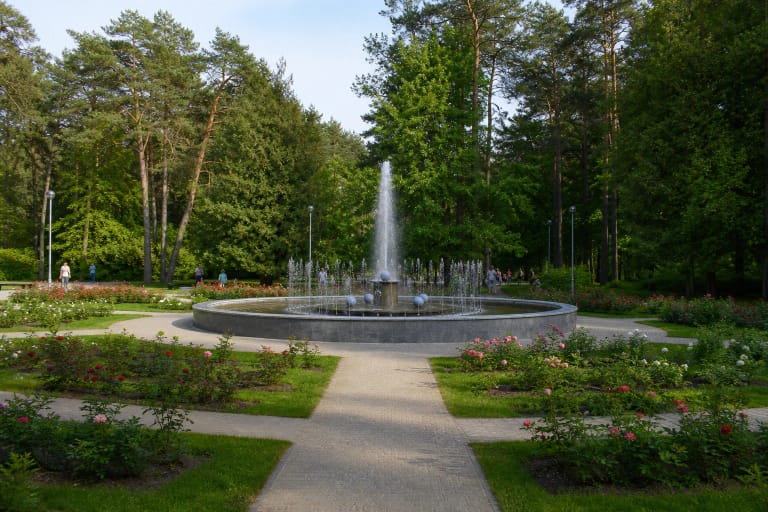
The Freedom Angel stands on the eastern side of Alytus City Garden, in a broad stone-paved square beside S. Darius and S. Girėnas Street. Coordinates 54.394028, 24.049393 mark the memorial itself. Several garden paths lead directly to it, so there is no separate entrance or ticket office to find. Do not park in the square: use marked city spaces only and check temporary restrictions during events.
This is a free outdoor public space with no daily opening hours published by the authorities. Daylight is nevertheless the best time to walk around the pedestal and examine its plaques. State ceremonies, concerts, or seasonal installations can temporarily occupy or fence off part of the square, so consult the municipality's programme when planning a visit for a particular date.
The main square is level and step-free, and the official tourism inspection identifies the place as accessible to disabled visitors. The pedestal itself rises behind several steps. Its imagery can be viewed from ground level, and climbing on the memorial is neither necessary nor permitted. Joints between paving stones and a wet surface may affect small wheels, so assess the conditions on arrival.
1928 marks the independence-anniversary project, while 1929 is the date of the actual unveiling
A public call for a common monument to volunteers killed around Alytus emerged in 1922, during the unveiling of officer Antanas Juozapavičius's grave monument. Donations came from national leaders, artists, banks, local organisations, and residents. Agreement on a site and design took years, and in 1928 the building inspectorate returned Antanas Aleksandravičius's drawings because of the proportions of the angel figure.
The memorial was intended to mark ten years of Lithuanian independence, which is why some brief official summaries date it to 1928. Archival newspapers, art-historical research, and the cultural register, however, show that the completed monument was formally unveiled on 27 October 1929. In other words, 1928 identifies the occasion, design work, and an unsuccessful first stage; 1929 begins the life of the finished monument.
The unveiling coincided with the tenth anniversary of the 19th Alytus Riflemen Unit. Nearly one thousand riflemen, soldiers, school communities, and townspeople attended, and Transport Minister Vytautas Vileišis unveiled the monument. A signed record and small Lithuanian coins were sealed into its pedestal. Construction cost 15,000 litas.
The work also exacted a personal cost from its sculptor. In 1928 Aleksandravičius fell from the scaffolding, broke his right leg, spent 43 days in Alytus hospital, and was unable to work for another five months. The fall is documented; a later story that somebody may have deliberately cut the scaffold has no reliable proof.
Trumpet, wreath, sword, and three reliefs form one account of the price of freedom
The memorial is about 13 metres high: a nine-metre shaft carries a winged, trumpeting figure about four metres tall. The trumpet was interpreted as a call to remain vigilant in defence of the homeland, while the wreath in the other hand honours the dead. The long device on the front may resemble a cross at first glance, but the art-historical description identifies it as a sword pointing downwards.
Three narrative brass reliefs decorated the original pedestal and together weighed 187 kg. Struggle showed a warrior fighting a dragon that threatened a girl personifying Lithuania. Death depicted a fallen fighter and an angel leading him to heaven. The third scene is called Graves in academic writing and Lament in a museum account: a young Lithuanian woman decorates military graves with wreaths while parents mourn their sons.
Four dark panels are visible around the pedestal today, so municipal and official guide descriptions sometimes refer to four bas-reliefs. It is more precise to distinguish the three narrative reliefs from the main dedication panel. This counting method resolves the apparent discrepancy rather than inventing an unknown fourth scene.
Lightning, Soviet demolition, and the 1991 reconstruction created three different Freedom Angels
The first angel was made of reinforced concrete. At about 7:10 on the morning of 26 March 1934, lightning struck the tall monument, which had no lightning conductor: the figure shattered, while the pedestal survived. A brief cultural-register record gives 1933, but contemporary press reports and the Alytus municipal history supply the precise 1934 date. Aleksandravičius made the second figure in 1937.
Soviet soldiers began to be buried around the memorial in August 1944. The symbol of an independent Lithuania was unacceptable to the new regime, and it was demolished in summer 1951; its debris was hidden and an obelisk with a five-pointed star occupied the site. Some later municipal summaries give 1952, but the register act and detailed garden research date the demolition to 1951.
The Alytus branch of Sąjūdis searched for the remains from 1988 but did not find them. The decision was therefore to reconstruct the composition from surviving photographs rather than reassemble an original. The Soviet soldiers were reinterred in a separate military cemetery, and on 23 November 1991, Lithuanian Armed Forces Day, the Freedom Angel rose on the same site for a third time.
Jonas Meškelevičius recreated the present angel, the first version to be cast in bronze, while Jonas Blažaitis remade the reliefs. Both artists used surviving iconography and retained Aleksandravičius's composition. A new text placed in the monument's capsule in October 1991 recorded its return together with Lithuanian freedom.
Protection covers the monument type and its place in the garden, not surviving material from 1929
Alytus City Garden entered the Register of Cultural Property in 1999 and is a state-protected site of regional significance. Its listed valuable features include the Freedom Angel monument type on the eastern side of the area and Freedom Angel Square. Protection therefore concerns the memorial's form, location, and relationship with the geometric garden.
The sculpture visible today is not made from the material touched by Aleksandravičius in 1929. Neither the first figure nor its 1937 replacement survived; the brass reliefs disappeared during the war, and the Soviet authorities destroyed the ensemble. The current work is a 1991 reconstruction whose historical value lies in the faithful return of the composition, the continuity of its imagery, and the civic effort to restore forbidden memory.
At least one physical fragment of the original did eventually return from obscurity. An Alytus Regional Museum researcher reported that in 2018 one of Aleksandravičius's lost reliefs, Lament, resurfaced after an Alytus family had protected it for decades. This does not change the authorship of the panels outside: visitors see Jonas Blažaitis's reconstructions on the present pedestal.
The schoolteacher model belongs to local storytelling, while the best visit begins with the sculpture's details
Local tradition says that Aleksandravičius persuaded a young teacher at Alytus Gymnasium to pose for the angel. When the second figure was created in 1937, rumours claimed that the same woman had posed again, but the sculptor denied them. Treat the model story as a living urban legend, not as a securely identified woman's biography.
Begin with the full silhouette and trumpet, then approach the device on the shaft and walk slowly around the pedestal. Give the three reliefs a circuit of their own: Struggle addresses the threat to the state, Death the fighter's sacrifice, and Graves or Lament the grief of those left behind. Read this way, the angel becomes a coherent memorial narrative rather than only a photogenic figure above the trees.
Continue into Alytus City Garden along its radial paths, and visit the Regional Museum for a broader historical context. The monument naturally becomes a ceremonial focus on 16 February and 23 November. Choose a different morning for a quiet inspection, or check the official city events programme in advance if you want to witness a living practice of remembrance.