- Place
- Alytus City Municipality
- Region
- Alytus
- Type
- historic town square and renewed public space
- Address
- A. Juozapavičiaus Street / Studentų Street, Alytus
- Coordinates
- 54.40283, 24.06466
- Visit duration
- 30-60 minutes
- Best time
- a summer evening when the fountain jets are lit, or a quiet daytime visit to read the square's history
First Alytus Square, Cross Square
Where roads to Punia, Merkinė, and Vilnius met
First Alytus Historic Square lies in First Alytus on the right bank of the Nemunas. It is more than a decorative renovation: the site belongs to the story of Alytus's public space and road network, and its scale feels distinct from the central city.
The square began to form in the fifteenth century where roads toward Punia, Merkinė, and Vilnius crossed. Stephen Báthory's municipal privilege also provided for a town hall, linking the place with administration and trade as well as travel.
A market plan and twentieth-century breaks
Nineteenth-century plans show an elongated triangular space whose outline became irregular as surrounding buildings grew. Weekly markets took place here, so the square is best understood as an everyday meeting place, not only as a ceremonial setting.
At the start of the twentieth century the space was reached by what is now A. Juozapavičiaus Street. German bombing during the Second World War damaged the surroundings, and reconstruction and environmental works followed in the 1970s. The present square is the result of several rebuildings.
The 2008-2012 renewal made a recognizable everyday space
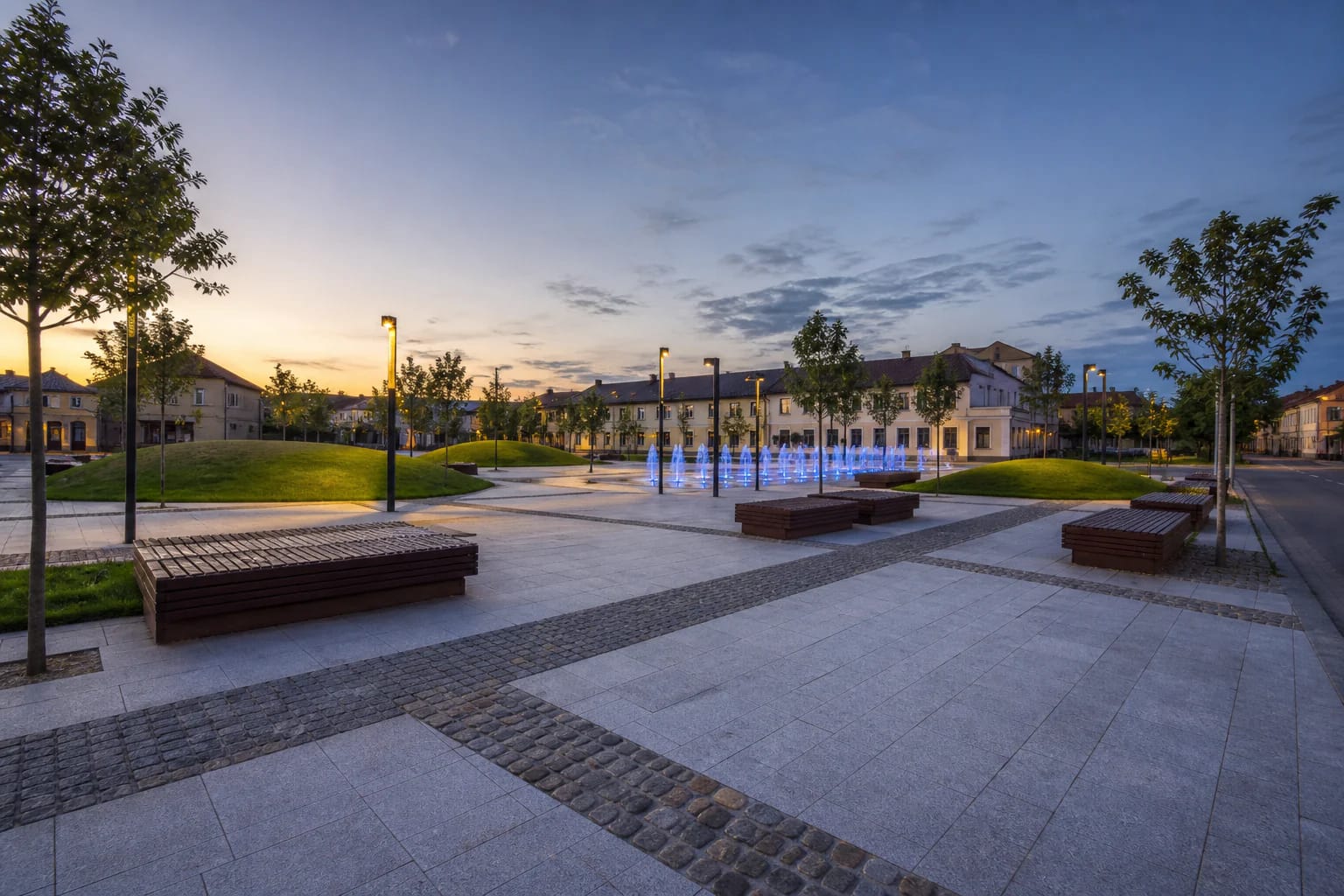
The square was comprehensively renewed in 2008-2012: paving, fountains, lighting, small urban elements, paths, and a children's play area were added or improved. Video-surveillance infrastructure is also present, reflecting the site's role as an active public space.
Pale slabs contrast with darker stone bands, rounded planted mounds, young trees, long timber benches, and slim lamps. In the evening the jets become a vivid focal point, but their operation and lighting should be treated as seasonal and maintenance-dependent.
Archaeological memory beneath the paving
Archaeological work in 2009 found human remains in the square. Archaeologists proposed an old cemetery, but that remains an interpretation of the research rather than proof that every present-day part of the square follows a precisely known cemetery boundary.
Local memory also preserves the name Cross Square, associated with a wooden cross and funeral processions. Heritage assessments place the square within the Alytus Old Town archaeological site, where the cultural layer reaches about 1.6 metres in places.
Visiting First Alytus Historic Square
The map pin is representative of the middle of the square; it does not identify one exclusive entrance or a parking space. Walk around the fountain area and paving, and leave a car only in lawful spaces on surrounding streets.
This is a public urban space rather than a ticketed museum, although events, maintenance, and the fountain season can alter the experience. Allow 30-60 minutes.