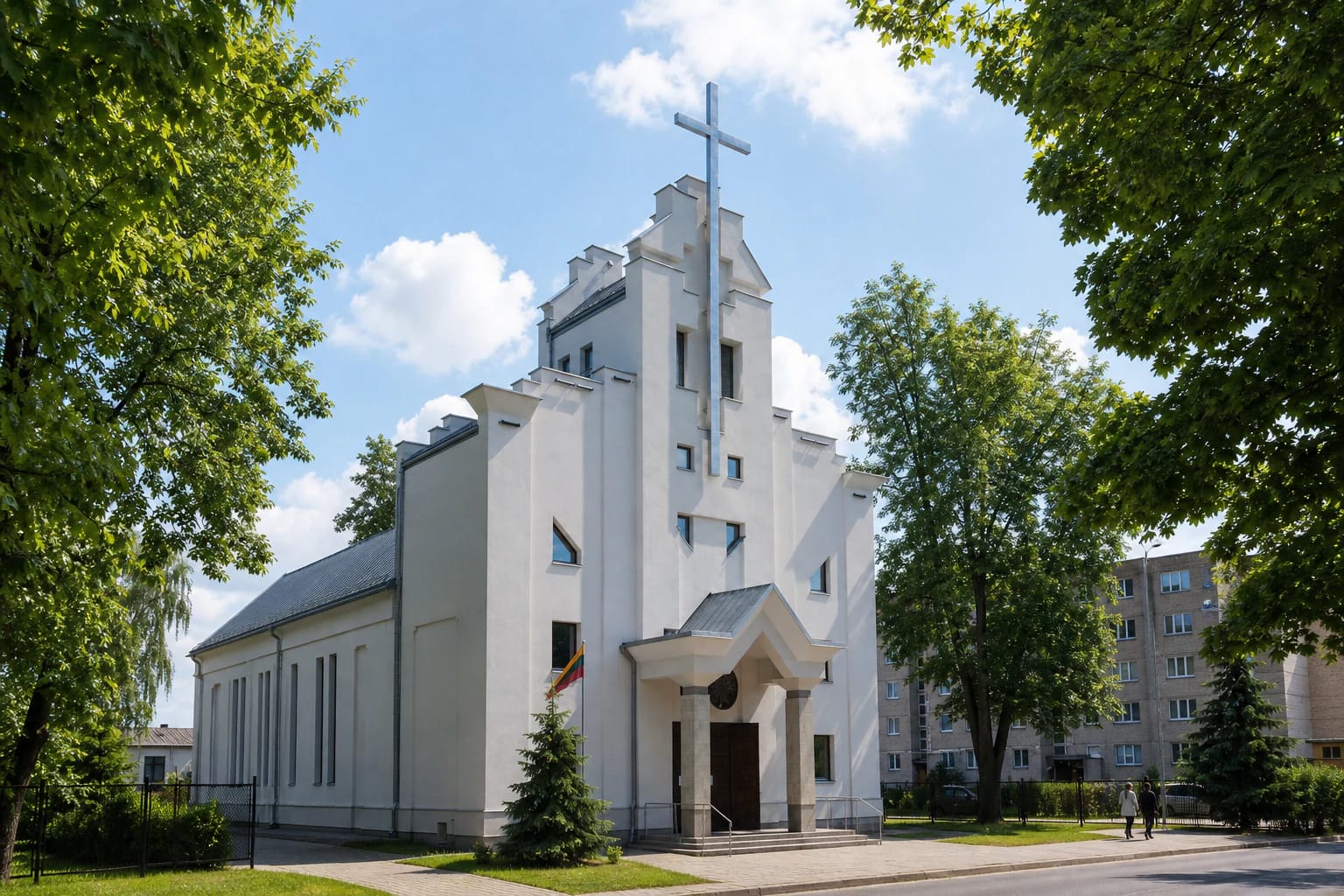
- Place
- Alytus, Alytus City Municipality
- Region
- Dzūkija
- Type
- active Catholic church occupying the reconstructed fabric of an Imperial Russian garrison Orthodox church
- Address
- 24A Varėnos Street, Alytus
- Coordinates
- 54.38376, 24.05519
- Visit duration
- 30-60 minutes for the exterior and interior when open; longer for Mass or a pre-arranged pilgrimage programme
- Best time
- in daylight for the architecture; before an officially advertised Mass if you hope to enter without a separate tourist timetable
Alytus St Casimir Church, Alytus Garrison Church, Former Pokrov Orthodox Church in Alytus, Alytaus Šv. Kazimiero bažnyčia
The exact address prevents confusion between two very different Catholic churches in Alytus
St Casimir Church stands at 24A Varėnos Street in the southern part of Alytus, close to the former artillery and uhlan barracks. It is an active parish of Alytus Deanery in the Diocese of Vilkaviškis. The sanctuary is dedicated to Saint Casimir, patron of Lithuania, and must not be confused with St Louis Church at 7 Panemuninkėlių Street in First Alytus, which belongs to the Diocese of Kaišiadorys.
Coordinates 54.38376, 24.05519 mark the church building and its site. The pinType is site because the point is not a verified principal door, churchyard gate, car park, or accessible drop-off bay. Use the full 24A Varėnos Street address when navigating, since several churches elsewhere in Lithuania share the Saint Casimir dedication.
The parish history records Catholic churches dedicated to Saint Casimir in Alytus in 1670 and 1762, with one still operating in 1804 before the Tsarist authorities closed it. That earlier tradition does not mean that seventeenth- or eighteenth-century masonry survives in the present building on Varėnos Street. The current sanctuary began as a late-nineteenth-century military Orthodox church in a different phase of the city's development.
The dates 1891 and 1904 reveal an unevenly documented beginning as a garrison Orthodox church
As the Russian Empire developed a third-class fortress and artillery barracks in southern Alytus late in the nineteenth century, its troops required a church of their own. The Diocese of Vilkaviškis dates construction of the masonry Pokrov, or Protection of the Mother of God, garrison church to 1891. Citing a 1913 publication on military churches, AUTC records its consecration in 1904 while also noting 1891 in other sources. This page therefore keeps 1891 and 1904 as differently reported construction and consecration milestones instead of compressing them into one supposedly uncontested date.
The original building was a basilican Orthodox church approximately 33 metres long and 16.5 metres wide. A taller tower rose at the front and a lower second tower stood above the iconostasis zone; both had tent-like roofs and small onion domes. Rendered facades imitated decorative brickwork, the interior was ornamentally painted, and icons for its dark-oak iconostasis came from the Olovyanishnikov workshop.
None of that richly decorated twin-towered silhouette survives as a complete composition. The onion domes, second tower, much of the elevated central nave, and the interior finish disappeared through successive alterations and wars. Historic photographs explain the building's origin, but they are not a picture of the white church visitors encounter today.
The building changed use with the armies and political regimes that controlled Alytus
During the First World War, the German military adapted the Orthodox church for Lutheran worship. After Lithuanian independence, the 2nd Uhlan Regiment of Grand Duchess Birutė occupied the neighbouring barracks. The Alytus city master plan records that the building became the Catholic St Casimir garrison church on 20 March 1919; around 1924 the tower with Orthodox domes was removed and the interior altered.
The church closed after the uhlan regiment moved to Tauragė at the end of 1939. It subsequently served as workshops and, for a period, the needs of an internment camp. Orthodox worship returned around 1941, but the building was badly damaged during the Second World War. After the war it became a warehouse and later a club for the Alytus machine factory.
Soviet alterations removed the second tower and the higher part of the central nave, changing both facade and interior. Sources also record the loss of marble floors, painted decoration, and stained glass. This succession of uses is more than an anecdote: it explains why the present sanctuary bears so little visual resemblance to photographs of the Imperial Russian church.
After its return in 1990, a new Catholic church was created rather than a literal replica
The building was returned to Catholics in 1990, and Juozas Gražulis was appointed the first parish priest of the re-established St Casimir parish on 3 January 1991. The parish developed supporting community institutions, building a parish house and helping establish a Catholic school that is now Alytus St Benedict Gymnasium.
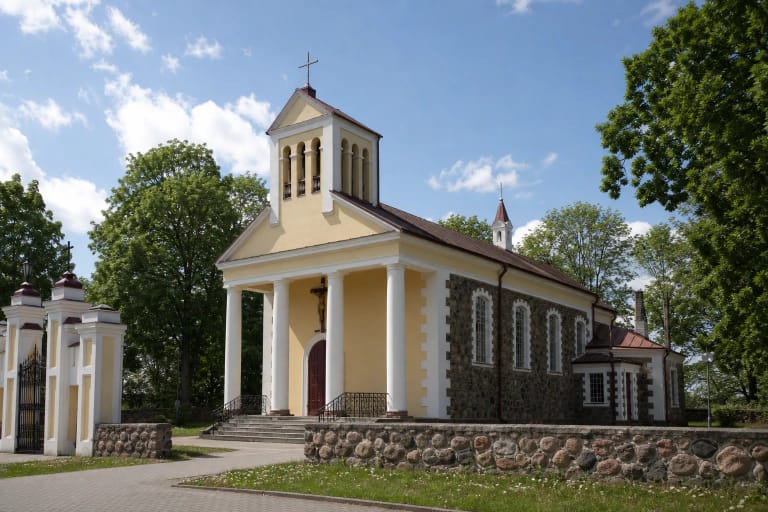
Reconstruction began in 1996 to a design by architect Vytautas Jakutis, with structural engineering by Saulius Stulpinas. The project did not attempt to recreate the two towers, onion domes, and Russian Revival decoration. Today's rectangular single-nave church has a gabled roof, a higher front mass with a square tower, a sharply folded open entrance canopy, and an exceptionally tall cross of polished metal rising beyond the tower. Pairs of narrow vertical windows give the long elevations their rhythm.
AUTC identifies the northern apse as the surviving part of the former Orthodox church, semicircular inside and three-sided outside. The municipal heritage assessment acknowledges that valuable exterior and interior features were lost through rebuilding, while recognising the site's continuing sacred and historical importance. It is most accurately understood as a repeatedly transformed historic building with one identified surviving fragment and a substantial late-twentieth-century architectural layer.
Exposed structures and contemporary sacred art define the present interior
The single nave contains neither a reconstructed iconostasis nor imitation historic decoration. Its character comes from exposed, substantial roof trusses, a small semicircular apse, and a large wooden Crucifix suspended on chains above it. Architects Violeta Beigienė and Rymantas Zimkus designed the sanctuary area, giving the interior an intentionally restrained contemporary language.
Sculptor Tomas Vosylius made the altar installed in 2007 and the statue of Saint Casimir added in 2010. These are not incidental decorative exhibits: the altar is the liturgical focus, while the patron saint gives the dedication a clear presence within the modern interior. Do not enter the sanctuary to inspect them closely without permission.
A first-class relic of the then Blessed Carlo Acutis was received here on 9 October 2022. He was canonised on 7 September 2025, so Saint Carlo Acutis is now the correct title even though the official 2022 event page naturally calls him Blessed. Contact the parish about a pilgrimage programme or access to venerate the relic at a particular time, because earlier event notices do not constitute permanent opening hours.
Mass times help with planning but are not tourist opening hours
On 21 July 2026, the Diocese of Vilkaviškis listed Mass at 09:00, 11:00, and 18:00 on Sunday, 18:00 on weekdays, and 11:00 and 18:00 on Saturday. An additional 11:00 Mass was listed for the first Friday of each month, with adoration after the evening Mass on Thursday. Holy days, funerals, weddings, and parish events can alter the routine, so recheck the official page before travelling.
The parish publishes neither a tourist admission fee nor fixed daily sightseeing hours. Its office hours of 08:30-17:30 on weekdays and after Mass at weekends do not mean that the church itself is open to tourists throughout those periods. If seeing the interior is central to your journey, contact the office in advance on its official number, +370 602 32028. During worship, remain in place rather than touring the nave, silence devices, avoid flash, and ask before photographing people, the liturgy, or sacred works at close range.
A public tourism record labels the attraction accessible to visitors with disabilities, but no detailed audit of a step-free route, door width, toilet, or accessible parking bay has been published. There are steps at the principal facade, so ask the parish which gate and entrance to use. No authoritative capacity or visitor policy for car parking was found either: park only where permitted, keep the churchyard gate and service access clear, and arrive early before well-attended services.