- Place
- Alytus City Municipality
- Region
- Dzūkija
- Type
- a recreation complex formed by two Nemunas oxbow lakes in Kurorto Park
- Address
- Kurorto Park, Alytus
- Coordinates
- 54.38760, 24.06800
- Visit duration
- 1.5-3 hours for both lakes, the shoreline paths, the Jurgis Kunčinas bridge, and time beside Great Dailidė
- Best time
- May to September for walking and waterside recreation; during the bathing season, only after checking the latest water test
Great and Small Dailidė, Dailidė Lakes, Dailidės ež.
Two Nemunas oxbows make one route, but they are not one lake
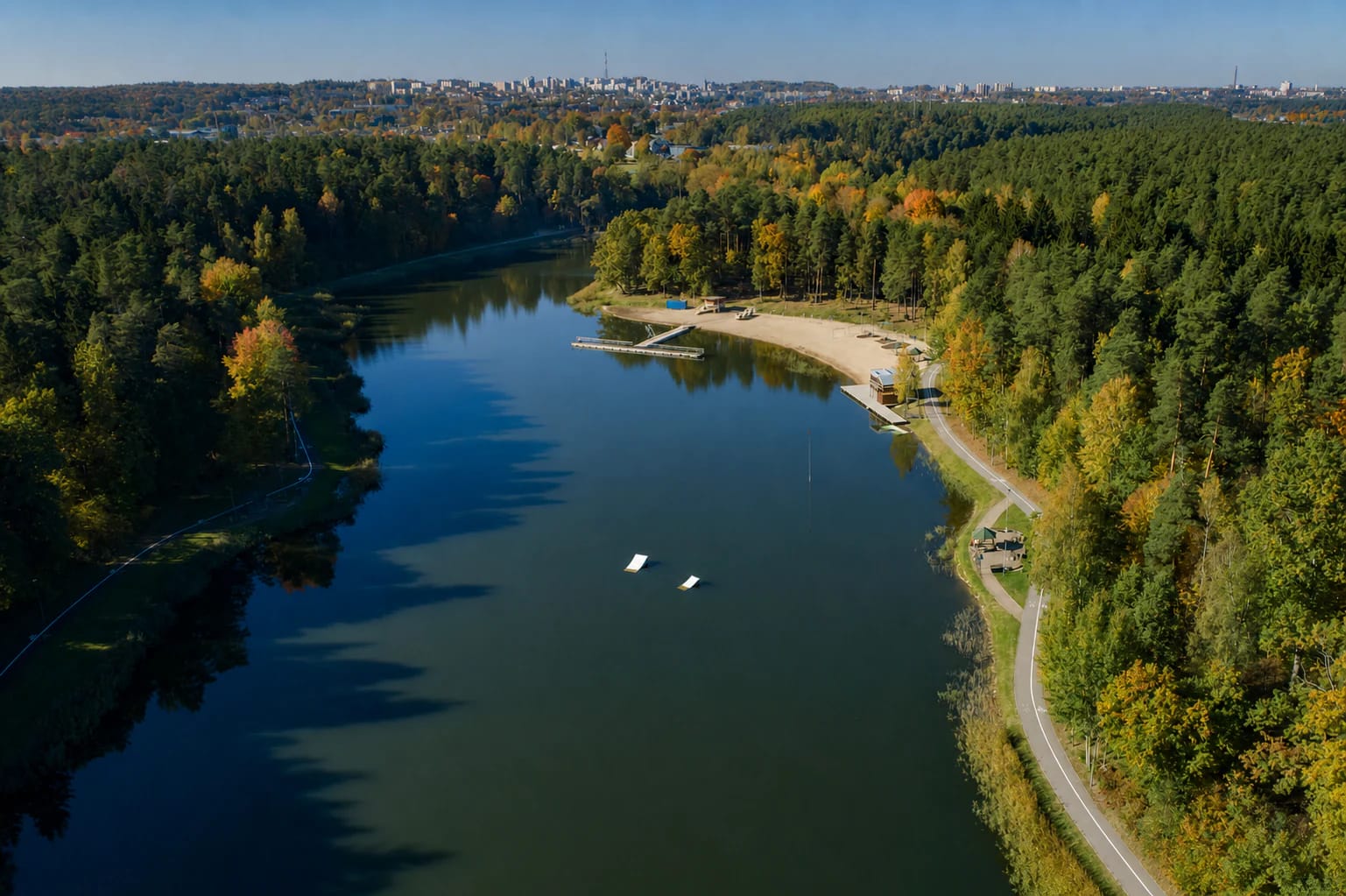
Great and Small Dailidė lie in Alytus's Kurorto Park beside a bend of the Nemunas and its pine woods. Alytus City Municipality identifies both as former channels of the Nemunas, now separated by an embankment. Their elongated shape and close proximity share one origin, yet visitors encounter two distinct shorelines with separate monitored bathing areas.
The current national list of state water bodies assigns an area of 10.2 ha to Great Dailidė and 4.2 ha to Small Dailidė. It classifies both as pike-type lakes and also lists tench and crucian carp. These administrative figures express the difference in scale more clearly than the collective name Dailidė Lakes.
Great Dailidė is the principal active-recreation area, with a broader beach, piers, and sports spaces. Small Dailidė is more compact and can be experienced as an intimate loop through the park. To understand the site, see both rather than stopping at the first piece of water selected by navigation.
Great Dailidė was cleaned in stages, and Small Dailidė followed later
Municipal project records connect the restoration of Great Dailidė with a site contaminated by heavy metals. A feasibility study and plans for 20 ha were prepared in 2005-2006. Preparatory work and cleaning of roughly 7 percent of the lake followed in 2006-2008, and contaminated sediment was excavated and taken to a storage facility in 2010-2011.
The cleaning project for Small Dailidė ran from 2011 to 2013. The municipality described its result as an improvement in ecological condition and adaptation of the lake for public needs. Today's beaches, bathing areas, and shoreline recreation spaces are therefore not simply a natural oxbow landscape but the product of long restoration and public planning.
Management did not end with those projects. Excess aquatic and shoreline vegetation was cut at both lakes from 2022 to 2024. In 2024, 420 two-summer-old tench were released into Great Dailidė and 246 into Small Dailidė. These recorded interventions show active management, but they do not guarantee unchanging water quality.
The Jurgis Kunčinas bridge identifies Small Dailidė, while the beach defines Great Dailidė
The distinctive feature of the smaller lake is a bridge named after poet and novelist Jurgis Kunčinas. It forms part of the shoreline route and brings walkers close to the water. This is a landscape element rather than a separate ticketed attraction or museum, so it is best experienced as part of the full Small Dailidė circuit.
At Great Dailidė, the main orientation point is the sandy beach with its bathing area, piers, and leisure infrastructure. The municipal description also records sports grounds. Particular seasonal equipment, services, and lifeguard cover can change, so none should be treated as a permanent promise for every day of the year.
The lakes connect to Kurorto Park's pedestrian and cycle-path system. Cyclists should share space carefully and slow down around the beach. On foot, allow 1.5-3 hours for both water bodies and unhurried stops, although a brief visit to one bathing area can be much shorter.
Both bathing areas are monitored, but one good result does not last all summer
The official Lithuanian list of monitored bathing waters names Great and Small Dailidė separately. The Institute of Hygiene's 2026 schedule provides sampling dates for both from late May into September. This distinction matters because official bathing-water status and an attractive lake view are not the same as microbiological safety on a particular day.
Alytus City Municipality reported on 29 May 2026 that the pre-season samples from both lakes met the hygiene standard. That finding describes the sampling date, not the entire season ahead. The municipality says routine tests are repeated every two weeks through the summer, with additional sampling when a problem is detected.
Before swimming, check the latest municipal or Institute of Hygiene update and read signs at the beach. Even when microbiological indicators are satisfactory, avoid water that is blooming, unusually coloured, or foul-smelling. Children require continuous supervision, and swimmers should remain inside marked buoy lines.
The tale of the Fair Manor is legend; the oxbow origin is documented
The municipality's visitor description preserves a local legend about an exceptionally beautiful manor that once stood where the lakes now lie. According to the story, greed and cruelty doomed its prince, and water pouring from a cursed cloud destroyed and submerged the estate. The lake was then named Dailidė after the lost Fair Manor.
This story explains the name in the language of folklore, but it is not geological or historical proof that such a manor existed. The checked official description identifies both water bodies as former channels of the Nemunas. The guide therefore keeps the legend clearly separate from the documented landscape explanation.
The two perspectives are easy to compare on site. Long water bodies, their proximity to the Nemunas, and the dividing embankment speak to the changing river valley, while the submerged-manor story adds a memorable cultural layer. Read the tale as folklore, not as an exact date or archaeological conclusion.
How to plan a visit to both lakes
The page coordinate 54.3876, 24.0680 is the official monitoring point for the Great Dailidė bathing area. Small Dailidė has a separate official point at 54.3928, 24.0610, so a visit to both is best planned as a shoreline route between these locations.
On the Great Dailidė side, orient yourself by the beach and sports areas; at Small Dailidė, look for the Jurgis Kunčinas bridge and the more compact shoreline circuit. Leave the car only in a marked place and do not drive onto pedestrian or cycle paths.
The official pages checked publish neither a shared ticket desk nor formal opening hours for the lakes. Shoreline paths are open park space, but the bathing season, lifeguard cover, sports equipment, and temporary works may follow separate arrangements. Check current official information before travelling and obey signs on site.