- Place
- Kėdainiai District Municipality
- Region
- Aukštaitija
- Type
- large dendrological park and woody-plant collection arranged around broad geographic regions
- Address
- Užvarčiai village, Krakės eldership, Kėdainiai District
- Coordinates
- 55.31712, 23.65498
- Visit duration
- 2-3 hours for the principal circuit; 3-4 hours for a botanical walk through more collection plots
- Best time
- during the spring magnolia display or from late September into October for the maple collection; always in daylight
Skinderiškis Dendrological Park, Kęstutis Kaltenis Dendrological Park, Skinderiškis Arboretum, Skinderiškiai Dendrological Park
A 123-125 ha park is much larger than its planted collection
Skinderiškis occupies an undulating landscape beside the Šušvė at Užvarčiai, where the Samogitian Upland meets the Central Lithuanian Plain. Official sources disagree slightly on total area: the current visitor description gives 123 ha, while the Environment Ministry's 2024 study gives 125 ha. Both include water, buffer woodland, peninsulas, small islands, and spontaneous vegetation, rather than describing only the exotic tree display.
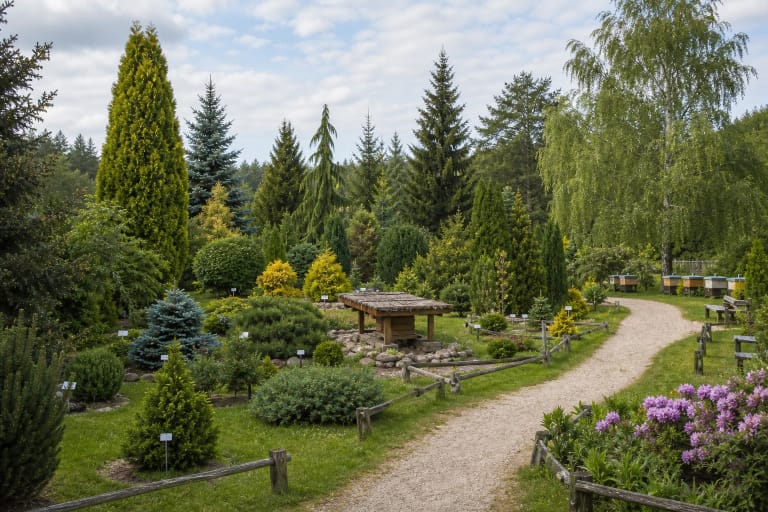
The same study says collection plants were introduced over roughly 35 ha, while the new inventory covered about 20 ha divided into 25 plots. The visitor therefore enters neither a compact city park nor a manicured botanical garden. Planted groups alternate with meadows, dense woodland, gullies, pools, and the waters of the Šušvė reservoir.
The coordinate marks the eastern visitor start beside the first car park, from which the 2024 inventory route proceeds west. It is not the centre of the entire park. A second parking area lies farther east, so note where you leave the car and keep vehicles off service tracks and mown footpaths.
Kęstutis Kaltenis began creating the park in 1971
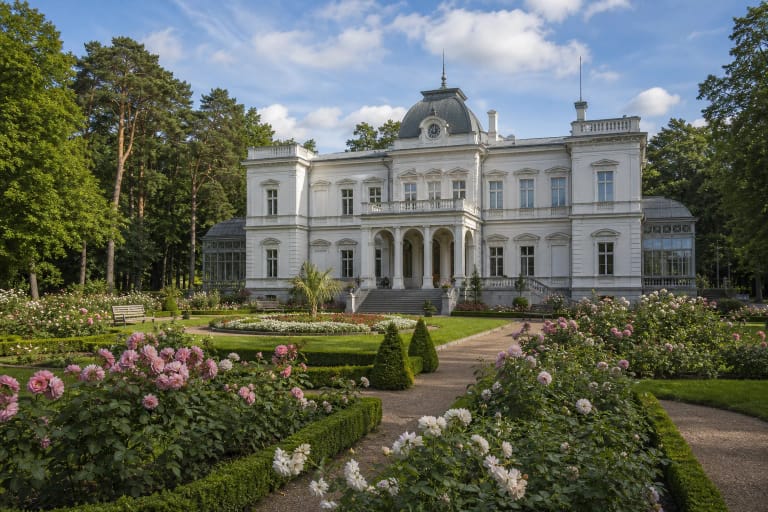
Work began in 1971 on the site of the small former Skinderiškis estate. In 2024, researchers identified a cellar built in 1938, chapel ruins, a historic boundary marker, two old horse chestnuts, and a group of lilacs as remnants of the earlier landscape. No representative manor house survives, so the place is defined by the later collection rather than by estate architecture.
The idea belonged to Antanas Kęstutis Kaltenis, then a forester for the Pajieslys collective farm. Its chairman Vaclovas Vitas assigned the land, and Kaltenis brought the first plants from his father's forest-station holding at Lapkalnis. He subsequently raised material from seed sent from many countries and from plants given to him. Dendrologist L. Čibiras and architect O. Skaisgirytė prepared a plan for 674 taxa and several visitor routes in 1974, but it was never followed literally; the collection developed around what could actually be obtained and established.
Kaltenis cared for the park for about five decades. He received the Valdas Adamkus environmental award in 1993 and the Viktoras Bergas prize in 2011. He died in 2022, and in 2023 the government formally named the territory Skinderiškis Kęstutis Kaltenis Dendrological Park. The sculpture 'Hands Nurturing a Tree' and a later wooden memorial near the central area commemorate him.
The older figure of 1,300 and the verified 341 measure different things
Visitor literature continues to cite about 1,300 species, subspecies, varieties, forms, and cultivars of trees, shrubs, and climbers. This is a historical estimate of the collection accumulated over many years and combines names at several taxonomic ranks. It is not a census of every living individual still present in 2024.
In the Environment Ministry's new field inventory, GPS receivers recorded 2,881 growing positions containing 4,073 woody individuals. Researchers identified 341 species and infraspecific taxa belonging to 100 genera: 50 conifer taxa in 11 genera and 291 flowering-plant taxa in 89 genera. The historic total need not be dismissed, but the 2024 figures are the more reliable description of the currently verified collection.
Maples form the richest genus, with 923 individuals representing 43 taxa. The inventory also recorded 288 magnolia individuals in 5 taxa, 239 oaks in 13 taxa, and 164 walnuts in 10 taxa. The tallest measured tree was a 34 m Chinese poplar cultivar, while four eastern cottonwoods and one white willow exceeded a metre in trunk diameter. Skinderiškis is a comparatively young, human-made collection, valued for breadth rather than for a few ancient trees.
Magnolia spring and maple autumn call for different routes
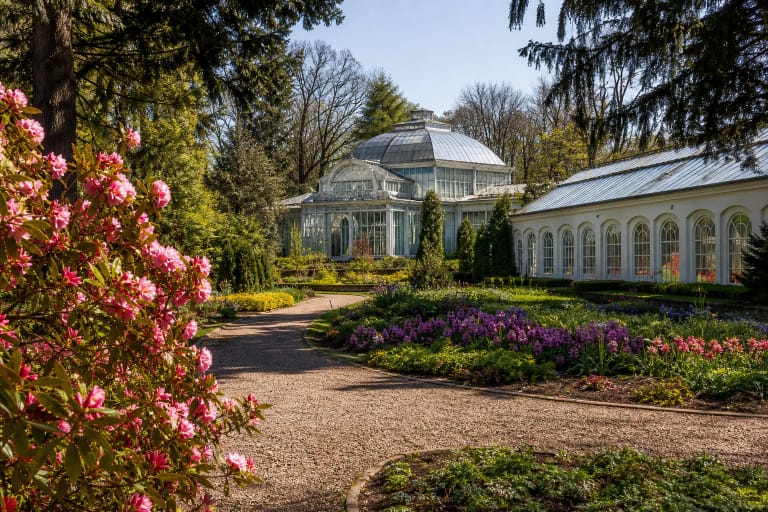
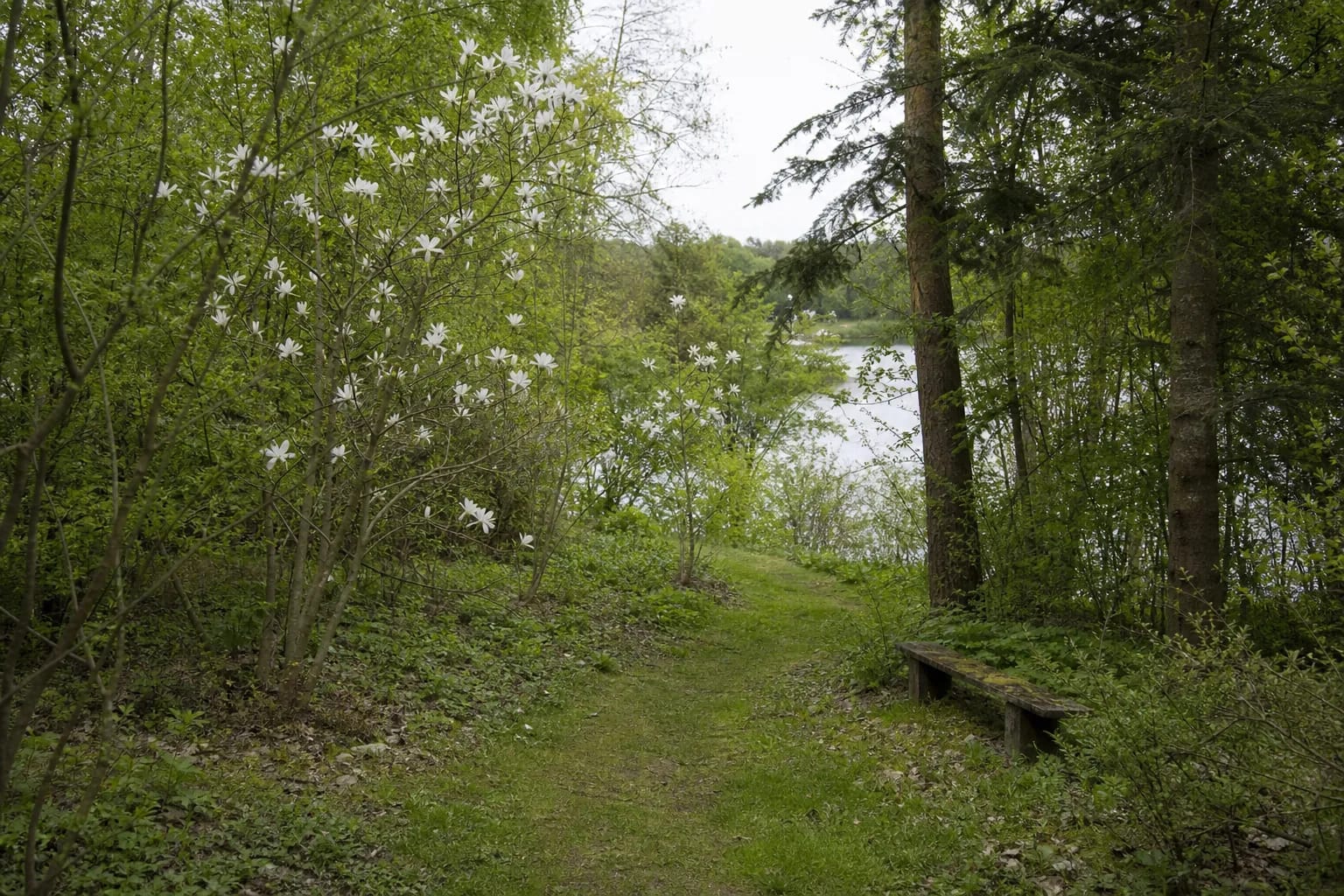
Flowering magnolias draw the largest spring crowds. In 2024, they occupied 212 recorded positions, with major concentrations in plots 7-10, 12, 18, 19, and 21. The start and peak of bloom shift with temperature, so do not schedule a trip solely from photographs taken in previous years. Look for a current notice from the park's managers or Kėdainiai organisations.
Autumn transfers attention to the 43 verified maple taxa. Differences in leaf colour are usually clearest from late September until leaf fall, although the precise peak also varies. Summer conveys the park's dense woodland scale, while bare winter crowns reveal trunks and landform more clearly. Mud, leaves, frost, and short daylight make neglected sections less forgiving outside the main season.
The 2024 study measured 5,201 m of well-built, maintained paths, identified 815 m in six sections needing work, and proposed another 1,122 m of new paths. These are survey findings and recommendations, not a guarantee that every proposed line is now marked. Use the clearly mown main paths for a two- or three-hour circuit, and enter remote plots only with enough daylight to return.
The 2024 survey and 2025 works document a park still in transition
Specialists rated 66 per cent of inventoried woody plants in good condition, 27 per cent satisfactory, 6 per cent unsatisfactory, and 1 per cent poor. They also documented collection plants being shaded by spontaneous growth, four invasive woody species, and hazardous giant hogweed in several plots. Their management plan specifies where to prune, thin, protect trees from beavers, and reopen access without losing rare specimens.
At the time of the survey, two of the three wooden observation towers were considered dangerous and the third had also begun to decay. Some interpretation panels were illegible, while certain bridges and secondary paths were weak or seasonally flooded. The project recommended replacing the towers, installing 32 new information panels, and repairing benches, drainage, and paths. Unless a newer sign on site clearly confirms completion and safe use, stay off the towers and do not bypass barriers.
Minutes from a Kėdainiai District Council meeting on 31 October 2025 record residents' concern about tree cutting in the park. The mayor said the State Forest Enterprise was implementing a project funded through the Environment Ministry and promised a site inspection. No final public audit resolving every issue was found in the official sources checked by 18 July 2026. Fresh work traces, temporary closures, and changed routes are therefore possible and should be judged on site rather than inferred from old photographs.
Free around the clock, but safest in daylight
On 18 July 2026 the official visitor listing described admission as free and the park as open around the clock. That does not mean it operates like a lit botanical garden with permanent staff at a gate. Because the grounds are extensive, paths vary, and management works can change access, visit only in daylight. Arrange a guided visit in advance through the manager contact published on the current visitor page.
Principal paths combine gravel, firm earth, and mown grass across rolling ground, with roots, wet sections, wooden crossings, and occasional stone steps. No dependable audit of full wheelchair accessibility was found. A shorter section can be assessed from the first parking area, but the complete 5 km circuit should not be presented as reliably step-free. Waterproof footwear is useful after rain and in spring.
Do not pick plants, enter marked rare-species patches, or touch giant hogweed. Use only established rest places for a picnic, light a fire solely where it is explicitly permitted, and follow any current wildfire restrictions. Parking can fill quickly on magnolia weekends, so arrive in the morning and keep roads and working access clear.