- Place
- Rokiškis District Municipality
- Region
- Aukštaitija
- Type
- private dendrological collection and state-protected natural heritage object
- Address
- Tervydžių g. 5, Tervydžiai, Jūžintai eldership, Rokiškis District
- Coordinates
- 55.80300, 25.60740
Tervydžiai village dendrological collection, Tervydžiai village oasis
A Private Living Tree Museum
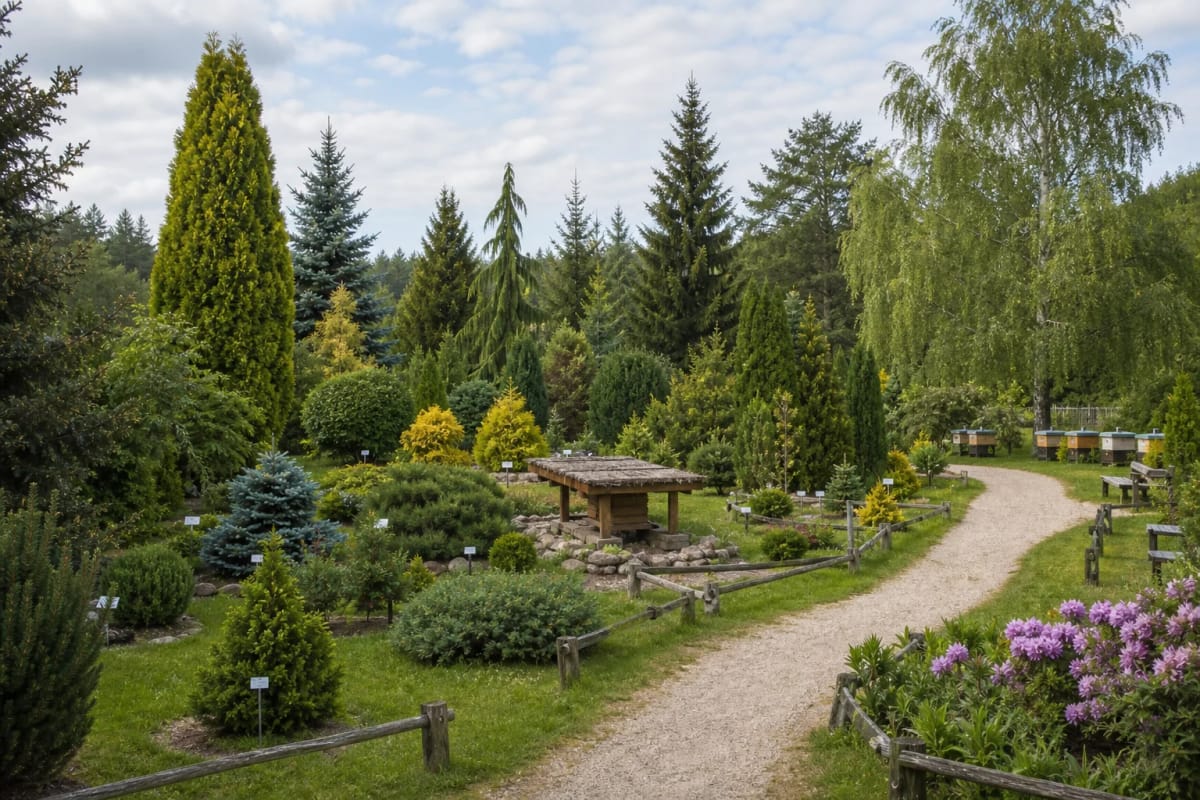
Tervydžiai Dendrological Park is a private collection of trees and shrubs covering about 5 ha near Tervydžiai village, in Jūžintai eldership, Rokiškis District. About 300 woody plant species and cultivars grow here, many of them rare in Lithuania, which makes the place a kind of living tree museum.
The official protected-object name is the Tervydžiai village dendrological collection, while tourism sources usually call it a dendrological park. It is best visited with a guide, because many trees here have their own story.
Kazys Jakubonis' Collection
The collection was created by Kazys Jakubonis, an enthusiastic gardener and beekeeper who followed the example of naturalist Tadas Ivanauskas. His biography is dramatic: as a partisan he spent several years in a Soviet labour camp, and after returning home he worked as a beekeeper so that he could plant on collective-farm land.
Jakubonis built the collection over decades. He ordered seeds by post and brought plants back from distant places. Sources do not agree on a single exact starting year, so the park is best described as a collection grown over many years, not as an object born on one precise date.
Plants and the Bee Bed
Among the plants are Siberian spruce, Turkish hazel, Amur cork tree, witch hazel that blooms in mid-February, Canadian prickly pear, and other trees and shrubs rare in Lithuania. It is said that one of the country's largest rowans grows here. Many decorative and medicinal herbaceous plants also grow in the park.
A distinctive curiosity is the bee bed: a resting bed under which three bee colonies live, designed for lying down and listening to the hive's sound. It reflects the creator's deep interest in beekeeping.
Protected Status and Visiting
In 2015 scientists inventoried the park and labelled the plants, and in 2016 it was declared a state-protected botanical natural heritage object by order of the environment minister. It was later adapted for visitors with fencing, paths, and information boards.
Today the park is cared for and shown to visitors by the creator's son, Linas Jakubonis. Entry is free, but visits must be arranged by phone in advance because there is no regular public schedule. The park is easy to combine with Jūžintai, Sartai Regional Park, or Rokiškis.