- Place
- Kaunas City Municipality
- Region
- Kaunas
- Type
- university botanical garden in the historic Aukstoji Freda manor environment
- Address
- Ž. E. Žilibero g. 6, Kaunas
- Coordinates
- 54.87152, 23.91078
Kaunas Botanical Garden, Vytautas Magnus University Botanical Garden, Aukstoji Freda Botanical Garden
Lithuania's oldest university garden in a manor park
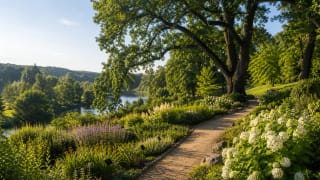
VDU Botanical Garden in Aukstoji Freda is the oldest and largest university botanical garden in Lithuania, covering 62.5 ha. It is not merely a set of plant collection plots: paths, ponds, park structure, and historic buildings are part of the visitor experience because the garden was established in the former Aukstoji Freda manor territory.
The garden was founded in 1923 as a national centre for botanical sciences by the Faculty of Mathematics and Natural Sciences of the University of Lithuania, renamed Vytautas Magnus University in 1930. A roughly 70 ha area was chosen in Aukstoji Freda, including the former manor park of Juozapas, or Jozef, Godlevskis with ponds and part of the Kaunas Fortress defensive structures. Visitors therefore see both botanical and historical layers.
From Konstantinas Regelis to VDU
The garden's founder was professor Konstantinas Regelis, invited from the University of Tartu in 1922 to teach plant systematics. He came from a famous botanical family: his grandfather Eduard Regel headed the Saint Petersburg Botanical Garden, and his uncle Arnold Regel was a notable park architect. Regelis's ties with the Berlin-Dahlem, Konigsberg, and Saint Petersburg gardens helped the Kaunas garden develop quickly and professionally. He led it in 1923-1940.
The territory was officially assigned on February 15, 1923, and on July 8 the garden was solemnly consecrated: Lithuanian President Aleksandras Stulginskis laid the cornerstone for the future conservatory. The collections grew rapidly: in 1926 they included 4,650 plant species, and by 1936 about 7,200. The garden became a teaching base for Lithuanian students of botany, medicine, and pharmacy.
Aukstoji Freda conservatory and plant collections
Today about 14,700 plant species, cultivars, and forms grow in the garden. Visitors see protected Lithuanian plants, collections of roses, dahlias, tulips and other bulbs, peonies, hydrangeas and petunias, medicinal and aromatic plant displays, dendrological and conifer plantings, a flora systematics display, and an educational vegetable garden.
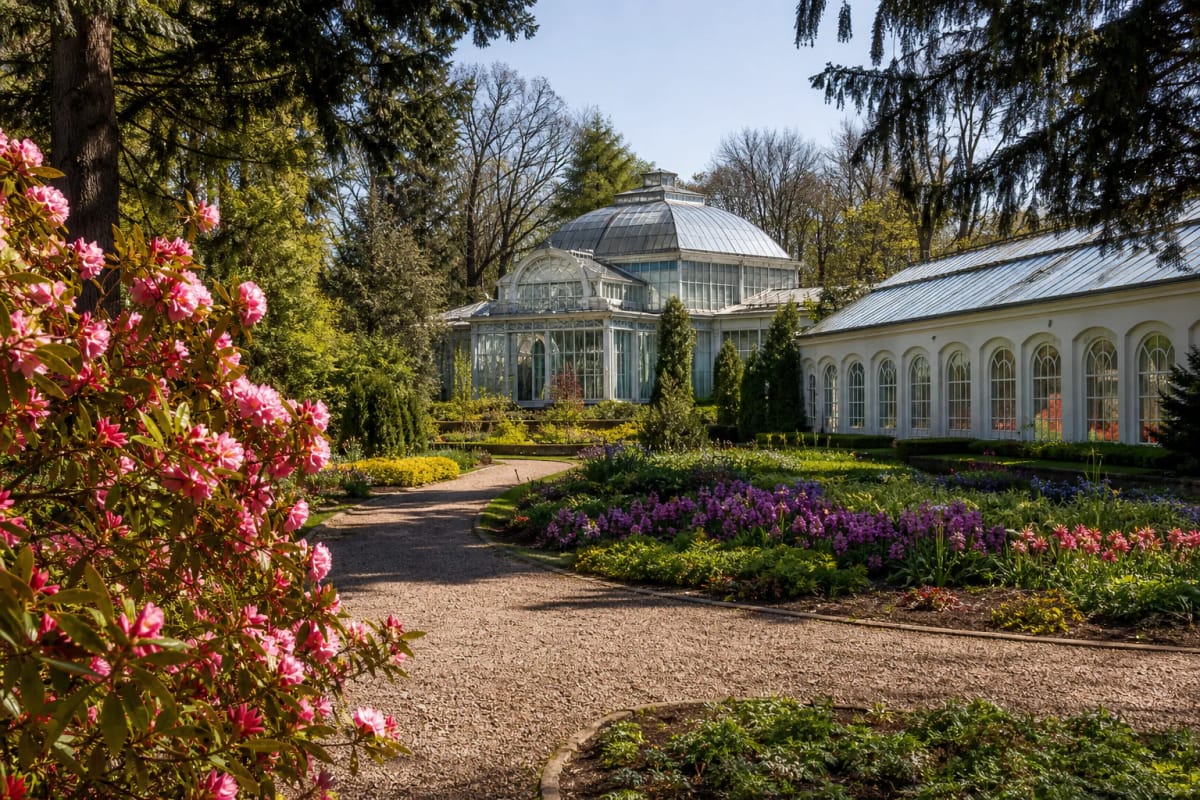
The conservatory makes the garden worth visiting even when there are fewer outdoor blooms. In the interwar period, as early as 1925, two greenhouses held tropical plants such as giant water lily and sacred lotus; in 1937 a 12.2 m high conservatory with a pool for palms was built. It shows best that the botanical garden is not just a beautiful park, but a place of living collections, research, and plant diversity conservation.
War, restoration, and return to the university
During the Second World War the garden suffered severely: part of the conservatory plants died and the rose collection was almost completely destroyed. After the Lithuanian Academy of Sciences was established in 1941, the garden passed to it, and in 1946-1959 it belonged to the Institute of Biology. Collections were gradually restored and expanded.
In 1976, a major reconstruction of the central part began under a project by landscape architect D. Juchneviciute: new flower beds, paths, and an irrigation system were installed. In 1983-1986 experimental greenhouses with laboratories were built. In 1989 the garden became a branch of the Botanical Institute, in 1990 an independent Academy of Sciences institution, and on January 31, 1992, it was attached to the restored Vytautas Magnus University.
What to see and how to choose a season
The best time depends on what you are looking for. For blooms and photographs, choose spring and early summer; for rose gardens and planting displays, summer; for colour, autumn; and in winter the main emphasis shifts to the conservatory and events. The garden is larger than it looks on a map, so wear comfortable shoes, and after rain some paths may be damp.
Distinctive details include a 1997 display for blind and partially sighted visitors, where plants can be touched and smelled and names are written in Braille; Birute M. Galdikas's oak grove planted in 2011; a large insect hotel built in 2013; and the sculpture Planet X. The garden is a member of Botanic Gardens Conservation International (BGCI) and the International Plant Exchange Network (IPEN).
Opening hours, tickets, and visiting
During research, the official VDU Botanical Garden page provided separate visitor information about opening hours, tickets, the conservatory, events, and possible discounts. Because the seasons change visiting conditions, check the official page before going.
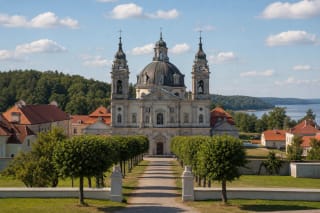
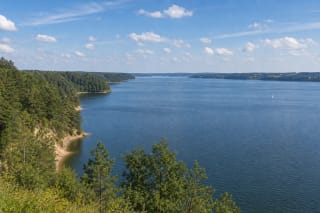
For a simple walk, plan 1-1.5 hours. If you want to visit the conservatory, read information panels, and photograph flowering areas, allow about 2-2.5 hours. The garden combines well with Pazaislis Monastery, Kaunas Reservoir, or a city-centre route.