- Place
- Rumbonys, Alytus District Municipality
- Region
- Dzūkija
- Type
- wooden hall church built in 1795, with a six-column vernacular Classical portico, separate bell tower, and chapel
- Address
- 55 Nemuno Street, Rumbonys, LT-62187, Alytus District
- Coordinates
- 54.46629, 24.05435
- Visit duration
- 25-45 minutes for the exterior, six-column portico, separate bell tower, and churchyard; longer only if an interior visit has been arranged
- Best time
- daylight, when the timber texture and Classical facade are easy to read; plan an interior visit only after receiving local confirmation
Rumbonys Church, Church of the Holy Trinity in Rumbonys, Rumbonių Švč. Trejybės bažnyčia
The six-column facade is the key to reading Rumbonys church
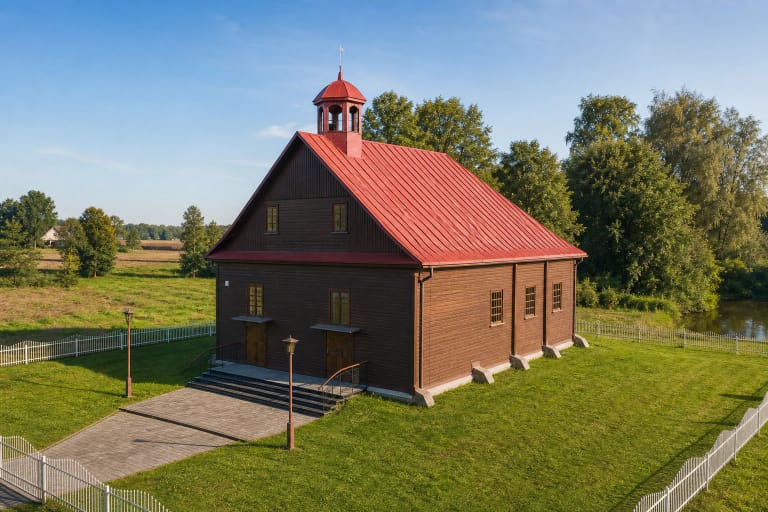
Rumbonys church is unusually restrained. It has no towers, its volume is almost a strict rectangle, and its walls are clad in muted ochre-brown vertical boards. A low sheet-metal gable roof covers the long hall, while tall white-framed windows repeat at even intervals along the sides.
Six plain white columns on pale square bases stand across the principal facade. They support a broad porch and an austere triangular timber pediment. The portico lends unexpected monumentality to a small village building and explains vernacular Classicism particularly well: forms associated with professional architecture are translated into timber and local building practice.
Alytus District sources call the church a wooden copy of Vilnius Cathedral or say that it resembles it. The likeness comes chiefly from the columned portico and towerless facade. There is no reason to promise an exact reduced copy of the Cathedral's plan, so look for an architectural quotation rather than identical proportions.
The present church dates from 1795, but Catholic life in Rumbonys is older
The first church in Rumbonys was built in the mid-eighteenth century on a hill southwest of the present building. Alytus District Municipality dates today's sanctuary to the late eighteenth century, while more detailed local historical sources give 1795 and connect its foundation with the Vyšniauskas family, then owners of the Rumbonys estate.
The new church replaced an earlier building that had begun to decay. Its wooden structure has required repairs over more than two centuries, so the boards, roof covering, windows, and paint visible today are not necessarily all original. Historical value resides not only in old fabric but also in the retained volume, plan, facade composition, and continuity of worship.
Work on the interior in 1913 is associated with sculptor Kazys Kriščiukaitis and painter Antanas Žmuidzinavičius. That documented episode should be distinguished from the looser story of a Cathedral copy: the artists belong to a specific early twentieth-century phase, whereas the Cathedral parallel is a convenient visual description.
The church is only one element of a protected ensemble
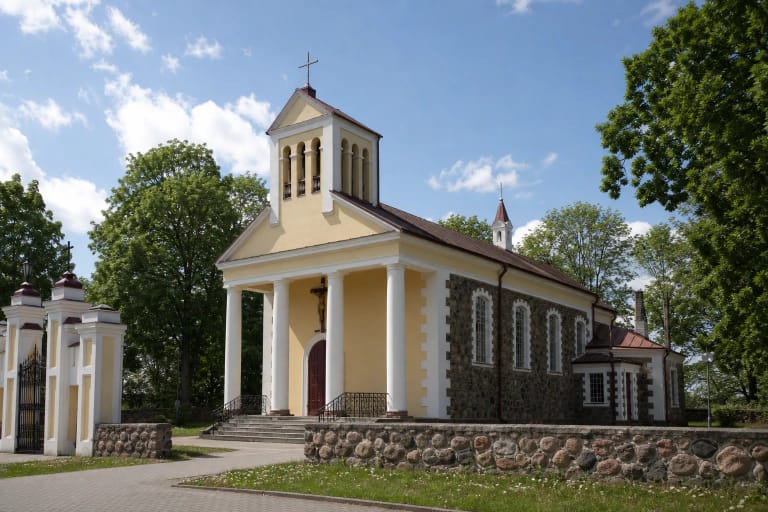
The Cultural Heritage Register identifies the church with unique code 23577. A separate timber bell tower and a chapel also stand in the churchyard, so a visit need not end after photographing the portico. Walking only on publicly accessible paths reveals how small buildings with different functions form a coherent rural sacred ensemble.
The bell tower is a simple square timber structure with a broader upper stage and a low pyramidal roof. It stands apart from the church because the bells were not placed in facade towers, which the sanctuary does not have. This arrangement is central to the silhouette and distinguishes Rumbonys from many nineteenth-century Lithuanian town churches.
The adjoining cemetery has its own history, including the protected Koreva family grave monument. It is neither church decoration nor a photo set. Keep quiet, do not climb grave enclosures, and never move candles or memorial objects.
Interior access, admission, and accessibility are not standardised
Rumbonys church is an active sacred site, not a museum with daily opening hours. Neither the municipal nor register pages publish guaranteed tourist access, a ticket desk, regular guided tours, or a permanently staffed visitor contact. If the interior is the main reason for travelling, confirmation before departure is essential.
No separate tourist charge is published, but that does not mean the doors are always unlocked. Give worshippers priority, do not photograph people without consent, avoid flash, and never touch the altars, paintings, or wooden finishes.
Official public information gives no complete description of a step-free route, accessible toilet, or reserved visitor parking. Steps are visible at the portico, so ask the local community in advance about the most suitable entrance and assistance for individual mobility needs.
Exact location, changing rating, and planning the route
The church stands at 55 Nemuno Street in Rumbonys. Google Maps coordinates 54.4662874, 24.0543495 mark the ensemble itself, not a specific lawful parking bay or entrance. Follow signs on the final approach, never block the gates, and keep cemetery access clear.
On 27 July 2026, the exact Google Maps entry with Place ID ChIJafBr6ZK04EYR_YV7wOyDon0 showed 4.8/5 from 127 reviews. The average and count will change, so they record visitor opinion only at the stated date.
Allow 25-45 minutes for the exterior and ensemble. Rumbonys Hillfort is a logical next stop, but treat the story of a tunnel beneath the Nemunas linking it with Punia Hillfort as legend rather than confirmed archaeology.