- Place
- Alytus District Municipality
- Region
- Nemunas Loops Regional Park
- Type
- nature and history educational trail, circular route
- Address
- Punia forestry forest museum, Nemuno g. 82, Panemuninkai village, Alytus District
- Coordinates
- 54.50710, 24.03830
Punia Forest educational route, Punia Forest Landscape Reserve educational route
8.8 km through old-growth forest
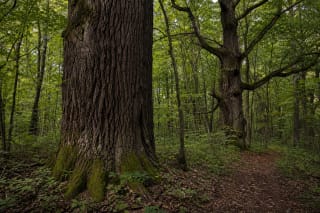
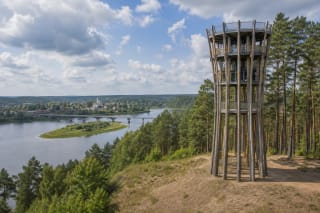
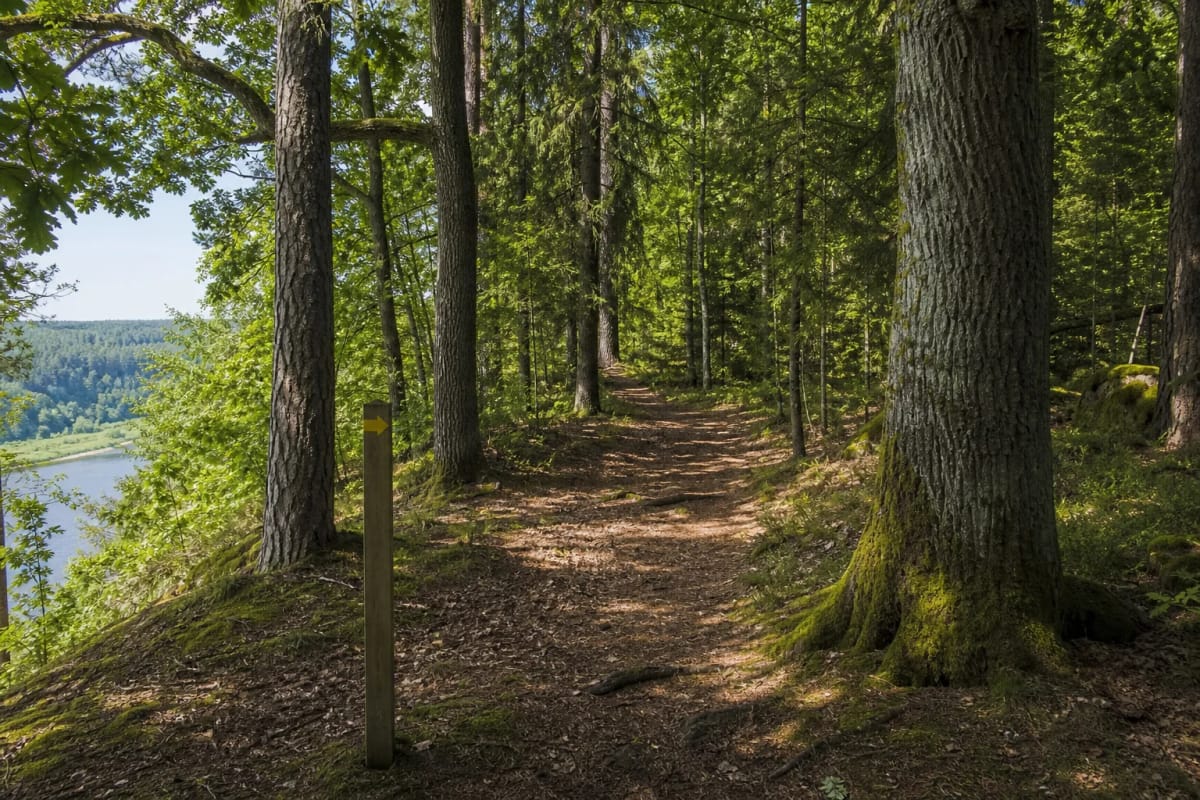
Punia Forest Educational Trail is an approximately 8.8 km circular route through Punia Forest, one of Lithuania's most valuable and best-preserved old-growth forests. The forest lies in a Nemunas loop on the left bank opposite Punia, about 12 km north of Alytus. The trail is marked with yellow arrows on a white background on trees and posts, and the most difficult places have stairs, ravine steps, and benches.
The route runs through the freely visited Punia Forest Landscape Reserve and only in its final kilometres follows the boundary of the strictly protected Punia Forest Nature Reserve; it does not enter the reserve itself. The route was opened in recent years, around 2024, and joins nature and history into one walking day.
What the trail visits
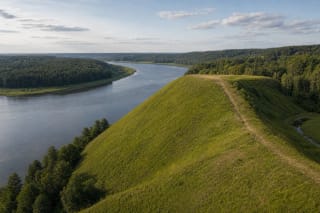
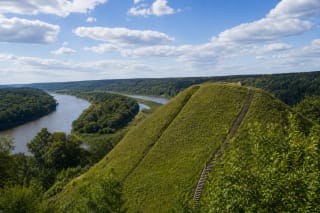
The route follows forest paths and a track, with climbs, descents, and long stairs near the Panemuninkai bluff. Visitors see Panemuninkai Hillfort, a modest object registered relatively recently around 2015, and a high scenic Nemunas bluff with stairs.
One highlight is Dukes' Avenue, a line of old oaks whose trees are dedicated to Lithuanian rulers with stylized signs. From the bluff you see Punia Hillfort across the Nemunas, and deeper in the route stands the reconstructed Dainava district partisan headquarters bunker. Old pines and old-growth forest views accompany the whole walk.
Punia Forest in a Nemunas loop
Punia Forest covers about 2,720 ha, of which about 2,510 ha are wooded. It is a mixed-age forest dominated by pinewoods, with many spruce, birch, and oak stands; average stand age is about 90 years and the tallest trees reach 40 m. Surviving old-growth areas make it one of Lithuania's most valuable forests.
The forest contains hundreds of higher plant species, rare birds, burial mounds, and protected plant sites. It was declared a botanical-zoological reserve in 1960 and has belonged to Nemunas Loops Regional Park since 1992. Avoid overstatement: it is not the largest forest, but it is certainly among the country's most mature and protected.
Dainava district partisan bunker
One of the trail's most important historical objects is the reconstructed partisan bunker that served as the Dainava district headquarters. The original well-camouflaged bunker, about 20 sq. m, was built in a stream slope near the Nemunas. On August 11, 1947, Soviet internal troops found and destroyed it: district commander Dominykas Jėčys-Ąžuolis and three staff members were killed, while remaining partisans were wounded and captured alive.
This was the headquarters of the Dainava district, later led from autumn 1947 by Adolfas Ramanauskas-Vanagas, so the bunker should not be called Vanagas's bunker. It marks D. Jėčys-Ąžuolis's headquarters. In 1992 the bunker was rebuilt according to a surviving partisan's memories by Lithuanian army engineers. Partisans operated in Punia Forest from 1945, with separate groups active until 1952.
Reserve and visiting rules
The educational trail is open, free, and independently visited all year; no ticket or registration is needed. The easiest start is by the Punia forestry forest museum at Nemuno g. 82, Panemuninkai village, where there is parking and an information stand.
Independent entry to the strictly protected Punia Forest Nature Reserve is not allowed. Its core is closed to ordinary visits, and educational or scientific access is possible only with permission from Nemunas Loops Regional Park Directorate and accompanied by an employee; unauthorized entry can result in a fine. Stay on the marked trail in the landscape reserve.