- Place
- Raižiai, Alytus District Municipality
- Region
- Dzūkija
- Type
- state-protected Sunni wooden mosque built in 1889, with a five-sided mihrab, hexagonal minaret turret, separate men's and women's halls, and a minbar made for Bazorai Mosque in 1684
- Address
- 9 Vytauto Street, Raižiai, Alytus District
- Coordinates
- 54.47992, 24.18782
Raižių mečetė, Raižių totorių mečetė, Raižiai Tatar Mosque, Raižiai Muslim Mosque
This is an active mosque without daily tourist hours, so arrange any interior visit in advance
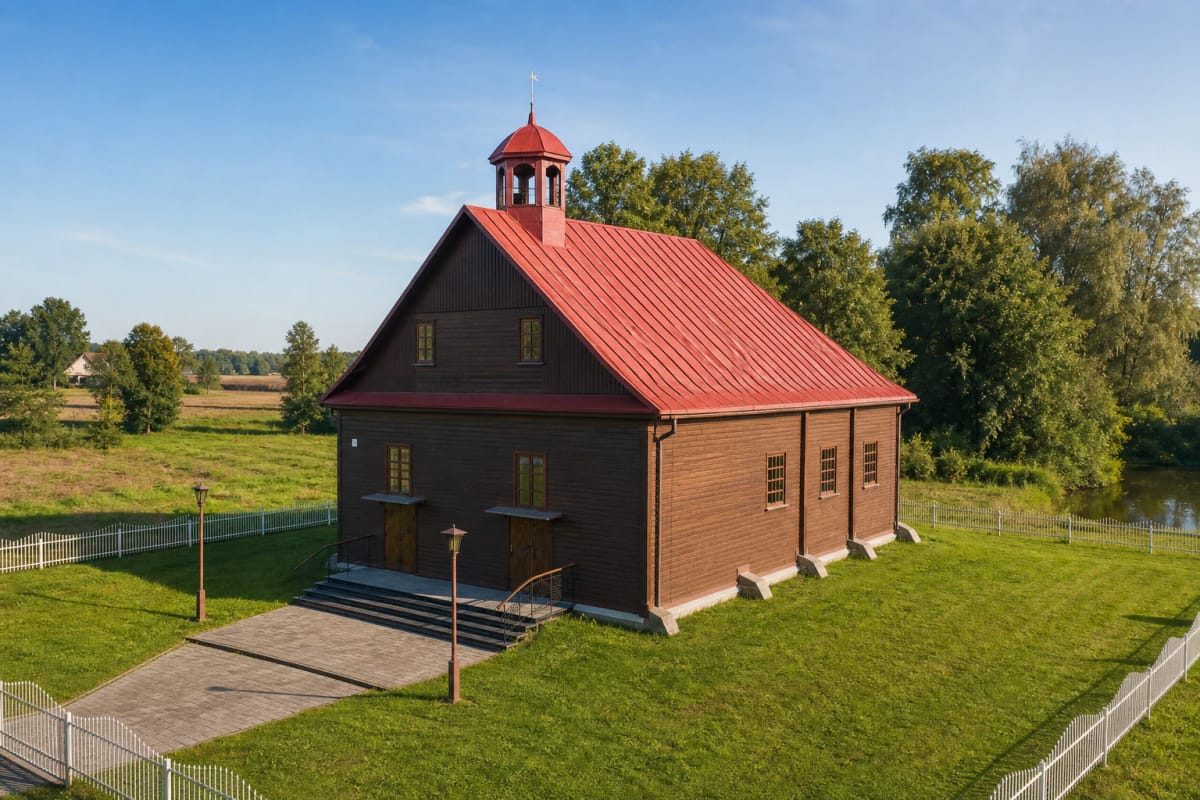
The mosque stands at 9 Vytauto Street in Raižiai, coordinates 54.479919, 24.187816, beside the road between Vaisodžiai and Butrimonys. Its dark-brown timber exterior, white fence, pond bank, sundials, and nearby Vytautas monument can be viewed without a ticket. An open gate or unlocked door, however, is not a promise that visitors may enter the prayer halls at that moment.
On 13 July 2026, the community published neither regular daily opening hours nor an official admission tariff. Regional visitor information listed advance arrangements on +370 686 56 801 for seeing the interior. Call before travelling, especially from a distance or with a group: a booked introduction, a religious celebration, and an independent look at the exterior are three different forms of access.
Remove shoes inside, cover shoulders and knees, and respect the men's and women's spaces according to the host's directions. Never photograph people, worship, or sacred objects without explicit permission. This is not a museum exhibit: prayer, funerals, festivals, and community needs always take precedence. No detailed accessibility statement is published, so also ask ahead about steps, doors, and assistance for a visitor with reduced mobility.
The year 1556 belongs to an earlier mosque, while the wooden building seen today dates from 1889
Raižiai took shape as a Lithuanian Tatar settlement in the late fifteenth and early sixteenth centuries. The earliest securely cited evidence for a mosque here dates to 1556 and is associated with registers kept by its imam. A date of 1663 circulates in popular accounts, but research commissioned by the Ethnic Culture Council calls it unsupported. Nothing certain is known of the first building's appearance or size.
In the 1870s, the Raižiai congregation counted 430 male and 431 female believers. When the old mosque proved too small, the community requested permission for a larger one, granted by the Vilnius provincial authorities in 1880. The present wooden mosque was completed in 1889. A late-Soviet document described it as approximately 200 square metres, meaning that even the replacement could not always contain everyone during major festivals.
The heritage register records renewal by local craftspeople in 1993. Earlier vertical façade boarding was changed to horizontal planks and the windows were replaced. Wooden roof covering had already given way to sheet metal in 1923; the roof was covered again in 2019 to a design by architect Daina Vanagaitė-Garbanovienė. The bright metal, brown boarding, and immaculate silhouette are consequently not an untouched image from 1889, although the volume and sacred use survive.
A five-sided mihrab and two prayer halls adapt local vernacular carpentry to Islamic worship
This state-protected, regionally significant mosque is a compact rectangular, single-storey building with an attic. A five-sided mihrab projects from the south façade and marks the direction of prayer towards Mecca. A low hexagonal turret, the architectural sign of a minaret, pierces the three-pitched metal roof; a half-domed cap, spike, and crescent complete it. The modest scale, timber boarding, and profiled cornice root the structure in the carpentry traditions of Dzūkija.
An enclosed porch on the principal façade joins separate entrances. From it, men enter the hall on the right and women the hall on the left. A wooden balustrade and curtain within the longitudinal partition allow everyone to hear worship while maintaining separation. Timber stairs in both halls lead to mezzanines or balconies once used when the main level became overcrowded.
The mihrab niche and minbar occupy the men's hall. Rectangular windows open through all four elevations, with small round windows in the sides of the mihrab. Ritual direction, spatial order, and the continuity of timber construction matter more here than lavish decoration. This explains why the exterior may first resemble a modest rural chapel even though Lithuanian Tatar Muslim practice determines its plan.
The Bazorai minbar of 1684 predates the present mosque by more than two centuries
As the present mosque was being built, the Muslim prayer house at nearby Bazorai burnt down. Its pine minbar, the pulpit from which an imam preaches, was rescued and transferred to Raižiai. A maker's inscription gives the precise date 14 August 1684. This primary evidence takes precedence over the year 1686 repeated in a few summary sentences issued by heritage bodies.
Arabic calligraphy, plant ornament, and painted tulips decorate the minbar. Specialists from the inter-university conservation institute of the Warsaw and Kraków art academies examined its structure and paint with infrared methods. In 2019, Lithuanian National Museum conservator Mantas Matuiza strengthened weakened pine, deformed elements, and painting. The pulpit returned not to a display case but to the same living prayer hall.
Ethnographic research records another important object: in 1879, Colonel Iljasevičius brought a Qur'an from Turkey and donated it to the mosque. Ask during an arranged visit which manuscripts or religious objects are then being shown. A worshipping community is not obliged to keep sacred possessions continuously on display as a museum would.
Legal worship through the Soviet period made Raižiai a symbolic capital of the Lithuanian Tatars
Following the Soviet occupation in 1940, Islam faced the same state hostility as other religions. Kaunas Mosque was closed and looted, Vinkšnupiai Mosque burnt in 1944, and the mosque in Vilnius was later demolished. People worshipped informally at Keturiasdešimt Totorių, whereas the Raižiai congregation and building received registration on 2 October 1951; an alternative 1954 date appears in part of the archive. Raižiai remained the only mosque officially functioning in Soviet Lithuania.
Even during periods without a permanent imam, the building retained its role in prayer, major festivals, funerals, and community meetings. Descriptions such as the Mecca or symbolic capital of the Lithuanian Tatars refer not to architectural scale but to religious continuity. Other Tatar mosques reopened after independence, so Raižiai is no longer the only active site, but its uninterrupted legal status remains exceptional.
More than one Muslim burial ground, called a mizar or zirec by local Tatars, survives in the landscape around the mosque. The ethnographic survey counted thirteen cemeteries in the Raižiai area, and in 1930 a researcher could still read the date 1671 on one old stone. They are not recreational extensions of the mosque: keep quiet, never step on graves or move stones, and photograph people only with consent.
The Vytautas monument and paired sundials place the Tatars within a shared history of Lithuania
On 26 June 2010, the six-hundredth anniversary year of the Battle of Grunwald, a monument to Vytautas the Great by sculptor Jonas Jagėla was unveiled near the mosque. The 5.2-metre block of pinkish granite combines the Columns of the Gediminids and the Tatar clan sign Tarak Tamga at its top. Dates 1392, 1397, 1410, and 1430 connect Vytautas's reign, the remembered settlement of Tatars, and their shared participation at Grunwald.
Two sundials designed by Jonas Navikas were installed beside the mosque in the same year. One marks local solar time in Raižiai and the other time at Grunwald, the battlefield in present-day Poland. A sundial is not a precise mechanical clock: cloud, season, and the difference between local solar time and official zone time affect the reading. Its meaning lies in joining the two places.
The monument, clocks, and mosque exterior form a worthwhile free stop even when the interior is closed. On 13 July 2026, the indexed Google Maps place record averaged 4.6 out of 5 from more than 100 reviews. Several reviewers specifically warn that the doors are not always open, so the strong score does not remove the need to arrange interior access.