- Place
- Punia Forest, Alytus District Municipality
- Region
- Nemunas Loops Regional Park
- Type
- old forest and protected oak landscape
- Coordinates
- 54.51300, 24.07800
Punia Forest oaks
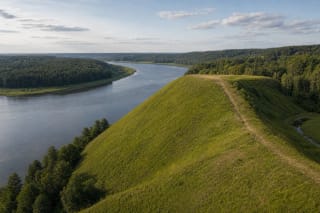
Old-growth forest in a Nemunas loop
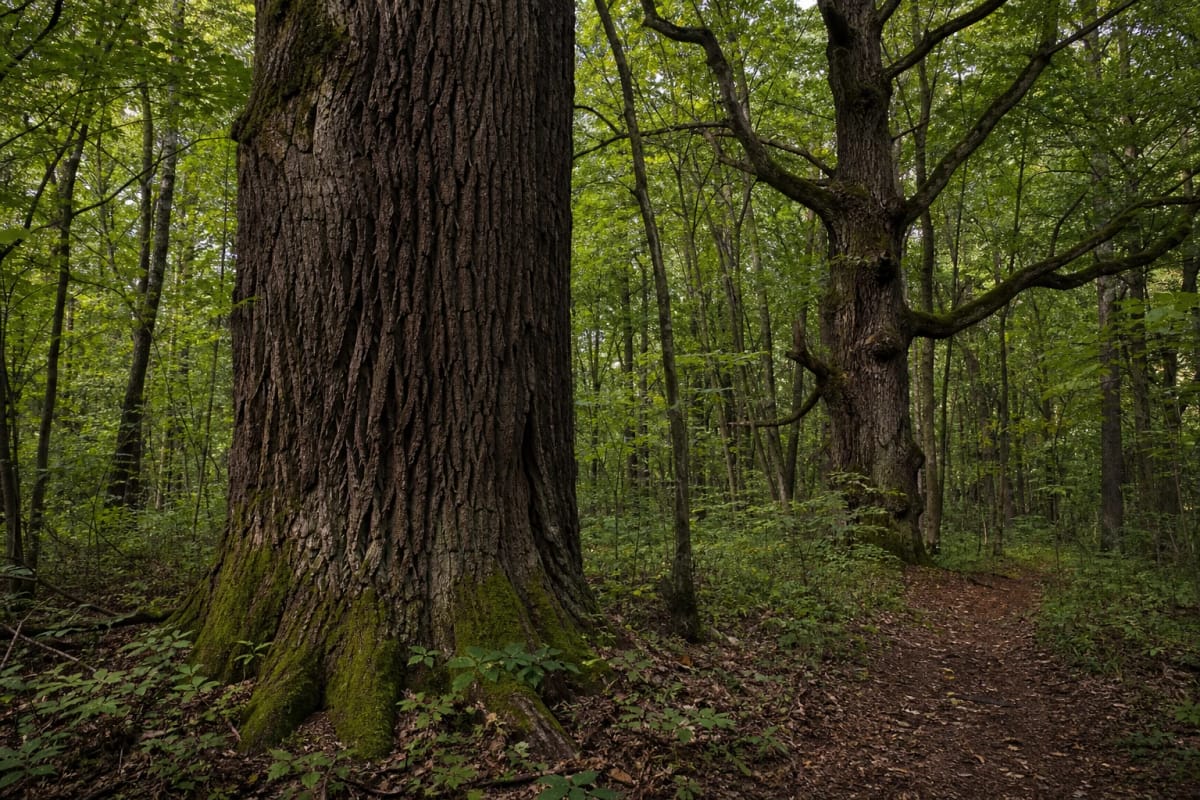
The old trees of Punia Forest are not a single map point but an old-forest experience. VLE states that Punia Forest lies in Alytus District, 12 km north of Alytus, in a Nemunas loop on the left bank opposite Punia. Its area is 2,720 ha, of which 2,510 ha are wooded. This is one of Lithuania's strongest images of old-growth forest, a place for a real walk rather than a quick stop.
VLE notes that the forest is very productive: some stands reach 40 m and old-growth areas survive, while the average stand age is about 91 years. Pinewoods dominate, about 42 percent, but spruce, birch, and oak stands also grow. The forest is botanically rich, with 683 higher plant species, including 47 moss species, so the old trees are part of a living, diverse ecosystem.
Five protected oaks
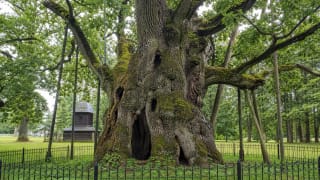
Saugoma.lt presents the Punia Forest oaks as a separate natural heritage object. They grow in the southern part of the forest, in Punia Forest Landscape Reserve, on the left bank of the Nemunas almost opposite the Punelė mouth. Saugoma.lt lists five old oaks with exact dimensions, so this is a documented group of trees, not a general label.
According to Saugoma.lt, oak I has a girth of 5.3 m and height of 28 m; oak II, 4.0 m and 27 m; oak III, 4.35 m and 30 m; oak IV, 5.0 m and 31.5 m; oak V, 3.9 m and 26 m. These dimensions show the forest's maturity. Visit in a way that does not damage them: trampling root zones or climbing roots for a photograph is not appropriate.
Reserve, landscape reserve, and natural monuments
Punia Forest has a strict protection core. VLE states that in 1960 it was declared a botanical-zoological reserve, since 1992 it has belonged to Nemunas Loops Regional Park, and a 420 ha area has strict reserve regime. Practically, this means part of the forest is not freely visited because undisturbed natural processes are being protected.
The protected values are concrete. VLE states that six trees are natural monuments, 52 Lithuanian Red Data Book plant sites and 14 bird-species nesting sites are protected. Bundoriai and Smolnica burial mounds in forest blocks 10 and 48 show that the forest also preserves archaeological heritage.
Educational trail and visiting rules
Saugoma.lt announces a new educational trail in Punia Forest, allowing visitors to see forest values without entering the most sensitive territories. According to VLE, a museum stands near the entrance to the forest, and a sculpture exhibition is on the eastern edge, providing orientation points.
Stay on the trail, follow information signs and restrictions. Reserve or limited-access signs are not decorative: they protect habitats where quiet natural processes matter. Part of Punia Forest has stricter protection than an ordinary forest, and unauthorized entry to the strict reserve is prohibited.
Partisan memory in Punia Forest
Punia Forest is also linked with postwar history. VLE states that Lithuanian partisan units active here from 1945 formed the Margis group of the Dzūkai detachment, and in 1946 a meeting of the South Lithuanian partisan staff and Dzūkai detachment commander D. Jėčys, code name Ąžuolas, decided to unite Dzūkija partisans and establish the Dainava district.
VLE notes that small partisan groups operated in Punia Forest until 1952. The memory reminds visitors that the value of an old forest is not only botanical: dense Dzūkija pinewoods became a refuge for armed resistance, remembered in monuments and place names.
What to observe and how to plan
Look at old trunks, hollows, dead wood, different stand ages, and changing light. Old-growth forest is not a sterile park: living and decaying wood both feed insects, birds, and fungi. If you expect one largest tree, you may be disappointed; if you come to understand mature forest, Punia Forest is one of Lithuania's strongest places.
For the old trees and trail experience, plan 1.5-3 hours, and more if combining it with Punia Hillfort. In spring and autumn the forest structure is easier to see; in summer the forest is denser and greener; after rain, paths may be slippery.