- Place
- Punia, Alytus District Municipality
- Region
- Nemunas Loops Regional Park
- Type
- hillfort with a foot settlement
- Coordinates
- 54.51210, 24.09030
Margis Hill, Punia Castle Hill
What you see from Margis Hill
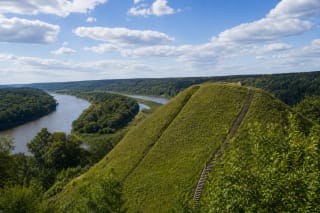
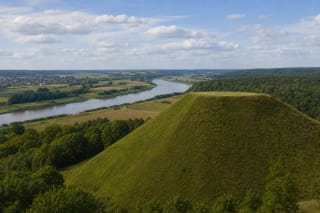
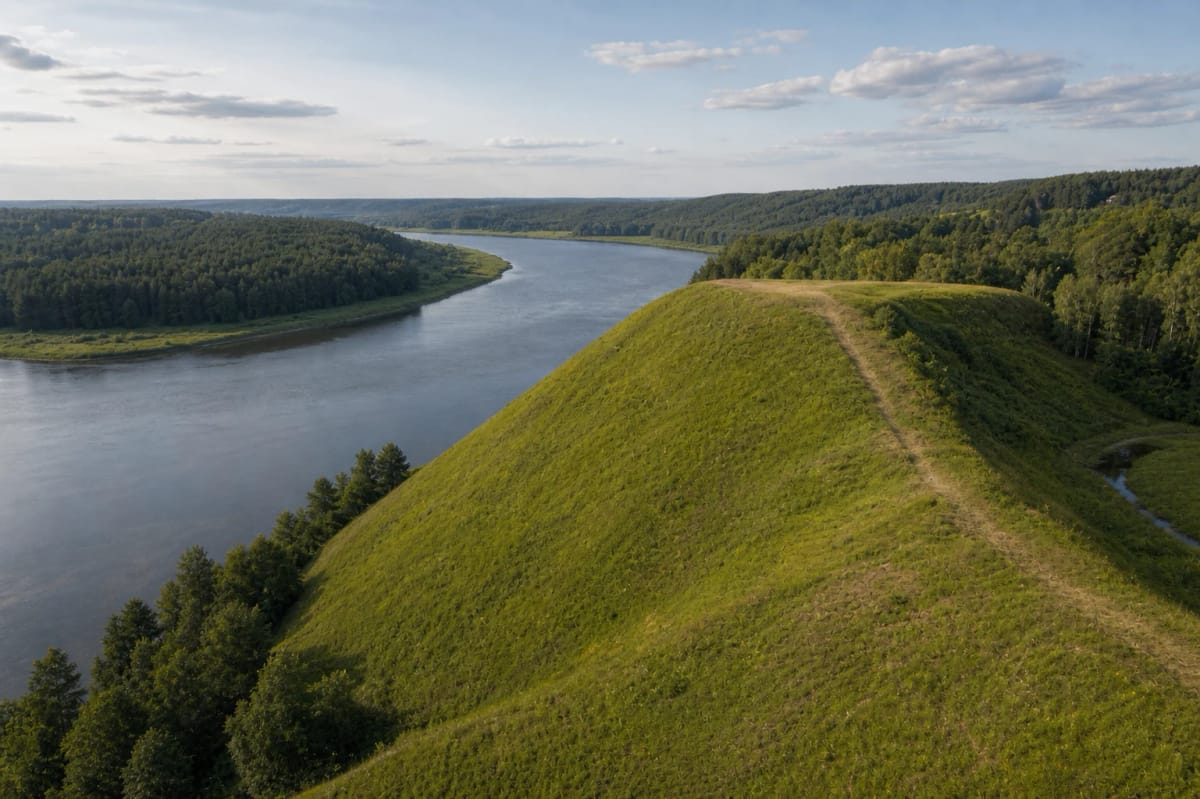
Punia Hillfort is one of the strongest places in the Nemunas Loops region because view and story meet here. From the hill you see a wide strip of the Nemunas, Punia Forest, and the direction of the Punelė valley, while the hill itself has long been called Margis Hill.
Saugoma.lt writes that one of the country's most beautiful panoramas opens from Punia Hillfort. It is not only a viewpoint: VLE describes it as a hillfort with a foot settlement in Alytus District, on the left bank of the Nemunas and the right bank of the Punelė.
Form and fortifications
VLE states that the hillfort is arranged on a highland, with a triangular platform 155 m long and 85 m wide. At the eastern end is a rampart 75 m long, 6 m high, and 30 m wide, beyond which lies a ditch about 60 m long, 30 m wide, and 4 m deep. In the seventeenth century the rampart was cut through, and research showed it was built in three phases.
These numbers matter on site: do not only photograph the Nemunas, but read the relief. The large triangular platform, pronounced multi-layered rampart, and steep slopes show a strongly fortified place. East of the hillfort lies a foot settlement of about 3 ha.
Punia and the Pilėnai question
Punia Hillfort is famous for the legend of Duke Margiris and the defenders of Pilėnai. Saugoma.lt clearly presents this as a long-living legend, and a stone with Maironis's lines about Margiris stands by the hillfort.
VLE's article on Punia uses a more cautious historical formulation: Punia is mentioned in Wigand of Marburg's chronicle in 1382, and that text refers to the Teutonic Order attack of February 25, 1336; some historians identify this event with the Pilėnai tragedy. It should therefore be understood as an important historical-memory tradition, not as an unequivocally proven location.
Research and finds
VLE states that Punia Hillfort was investigated in several expeditions: 1958-1959, 1961-1962, 1972, 1994, and 2000. In total, a cultural layer up to 3.5 m thick was found in an area of 1,282 sq. m.
The investigations showed a longer history than a medieval castle alone. Palaeolithic artefacts, hearths, and pottery remains were found, while fortifications date to the fourteenth and fifteenth centuries, when Punia Castle stood here. VLE also mentions fifteenth- to eighteenth-century manor-site finds, from stove tiles and glass vessels to household objects and coins.
Among the finds VLE highlights stove tiles with the Gosiewski coat of arms, an iron spur, a silver spoon, and a Riga shilling from Christina's time. They show that in the fifteenth to eighteenth centuries the Punia elder's manor operated here, declined in the eighteenth century, and was later followed by a homestead that stood until 1938. The finds are kept at the National Museum of Lithuania.
Planning a visit
Punia Hillfort is best combined with Punia town, Nemunas Loops Regional Park routes, and views of Punia Forest. If you come only to the hillfort, leave time to walk around the platform, stop by the rampart, and look at the Nemunas from several angles.
After rain, slopes and grass can be slippery, so wear suitable shoes. Protect ramparts and slopes by using existing paths, not cutting straight across slopes, and leaving no litter in a place that is both landscape and archaeology.