- Place
- Rietavas, Rietavas Municipality
- Region
- Žemaitija
- Type
- historic central square with a reconstructed monument to the tenth anniversary of Lithuanian independence
- Address
- Laisvės Square, Rietavas
- Coordinates
- 55.72374, 21.93347
- Visit duration
- 20-30 minutes for the square and monument; 1.5-2.5 hours with the church, manor grounds and Oginskiai museum
- Best time
- in daylight, when the sculpture and heraldic reliefs are clearest; check municipal notices before national commemorations or town events
Rietavas Freedom Square, Rietavas Freedom Monument, Laisvės aikštė, Laisvės paminklas, Laisvės (buvusi Turgaus) aikštė ir paminklas, Lithuanian Independence Decade Monument, Rietavas Market Square
The map pin marks the monument itself, while the square is an open civic space
The coordinate 55.723738, 21.933473 leads to the Freedom Monument in Rietavas's central square, not to the municipal entrance, church gates or a parking place. The Cultural Heritage Register names the object the Lithuanian Independence Decade Monument and assigns it the unique code 20787.
The square and outdoor monument have no separate ticket office or tourist opening hours. It is a public space, but national ceremonies, the Mykolinės festival, fairs, other town events or maintenance can occupy parts of it. Check current Rietavas Municipality notices if timing is important to your trip.
Most approaches have hard paving and are relatively level, while a low lawn and flower bed surround the monument. No comprehensive current accessibility audit was found, however, and rain, snow or ice can change conditions. Do not treat the map pin as parking guidance; follow the signs on site.
The former Market Square now joins the church, municipal offices and event space
The old Market Square name recalls the practical role of Rietavas's centre. VLE records a regular market and twelve annual fairs in the town in 1928. No dependable document precisely dating the change from the Market name to Freedom Square was found, so the old and current names should not be turned into an invented day-by-day renaming story.
The plan for Rietavas's central area was prepared in 2002 by Liucijus Dringelis, Regimantas Pilkauskas, Albertas Lamauskas and Aušra Mlinkauskienė. The square was reconstructed in 2004-2005, and the project received second prize in Lithuania's 2005 exhibition and competition of landscape architecture works.
The scheme was more than decoration. It retained a ceremonial zone with the Freedom Monument in the centre, placed seating, lawns and flower beds nearby, and separated the parking zone from the principal public space. The municipal administration and the white Church of St Michael the Archangel define the composition; the church remains the square's strongest vertical landmark and a dominant across the wider Rietavas landscape.
The register's 1928 date and a 1931 newspaper account tell different stories
The KVR assessment act says that the first monument was erected in 1928 for the tenth anniversary of Lithuanian independence. It stood in a small green beside the larger square, not at the centre of today's reconstructed plaza. The register names the young sculptor Bronius Pundzius as the presumed designer, and that qualification matters: the attribution is not presented as proven beyond doubt.
A Plungė District Municipality review of interwar newspapers gives another account. It associates the Rietavas monument with September 1931 and says the works in Plungė and Rietavas were made by a self-taught craftsman called Kleinauskis, whose first name is unknown. A 1932 report further claimed that both monuments suffered defects in artistic work by the same maker.
The years 1928 and 1931 might mark conception, the start of construction and completion, but the evidence located for Rietavas does not directly establish that sequence. The careful approach is therefore to retain the KVR's formal 1928 date and call Pundzius only the presumed designer, while clearly recording the conflicting 1931 Kleinauskis evidence.
A road roller used on the 1852 route to Endriejavas forms the pedestal
The KVR history states that the monument's base incorporates a road roller used to level the road to Endriejavas laid in 1852 and later employed in nineteenth-century street paving. The engineering object did not disappear inside an ordinary foundation: it became the recognisable tall cylindrical pedestal carrying the figure of Freedom.
Popular accounts sometimes connect the roller with construction of the Žemaičių Highway. The official KVR act gives the earlier and more specific origin instead - the 1852 road to Endriejavas and nineteenth-century street works - so this page does not repeat the highway version as fact.
The road roller once had a separate KVR record, code 2340, and was listed on Plungės Street. In 2022 a KPD director's order moved that record into the register archive and published the order with the documents for both the roller and the Freedom Monument, code 20787. Old lists should therefore not send visitors searching for two separately protected rollers.
Julius Vertulis reconstructed the Soviet-destroyed monument in 1992
KVR does not give an exact date for the destruction of the first monument. It states only that the monument was destroyed in the Soviet period while the historic roller survived. The present view is therefore not an intact 1928 or 1931 original; the most important authentic survivor from the interwar composition is its unusual base.
The monument was reconstructed in 1992 to a design by sculptor Julius Vertulis. KVR adds a crucial qualification: it was rebuilt in a slightly different place, at the centre of the square. Saying that every element returned to its exact historic position would be wrong. The statehood symbol and surviving roller returned, but their position in the civic space changed.
Contemporary press allows the unveiling to be dated to Sunday, 29 November 1992, following Rietavas's centenary celebrations of electrification. That detail supplements the reconstruction year in KVR, while the authorship of the present project remains the register's Julius Vertulis, not Pundzius or Kleinauskis, the names associated with the interwar work.
Walk around the sculpture for every emblem; the Oginskiai monument is elsewhere
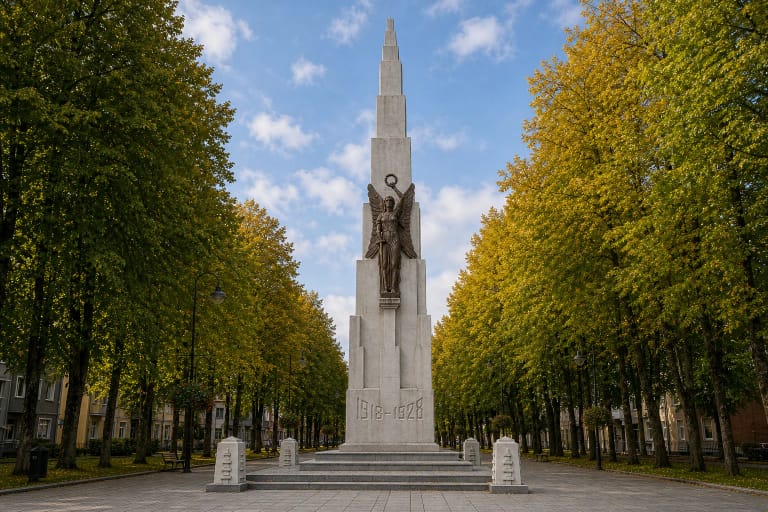
The current monument combines a three-stage cylindrical pedestal of concrete and dressed granite with a concrete female figure. Representing Freedom, she raises a torch high in her right hand and holds a shield bearing the Vytis in her left. The dark rounded pedestal and pale figure create a strong contrast within the broad square.
Circle the monument because no single face contains its full programme. Plaster shields on the pedestal carry reliefs of a lion, a bear and the Cross of Vytis, separated by relief garlands of oak leaves. The Vytis shield held by the woman and the Cross of Vytis on the pedestal are two different details and should not be conflated.
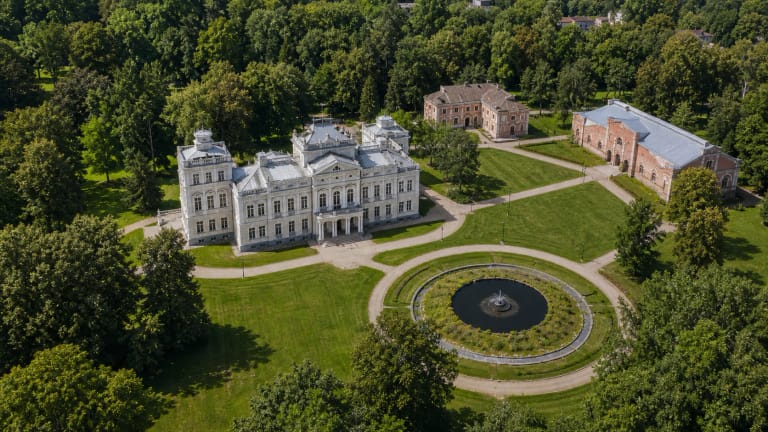
This is not the monument to the Oginskiai princes. Their memorial stands in the parterre of the former Rietavas manor palace, farther from Freedom Square; a natural route reaches it along the church and manor axis. The church interior, Oginskiai museum and other manor sites each have their own access conditions and are not part of this outdoor square monument.