- Place
- Plungė, Plungė District Municipality
- Region
- Samogitia
- Type
- late nineteenth-century lime-tree boulevard and a 1992 reconstruction of the 1928-1931 Lithuanian independence decade memorial
- Address
- Laisvės Avenue, Plungė
- Coordinates
- 55.91493, 21.84428
- Visit duration
- 30-45 minutes for the avenue and monument; 1.5-3 hours with Oginski Manor Park and central Plungė
- Best time
- in daylight from late spring to autumn, when the perspective through the lime trees reads best; state commemorations may occupy the space on public holidays
Freedom Monument in Plungė, Plungė Independence Monument, Lithuanian Independence Decade Monument
Laisvės Avenue is a public pedestrian axis, while the map pin marks the monument itself
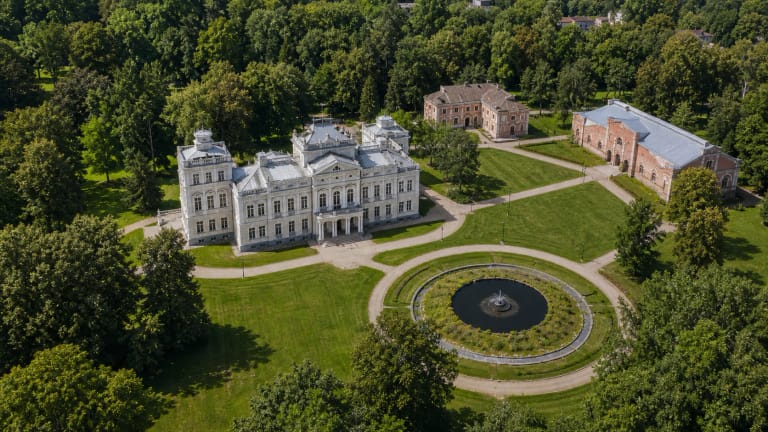
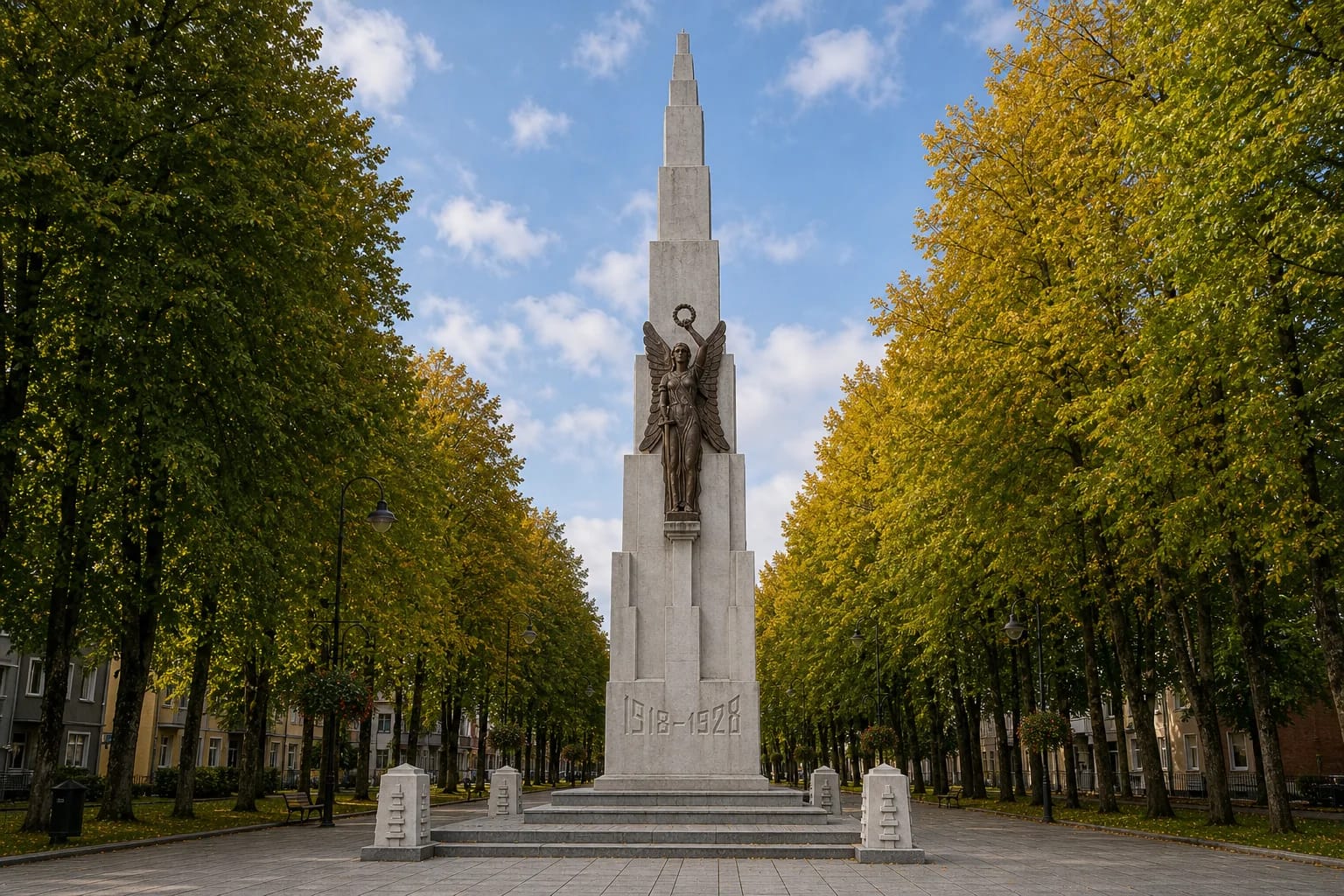
The coordinates 55.914926, 21.844279 lead to the Lithuanian Independence Decade Monument on Laisvės Avenue, close to the manor-park gates. The pin marks the memorial rather than the middle of the avenue. From here, one direction opens into the lime-lined town perspective, while the Plungė manor and park landscape begins on the other side.
The avenue and the approaches to the monument are a free public outdoor space. There is no separate ticket office, tourist opening schedule, or admission charge, although access arrangements may change during 16 February commemorations, the city festival, and other events. Check the Plungė District Municipality programme before a time-specific visit.
The main avenue is paved and largely level, with benches and lighting. The obelisk itself rises from several steps, but the angel, dates, and reliefs can be viewed from the surrounding pavement. Rain, fallen autumn leaves, or winter ice may make the surface slippery, so assess conditions on site and do not climb on the memorial.
Mykolas Oginski's boulevard linked the town with the manor park in the late nineteenth century
The history published by Plungė District Municipality and the Samogitian Art Museum dates the public boulevard to the late nineteenth century and attributes the commission to Duke Mykolas Oginski. It was intended not only as a representational approach to the estate, but also as a place where townspeople could walk and rest. Two pairs of lime-tree rows, four rows in total, formed a clear green axis between town and residence.
Around the turn of the twentieth century it was known as Liepų, or Lime Tree, Boulevard and simply Boulevard Street. After the Lithuanian state was restored, it became Laisvės Avenue. During the interwar republic, municipal offices, the post and telegraph, a school, the Riflemen's club, a cinema, and other important premises gathered here. This was not a decorative edge to the park, but the representative stage of everyday town life.
The Soviet authorities renamed it Žemaitė Avenue, but its historic axis and rhythm of lime trees remained. Later renewal preserved the four-row planting concept while improving surfaces and street furniture. The St Florian monument by Vytauto Street and the Independence Monument by the park are two separate landmarks at opposite ends of the historic walk.
The year 1928 marks the first monument's beginning, while 1931 is its documented completion
Short encyclopedic summaries sometimes date Plungė's Freedom Monument to 1928. The Register of Cultural Property and archival findings published by the municipality show a longer process: the monument for the tenth anniversary of Lithuanian independence was probably initiated by the Pavasarininkai Catholic youth organisation in 1928, while a local newspaper recorded completion in September 1931. Researchers have not found a reliable account or exact date for a formal unveiling.
No author is named in the surviving project documents. A 1931 newspaper item suggests that the monuments in Plungė and Rietavas were made by the same self-taught craftsperson, Kleinauskis, whose first name remains unknown. Kleinauskis should therefore be described as the probable maker, not as a conclusively identified professional sculptor.
Interwar reports described the original as a cement obelisk about 18 metres high with a three-metre white plaster figure of a winged woman. She held a wreath and sword and wore a sash whose wording, Laisvė or Lietuva, is no longer certain. Its sides carried the Plungė arms, the Samogitian bear, and possibly a sign associated with Vytautas the Great, while corner urns incorporated the Columns of Gediminas motif.
A cost of about 8,000 litas did not secure sound construction. The statue's arm and sword soon fell, heraldic panels crumbled, and the tall structure leaned. Contemporary newspapers document those defects. The story that hostile townspeople deliberately damaged the monument must be separated from witness reports that parts fell because the construction itself was poor.
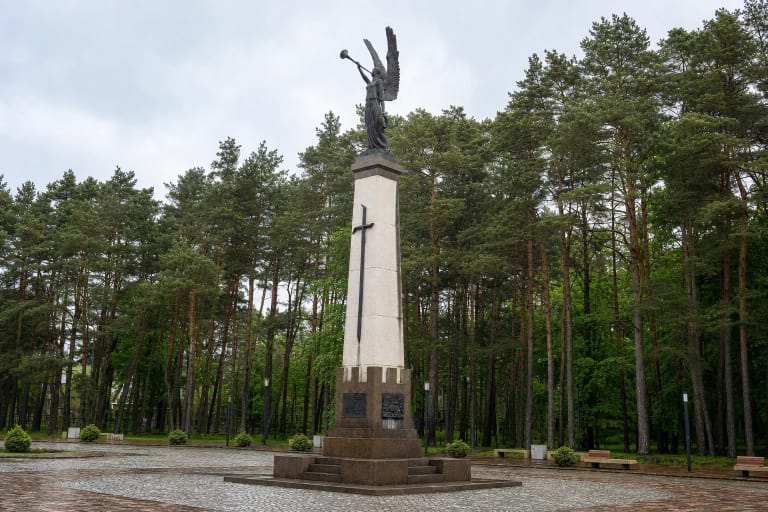
The present obelisk is identified by its copper angel, two Plungė coats of arms, and Columns of Gediminas
The Register of Cultural Property lists the monument under unique code 4502 as an individual work of regional significance with artistic and historical value. Its protected area of about 100 square metres also lies within the registered Plungė Manor complex. The heritage value encompasses not only the angel, but the stepped obelisk, inscriptions, heraldry, four octagonal concrete posts, and relationship with the manor-park approach.
A winged Freedom Angel is mounted on the south face of the present monument: one hand raises a wreath overhead and the other lowers a sword. The dates 1918-1928 are carved beneath it. The east and west faces bear two versions of the current Plungė coat of arms, showing a wheat sheaf and the Eye of Providence, while reliefs of the Columns of Gediminas encircle the obelisk.
The present sculpture and coats of arms are the work of Plungė-born sculptor Vilimas Ketvirtis. The municipality calls the angel brass and says it was cast in Saint Petersburg, while the heraldic panels were cast in Kaunas. The Register uses the term cast copper; because brass is a copper alloy, copper-alloy decoration is the clearest description for visitors observing the dark patinated metal.
The 1992 work does not reproduce every interwar detail. Two Plungė coats of arms now replace the old combination of Plungė arms, Samogitian bear, and possible Vytautas emblem, while the angel's sash inscription is absent. These differences matter: archival imagery supported the recovery of the broad silhouette, but gaps in knowledge prevented a detail-for-detail replica.
The Soviet authorities demolished the original, and a reconstruction returned to the avenue in 1992
The interwar monument was already deteriorating before occupation. Press material collected by the municipality suggests that the damaged Freedom figure may have been removed in 1936, but that date should not be confused with destruction of the whole obelisk. The Register dates the demolition broadly to 1950-1953, while VLE gives about 1953; no securely documented day is known.
Destroying the statehood symbol and renaming Laisvės Avenue did not erase the place's meaning. The Lithuanian tricolour was raised here again in 1988, the separate St Florian monument returned in autumn 1990, and the Independence Decade memorial was rebuilt in 1992. These distinct elements of the town's memory came back at different moments and should not be merged into a single object.
The reconstructed monument was consecrated by Bishop Antanas Vaičius on 7 September 1992 during celebrations of the 200th anniversary of Plungė's municipal self-government. Its historical value does not depend on surviving 1931 material, but on a recovered silhouette in the same avenue axis, public remembrance, and the prominently visible dates 1918-1928.
The best route runs from St Florian through the lime-tree perspective to the manor park
Begin by Vytauto Street and the St Florian monument, then walk slowly along the rows of lime trees. Look beyond the planting to the scale of the buildings: the former representative street reveals how the Oginski estate was connected with the public life of the town. St Florian is an independent, older town symbol, not a component of the Independence memorial.
At the Freedom Monument, first read the full silhouette of the stepped obelisk, then approach the angel, sword, wreath, and dates. Walk around both sides to find the heraldic panels and Columns of Gediminas reliefs. The view from the park side makes the monument's position between the town avenue and manor gates particularly clear.
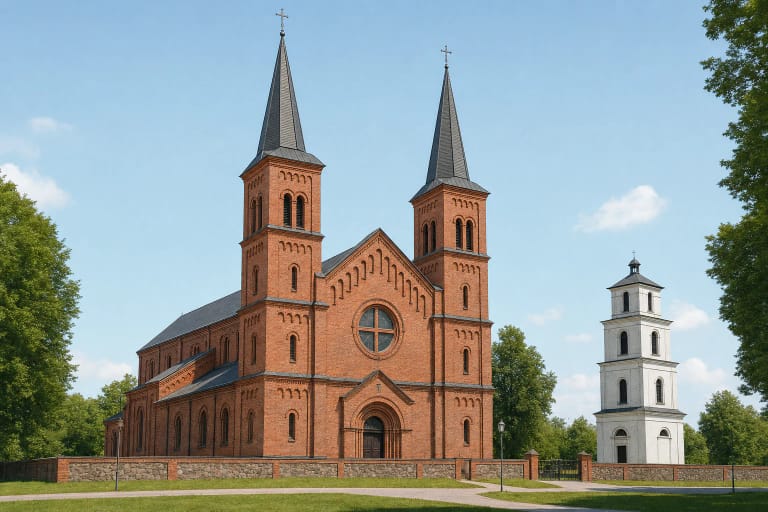
Allow about 30-45 minutes for the avenue and memorial. Continue into Plungė Oginski Manor Park, or extend the town-side route to the Church of St John the Baptist. Choose an ordinary daylight visit for photographs without event equipment and crowds; to witness an active practice of national remembrance, check the programme for 16 February or another official commemoration in advance.