- Place
- Punia, Alytus District Municipality
- Region
- Dzūkija
- Type
- nineteenth-century Neo-Baroque twin-towered masonry church designed by engineer Konstantinas Suchodolskis, with valuable works of art
- Address
- 1 Kauno Street, Punia, LT-64401, Alytus District
- Coordinates
- 54.51203, 24.09578
- Visit duration
- 35-60 minutes for the twin-towered facade, cruciform massing, works of art, and churchyard when the church is open
- Best time
- daylight for the exterior; arrive before Sunday worship to see inside, but always recheck the latest time on the diocesan page
Punia Church, Church of Saint James the Apostle in Punia, Punios Šv. apaštalo Jokūbo bažnyčia
Two white towers conceal a cruciform building behind their symmetry
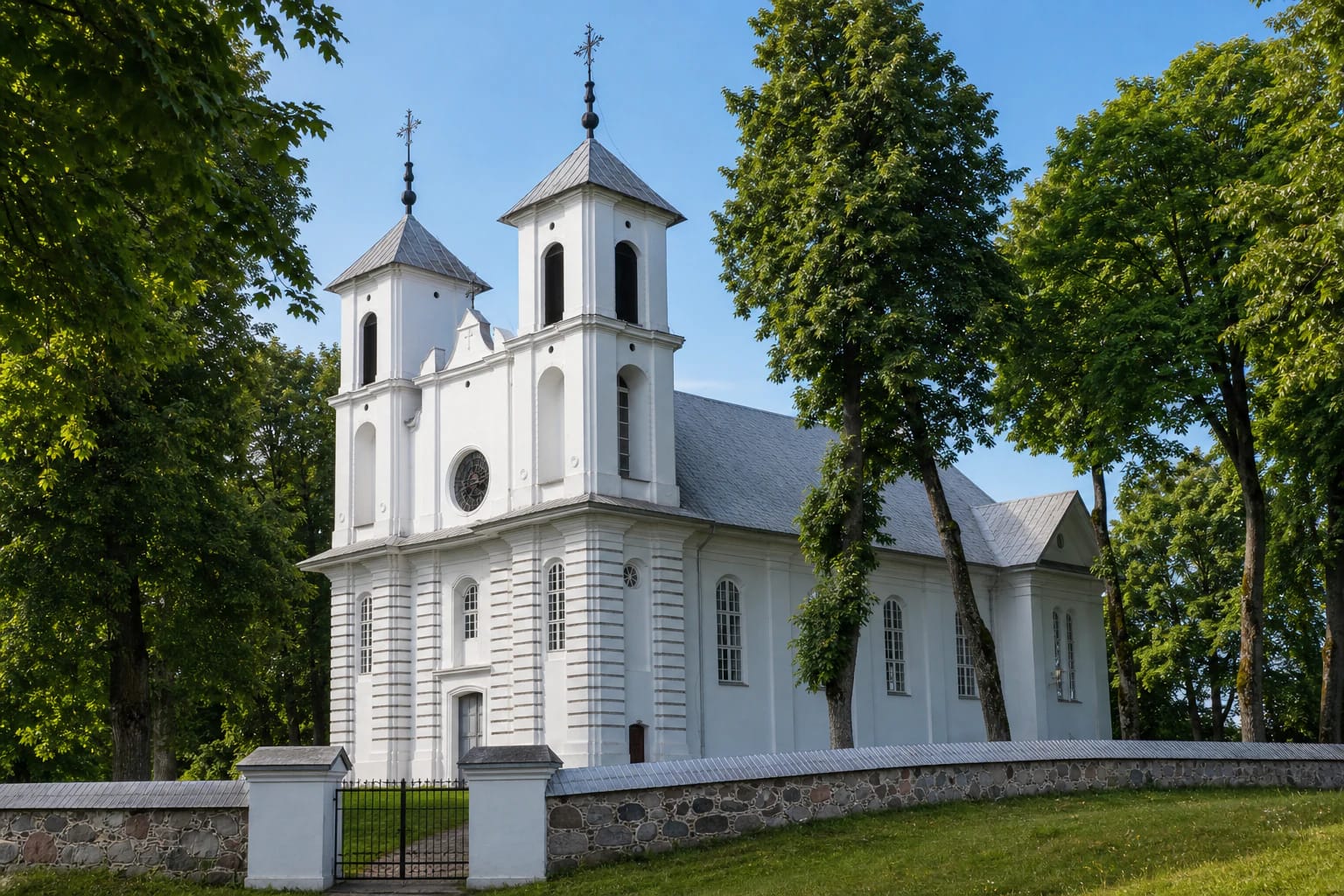
Two white square towers rise on the principal facade. Each has tall, dark, round-arched bell openings, strongly projecting cornices, a low pyramidal sheet-metal cap, and a slender metal cross. The pair creates a Neo-Baroque silhouette, although the composition itself remains rigorously symmetrical.
A circular stained-glass window and a modest shaped gable occupy the space between the towers. Horizontal rustication bands divide the lower pilasters and continue along the side elevations. Tall white small-pane windows end in semicircular arches, making the substantial masonry appear more vertical.
From the side, the long three-nave basilica and broad transept become visible. A low fieldstone churchyard wall clarifies the building's scale, while mature trees often conceal parts of the towers. Walk the public paths to understand the plan rather than stopping at a single photograph from the gate.
Official dates differ, so the fire, construction, and completion must be separated
A church existed at Punia by the fifteenth century, and town histories often cite about 1425. Tradition associates that early foundation with the time of Vytautas the Great, but the building visible today is much later and is not an unchanged medieval sanctuary.
The 1857 fire destroyed the earlier church and prompted construction of the present masonry sanctuary to a design by engineer Konstantinas Suchodolskis. Official summaries use different dates: Alytus District Municipality gives 1857, while the Encyclopaedia of Lithuania dates the building and implementation of the design to 1868. The soundest reading treats them as stages marking the fire and beginning of work, followed by final completion.
Wartime action damaged the church in 1944. It was reconstructed in the 1950s, so the present appearance also incorporates post-war restoration decisions. A single date on a tourist board cannot describe every layer of the building.
Look for specific works inside, not generic splendour
The Encyclopaedia of Lithuania singles out paintings and sculptures in Punia church. Particularly important is Nikodemas Silvanavičius's 1889 painting Saint Francis of Assisi. Its named artist, date, and subject identify documented nineteenth-century art rather than anonymous decoration.
The high altar iconography is connected with the titular patron, Saint James. Images of Lithuanian saints and historical patrons also appear inside. The position of paintings and liturgical decoration may change for feasts, so never describe a temporary arrangement as permanent museum display.
The dedication to Saint James naturally connects Punia with contemporary pilgrimage routes. A route marker does not, however, prove that the doors remain open all day. Pilgrim stamps, reception, and group visits should be arranged with the parish.
Sunday worship is a clear reference point, not tourist opening hours
On 27 July 2026, the Kaišiadorys Diocese page listed Sunday worship at 13:00 and also provided parish telephone and email contacts. Recheck the time before travelling, because feasts, funerals, or clergy service elsewhere can change the liturgical schedule.
No separate tourist admission charge or daily museum hours are published. Arrange a quiet interior visit, group stop, or pilgrimage need in advance. During worship, do not photograph people without consent and never use flash.
The official parish page gives no complete description of a step-free route, accessible toilet, or reserved visitor parking. Gates, churchyard surfaces, and thresholds may matter for individual access, so ask about them before arrival.
The Kauno Street point suits a walking route through town
The church stands at 1 Kauno Street, close to the centre of Punia and the route toward the hillfort. Coordinates 54.5120271, 24.0957793 mark the side of the principal gate and entrance. They do not guarantee an available parking bay, so keep gateways and residents' access clear.
Google Maps Place ID ChIJk73rOkWx4EYRTeLGOm0V6-E identified the Punia church listing, rated 4.7 out of 5 by 109 reviewers on 27 July 2026. Treat those changing public opinions separately from any professional architectural or access assessment.
Allow 35-60 minutes for the church and plan a separate stop for Punia hillfort. Although the two sites are close, the church coordinates are not the hillfort car park or the trailhead into the Punelė valley.