- Place
- Pakruojis, Pakruojis District Municipality
- Region
- Pakruojis District
- Type
- Historicist twin-towered, three-aisled pseudo-basilican masonry church
- Address
- 67A Vytauto Didžiojo Street, LT-83158 Pakruojis
- Coordinates
- 55.98047, 23.85397
- Visit duration
- 30-45 minutes; longer for Mass or an interior visit arranged in advance
- Best time
- before an officially announced Mass or afterwards, when you can enter without disturbing parish life; check a separate programme for the Feast of St John the Baptist
Pakruojis Church, St John the Baptist Parish Church in Pakruojis
A white twin-towered landmark beside the Kruoja
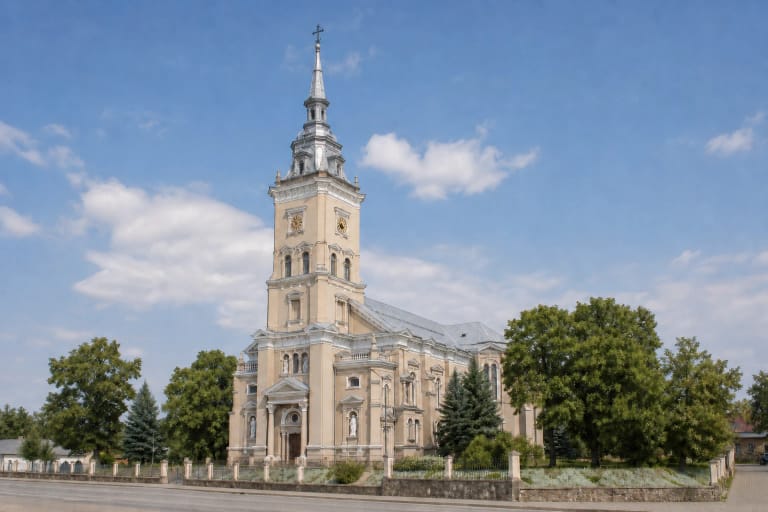
Pakruojis Church of St John the Baptist stands on Vytauto Didžiojo Street, on the right bank of the Kruoja. VLE classifies it as Historicist architecture. Two square towers with tall, sheet-metal spires frame the white-rendered west front, and a triangular gable rises between them. A round window sits above the arched portal, while the openings in the towers and side walls have semicircular heads. These rounded arches reveal a Romanesque Revival influence, although VLE uses the broader term Historicist for the building as a whole.
A stone and masonry boundary with ornate wrought-iron railings encloses the churchyard. The main gates establish a direct view towards the facade and provide the clearest overall vantage from the street. The coordinates 55.980475, 23.853969 are a representative point at the official diocesan address of 67A Vytauto Street, not an artificially exact point on the threshold. There is no detached bell tower - the two bells hang in the facade towers.
Three different buildings: the chapel of 1630, the wooden church of 1750, and today's sanctuary
VLE records a filial church built in Pakruojis in 1630. The municipality library's 2024 publication also notes a 1613 version, but presents it as a hypothesis about a small wooden place of worship on the site of the old cemetery. The soundest approach is to treat 1630 as the documented starting point and 1613 as a proposal preserved in local historiography rather than a settled date.
A church destroyed during eighteenth-century warfare was rebuilt in 1750 through an endowment from Jonas Zabiela, owner of Pakruojis Manor. This predecessor was a spruce-log building on stone foundations, laid out as a cross with two chapels and six altars. Two timber towers were added later, while its bells hung in a separate wooden belfry. Those details belong to the church of 1750 and should not be transferred to the masonry building completed in 1887.
Galinevičius's design, construction in 1885-1887, and consecration in 1890
Permission for a new masonry church had been sought since 1873. Ustinas Galinevičius, architect to the Kaunas Governorate, prepared the design in 1884, and it was approved on 31 March 1885. Parish priest Stasys Tomkevičius began building after receiving a notice dated 9 July 1885 from Mečislovas Paliulionis, Bishop of Samogitia. The church was completed in 1887. VLE also dates the building to 1887 and says it was blessed in 1890; the library study states that Bishop Paliulionis consecrated it that year.
One Pakruojis municipal urban study gives 1891, but VLE and the more detailed 2024 library publication agree on 1890, so this guide uses 1890 while openly recording the discrepancy. Accounts of the funding also differ: some emphasise parishioners' contributions, while others say the von Ropps of Pakruojis Manor supplied building materials. It is more accurate to acknowledge both forms of support than to name either party as the sole builder.
A pseudo-basilican interior and three altars in Classical architectural forms
The historical chapter of the library study describes the present church as twin-towered, three-aisled, and pseudo-basilican, built of stone and brick, rendered, and roofed in sheet metal. The same publication is inconsistent about its plan and east end: one passage calls the plan rectangular with a straight apse, another cross-shaped with a three-sided apse. This guide therefore does not pretend that one version is conclusive. The dependable identifiers are the three-aisled volume, two facade towers, rendered masonry, and tall spires.
Once the masonry church had been erected, new altars were commissioned from a craftsman named Danauskas. The three-tier high altar is dedicated to Our Lady, Liberator of Captives: statues of St Peter and St Paul stand on its lowest level, with paintings of the Baptism of Jesus and the Holy Trinity above. The right-hand altar is dedicated to the Crucified Christ and the left-hand altar to the Visitation. These are the three altars documented in the present interior, not the six recorded in the wooden predecessor of 1750.
The Garalevičius organ and bells from Moscow and Valdai
The organ was built in the early twentieth century, no later than 1904, by the Kaunas organ builder Jonas Garalevičius. A porcelain maker's plaque on the console reading Jan Garalewicz / Kowno confirms the attribution. The Lithuanian register of heritage organs dates it to the early twentieth century and lists one manual, pedals, 13 stops, and the ensemble code 4420. The library publication gives 12 voices instead, so the two sources do not agree; this guide follows the official register's 13-stop entry while making the difference explicit.
The towers hold two late nineteenth-century bells that ethnologist Libertas Klimka connects with foundries in Moscow and Valdai and with two distinct traditions of bell form. Their exact casting and installation dates remain unknown. The larger Valdai bell measures 80 cm in diameter and 80 cm in total height, with a marked weight of 19 poods and 30 pounds. The smaller bell is 48.5 cm in diameter and 48 cm high, marked as 3 poods and 19 pounds; two medals bearing the Russian coat of arms allow it to be dated to 1882-1896. Both bells are now rung electrically.
Churchyard memory and a visit shaped by parish life
The churchyard deserves more than a glance at its gates. It contains a monument erected in 1933 by the Pakruojis branch of the Lithuanian Catholic youth organisation Pavasaris, a memorial to deportees unveiled in 1989, and a number of crosses and wayside shrines. Priest and writer Mikalojus Šeižys-Dagilėlis, parish priest here from 1933 to 1950, is buried in the churchyard; he repaired and repainted the church in 1934 and wrote a history of the parish in 1947. New oak ceremonial doors installed in 2023 bear the Pakruojis coat of arms and the jubilee emblem of the Diocese of Šiauliai.
On 20 July 2026, the Diocese of Šiauliai listed Mass at 09:00 and 10:30 on Sundays, and at 17:00 on Saturdays and weekdays. This is a liturgical schedule, not a guarantee of tourist opening hours. No separate daily visitor hours, admission price, detailed accessibility information, or photography policy is officially published. Recheck the diocesan page or call the parish on +370 421 52 110 before travelling; during Mass, enter as a participant and do not photograph people or the liturgy without permission.