- Place
- Pakruojis, Pakruojis District Municipality
- Region
- Pakruojis District
- Type
- restored wooden synagogue, museum, and cultural venue
- Address
- 8 Kranto Street, LT-83156 Pakruojis
- Coordinates
- 55.97920, 23.84991
- Visit duration
- 45-75 minutes; allow about 60 minutes for the educational programme
- Best time
- Tuesday-Sunday outside the 13:00-14:00 lunch break; recheck museum information before travelling
Pakruojo sinagoga, Pakruojis Wooden Synagogue, Pakruojis shul
Exact location, the 1801 date, and the limits of the claim
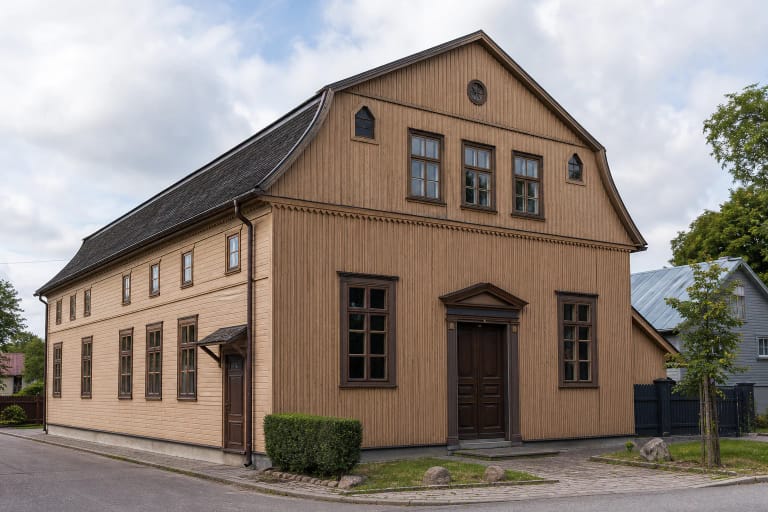
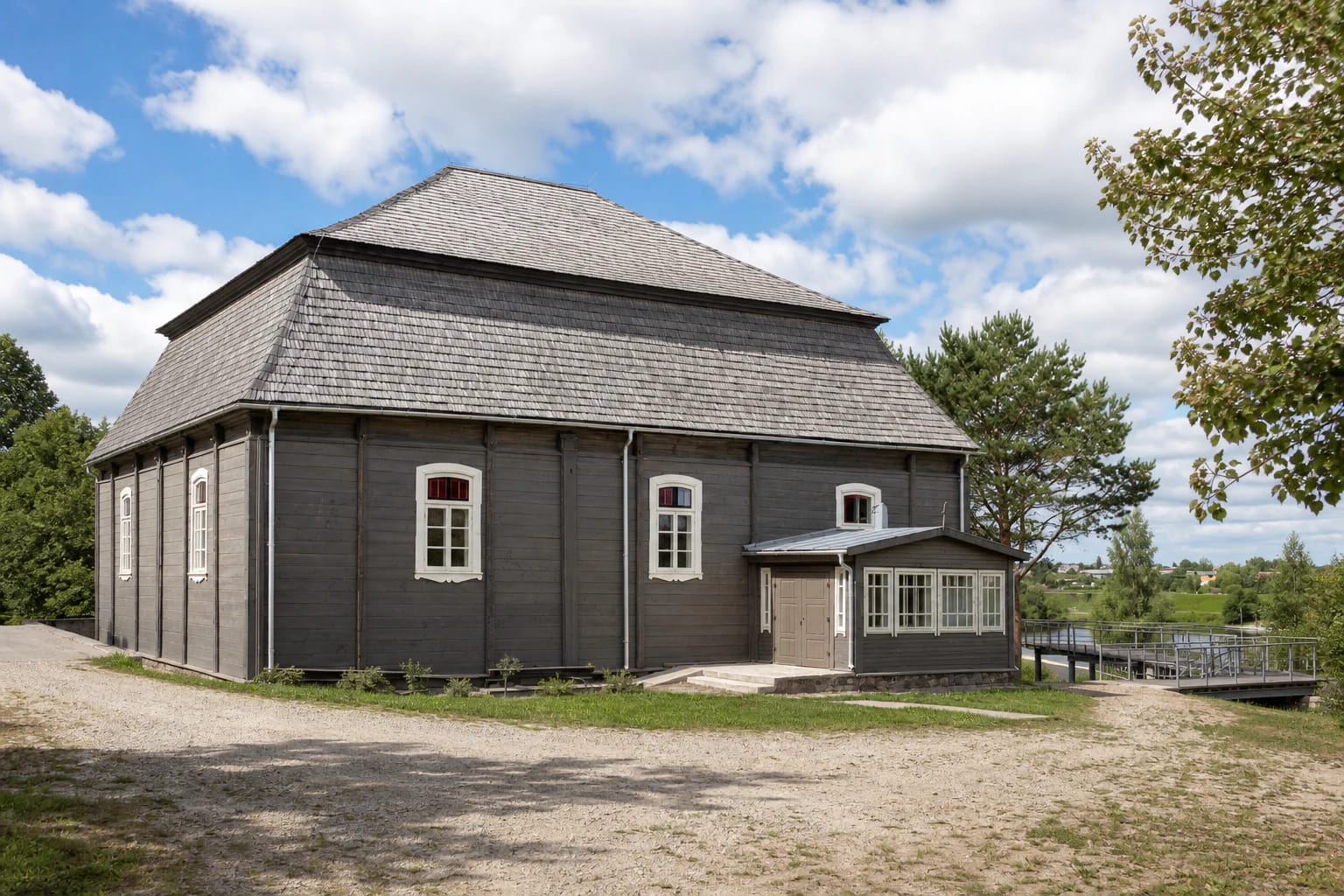
Pakruojis Synagogue stands at 8 Kranto Street, set back within its plot on the higher bank of the Kruoja River. It was the unheated summer synagogue; the heated winter synagogue that stood opposite has not survived. The present building was one of three prayer houses marked on a 1935 plan of Pakruojis and is the only surviving structure from that cluster.
The Lithuanian Register of Cultural Property dates the building to 1801. That date has a specific source: linguist Chackelis Lemchenas read it in an inscription on an interior door while researching the synagogue in 1938, and his notes together with Stasys Vaitkus's photographs became a basis for later study and reconstruction. Pakruojis Regional Museum, AUTC, and architectural research call it Lithuania's oldest surviving wooden synagogue. This is a precise comparison among surviving wooden synagogues, not a claim that every part of today's interior has remained unchanged since 1801.
Building form, women's gallery, and documented decoration
A very high two-tier hipped roof covers the compact rectangular single-storey log volume. Vertical bracing posts articulate the horizontal weatherboarding, while small segmental-headed windows are arranged at the levels of the prayer hall and the upper women's gallery. In the historic layout, a vestibule, stairs, and an ancillary room served the main men's prayer hall and a separately reached gallery; the reconstructed gallery space now holds an exhibition.
The 1938 documentation records a carved and painted three-tier Torah ark, an octagonal bimah with an openwork railing, and a painted timber vault. Photographs and descriptions show a stag, lion, tiger, eagle, elephant, camel, birds, trees, flowers, a table with books, a train, and Leviathan biting its tail above the bimah. These are listed as documented images without assigning new symbolic interpretations to them.
The chronology of the later decoration is not fully consistent across records. KVR lists repairs in 1885 and 1920, while architectural research based on Lemchenas's material associates the repainting with 1895. The original 1801 layer and the late nineteenth-century repainting should therefore not be collapsed into one phase; researchers themselves caution that photographs do not always allow the layers to be separated reliably.
The Jewish community of Pakruojis and the Holocaust
Jews settled in Pakruojis from the early eighteenth century. The Vilna Gaon Museum of Jewish History records 420 people in the Pakruojis kahal in 1765, 1,093 Jewish residents in the town in 1897, and 454 in 1923. Between the world wars, the community maintained a Hebrew school, libraries, a branch of the Jewish People's Bank, workshops, and businesses; the synagogue served prayer until 1941, and part of the building was also used as a school.
The Nazi occupation ended this life. According to the Vilna Gaon Museum of Jewish History, in July and August 1941 German soldiers, assisted by local collaborators, murdered about 400 Jews from Pakruojis rural district in nearby Morkakalnis Forest. The synagogue is not a neutral piece of picturesque antiquity: its interrupted religious use and present display are directly tied to the history of the local community that was destroyed.
Postwar destruction, the fire, and the 2017 restoration
The building stood unused from 1941 to 1954. After the war it housed a leisure club, cinema, and sports hall, while a 1954 conversion changed its plan: the painted vault was dismantled, the Torah ark and bimah were destroyed, some openings were blocked, and partitions, wall linings, and plaster were installed. The synagogue later suffered several fires; the 2009 fire severely worsened the condition of an already deteriorating building, which was conserved in 2010.
Preparatory research and planning for restoration began in 2004, and a virtual reconstruction based on the Lemchenas and Vaitkus documentation was produced in 2006. In 2011 Pakruojis District Municipality and the Lithuanian Jewish Community signed a 99-year building-use agreement. Conservation and restoration work began in 2015; removing postwar linings revealed authentic fragments of paper wall covering and several polychrome boards from the vault. The restored synagogue reopened to visitors on 19 May 2017.
The historic log volume and surviving finish fragments were conserved, but much of the visible interior is not an untouched prewar original. The paper wall covering was reproduced from surviving blue-patterned samples, and the vault painting was reconstructed from the 1938 black-and-white photographs and research material. The original Torah ark and bimah were destroyed in 1954. This distinction among surviving material, conservation, and documented reconstruction is central to understanding the present display.
Exhibition, visitor information, and the exact Maps card
The synagogue is now a branch of Pakruojis Regional Museum and a venue for cultural events. The former women's gallery contains a permanent Lithuanian- and English-language exhibition on the history and culture of the Jewish community of Pakruojis; the main hall hosts temporary exhibitions, concerts, meetings, and discussions. Temporary displays change, so check the museum's current programme for a specific visit.
On 2026-07-15, the museum's official visitor page listed the synagogue as closed on Mondays and open Tuesday-Sunday from 09:00 to 18:00, with a lunch break from 13:00 to 14:00; admission was listed as EUR 2. The Atgimimas, or Rebirth, educational programme was described as a 60-minute activity for visitors aged 7-16, for groups of 15-30, with a listed price of EUR 3. Recheck hours, prices, and educational bookings before travelling by calling +370 676 27181 or emailing sinagoga@pakruojomuziejus.lt.
The exact Google Maps card is named Pakruojo sinagoga. On 2026-07-15 it showed a rating of 4.8 out of 5, and its place ID was ChIJExSWrFgc5kYRtwtiMR22y4s. The card point at 55.9792042, 23.8499079 marks the synagogue building and site at 8 Kranto Street, so the coordinates are presented as a site point rather than an invented door-threshold position.