- Place
- Pakruojis, Pakruojis District Municipality
- Region
- Pakruojis District
- Type
- urban park in the Kruoja valley with wood sculpture, bridges, an island, and event spaces
- Address
- P. Mašioto Street approaches, Kruoja valley, Pakruojis
- Coordinates
- 55.98066, 23.84931
- Visit duration
- 45-90 minutes for the sculptures, river, and several bridges; longer during an event or with the synagogue and town centre
- Best time
- May for the sakura blossom, and a dry day from spring to autumn for sculptures and riverside paths
Pakruojis Park, Pakruojis City Park by the Kruoja
This is Pakruojis City Park, not the manor park
Pakruojis City Park occupies the Kruoja valley beside P. Mašioto and Kranto streets. The 2025 city master plan identifies it as Pakruojis's largest urban green space functioning as a separate public park and gives an area of about 140,000 square metres, or 14 hectares. Google coordinates 55.9806644, 23.8493124 mark a point inside the park, not a drive-in entrance or parking space.
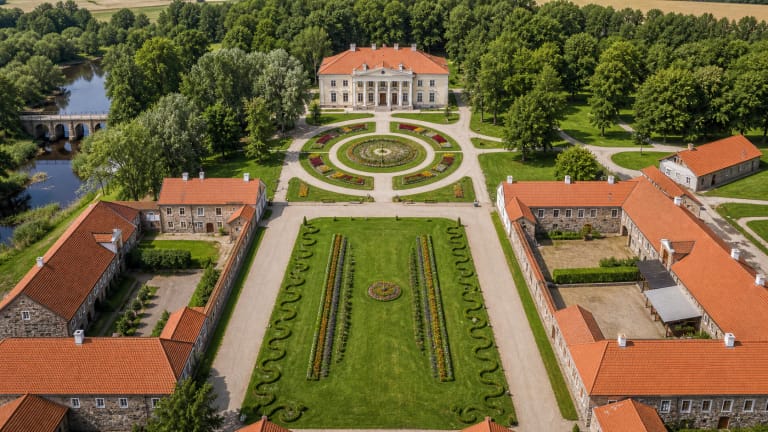
Pakruojis Manor park is a different attraction at 9 Karčiamos Street, roughly 1.9 kilometres east in a straight line. Its palace, formal planting, and large seasonal festival displays do not belong to the city park. When choosing Pakruojis Park in navigation, check that the pin sits in the Kruoja valley near the synagogue rather than on the manor grounds.
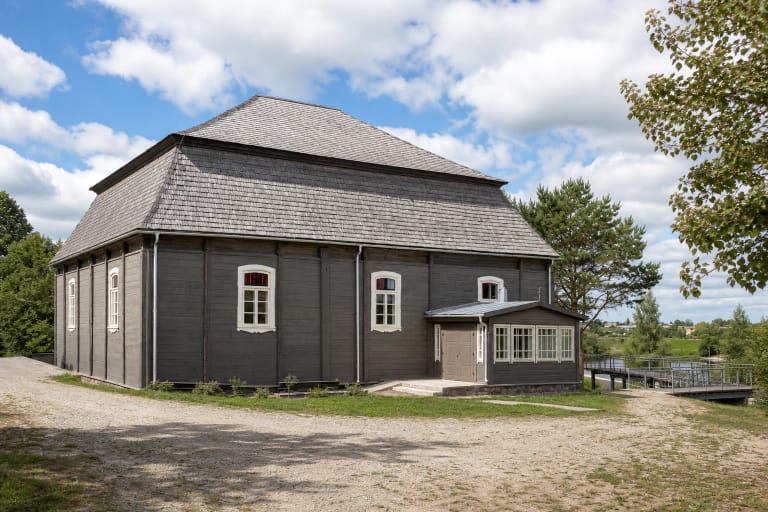
The city park spans both banks and links the older and newer parts of Pakruojis. Local visitor information describes three narrow suspension footbridges and two additional bridges. Conditions and temporary closures can change, so follow signs on site and treat the map point as an orientation marker, not a guarantee that every bridge is open.
A 1974 park gained a carvers' workshop and sakura grove
The chronology published by the local visitor centre dates the beginning of the city park to 1974. This was the creation of a public green space in the Kruoja valley rather than restoration of a manor garden. Mature trees, the river bend, and islands now soften much of its planned urban geometry.
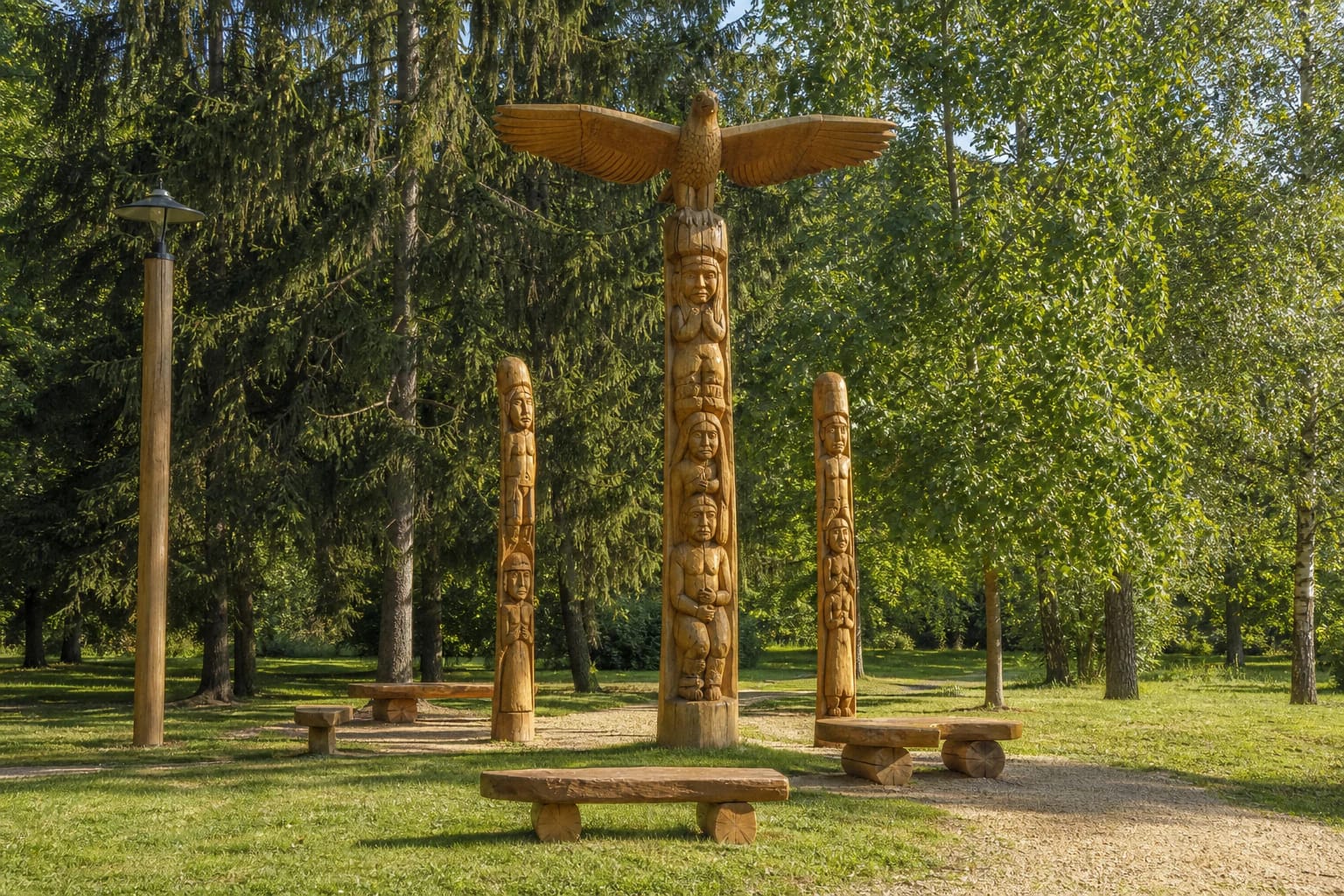
A national woodcarvers' workshop was held here in 1987, leaving an ensemble of tall figurative sculptures. In one striking group, human figures are carved into upright posts and a broad-winged bird crowns the tallest. These are works of public art, not ancient cult idols or archaeological remains.
Pakruojis Rotary planted the sakura grove in 2016. Blossom is usually expected in May, but the precise week depends on winter conditions, spring temperature, wind, and rain. Even after the petals fall, the sculptures, river valley, and bridges provide a complete route.
Sculptures, suspension footbridges, and the island shape the route
Begin with the wood sculptures, then continue towards the river. Pause to study the layered carving, bird and human motifs before choosing a bridge. Authors and titles are not consistently published for every 1987 work, so individual sculptures should not be attributed by guesswork.
The suspension structures are narrow pedestrian crossings, not large urban bridges. They may move slightly under footsteps. Avoid crowding, yield to people coming the other way, supervise children, and follow local signs when cycling. Approaches and Kruoja slopes can be slippery after rain.
The river island and its approaches host events. The improvement project added spectator places, a stage, steps, viewpoint, lighting, and park furnishings. This does not imply a daily stage programme; check municipal or cultural-centre announcements for midsummer celebrations, town festivals, and temporary access changes.
Work in 2018-2024 renewed both art and riverbanks
The 2018-2023 improvement project cost €643,315.59. It renewed Kruoja banks, park and island approaches, pedestrian bridges, paths, lighting, CCTV, park furnishings, event areas, and viewpoints. Right-bank paths were adapted for disabled visitors.
In 2024, the municipality funded restoration of the wooden sculptures, park house, and pavilion beside the stage. Folk artists Jonas Dzvėga and Eugenijus Rimdžius carried out the work. Restoration helps preserve the ensemble but does not make the sculptures new 2024 creations; their principal historical layer remains the 1987 workshop.
Outdoor wood remains exposed to sun, moisture, and frost. Do not climb the figures, sit on their bases, or let children hang from wings and projecting details. A sculpture may be temporarily fenced after a storm or during maintenance.
Access is free, but not every route is equally step-free
The municipality publishes no standard park ticket or gate hours. Google labels the park open 24 hours, although sculptures, riverbanks, and bridges are safer in daylight. The city plan classifies it as a quiet nature zone with a 55 dBA night-time limit from 10 pm to 6 am, so open access is not permission for late-night noise.
The improved right-bank paths were officially adapted for disabled visitors, and Google marks an accessible entrance and parking. Across 14 hectares, however, surfaces, steps, slopes, and narrow suspension bridges vary. Wheelchair users should favour the renewed right-bank route rather than assume every crossing and island approach is step-free.
The park map point is not a vehicle entrance. Approach from P. Mašioto or Kranto Street, use only marked public parking, and keep cars off internal pedestrian paths. Google allows dogs, but leads, waste removal, local signs, and stricter event conditions still apply.