- Place
- Pakruojis District Municipality
- Region
- Pakruojis District
- Type
- late Classicist manor estate, park, and living-history site
- Address
- Karčiamos g. 9, LT-83166 Pakruojis
- Coordinates
- 55.98599, 23.87954
The largest manor estate in Lithuania
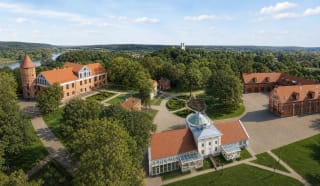
Pakruojis Manor Estate is presented as the largest surviving manor-building complex in Lithuania, entered in the Lithuanian record book as the largest protected manor estate. Sources give different building counts: official manor history and tourism material mention about 47 structures, while VLE says that 26 buildings from the late eighteenth- and nineteenth-century manor estate form four sectors: representative, two farm, and production.
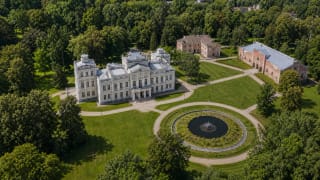
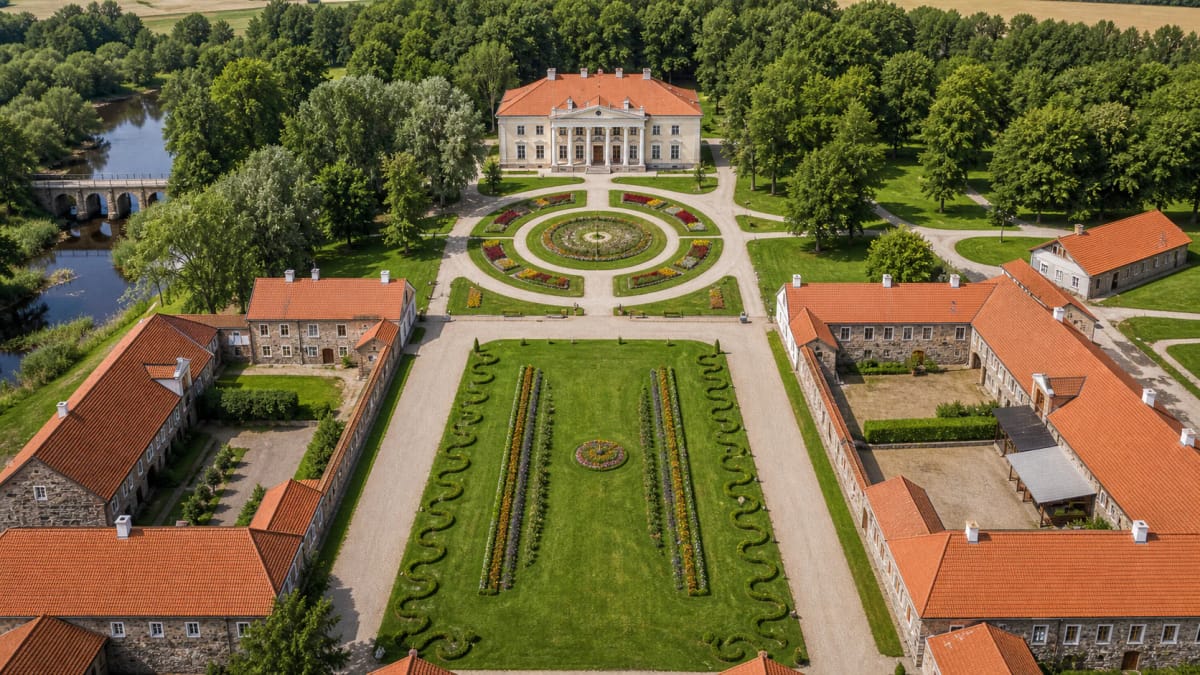
This is not just a palace facade. Pakruojis is strong as an ensemble: palace, farm wings, red-roofed stone buildings, park, the Kruoja river zone, arched bridge-dam, and the manor experiences created here today.
From Vakavičius to the von Ropps
Official manor history states that Pakruojis manor site was first mentioned in written sources in 1531, when it belonged to Martynas Vakavičius, steward of Rietavas. VLE gives the precise date of July 30, 1531, when the Pakruojis manor and town being established on peasant lands in Upytė County were mentioned.
Owners later changed until 1778, when the manor passed to the barons von Ropp. The von Ropp period saw Pakruojis Manor grow strongly, and the rule of Theodor von Ropp is associated with its flourishing.
Late Classicist palace
According to official history, the masonry palace ensemble was built in 1817-1840 from local materials, and the manor continued expanding until 1890. Construction was begun by Wilhelm von Ropp, and later buildings were designed and built by Theodor von Ropp. VLE dates the palace to the early nineteenth century and notes restorations in 1959, 1968, and 2013.
The main accent is the two-storey palace with a portico, Doric columns, pilasters, arches, and vases at balcony corners. The interior plan was enfilade, with an oval hall and Ionic colonnade at the centre.
VLE gives a detailed ensemble description: the late eighteenth- and nineteenth-century manor estate is one of Lithuania's largest, and its buildings form four sectors. Dated structures include the office building of 1818, water and wind mills of 1823, bridge-dam of 1821 restored in 2001, fence with gates of 1840, and miller's house of 1836.
Estate economy, crafts, and park
Pakruojis Manor functioned as a large economic organism. Tourism-centre data mention a brewery, sawmill, mill, and dairy. Official history also mentions stables, icehouse, brewery, dairy, pigsties, granaries, smithy, inn, and wind and water mills.
A large English-style park was established in 1835-1840. VLE dates the landscape park to 1850-1860 and notes that in 1975 it was arranged according to architect R. Paslaitienė's project. Today the park and formal flower beds create one of the strongest first impressions for visitors.
The arched Kruoja bridge
One of Pakruojis Manor's strongest features is the arched bridge-dam across the Kruoja. The official manor page presents it as a late Classicist hydrotechnical structure reminiscent of an ancient Roman aqueduct.
The bridge history includes the year 1821, local dolomite, a length of 33 m, width of 4.8 m, and height of 5 m. It was restored in 2001, so it is worth including even if you arrive mainly for the palace or festival.
A living manor experience
Today Pakruojis Manor works as a historical-reconstruction and entertainment site. The official website offers tours, educational activities, tastings, accommodation, a restaurant, events, and seasonal festivals.
The programmes emphasize theatrical education: traditional crafts, wax-candle casting, manor farm work, sheep shearing, wool felting, and stories by the smith, miller, manor housekeeper, and baron. This matters when planning time, because the visit depends on the programme chosen.
How to visit Pakruojis Manor
The official visitor address is Karčiamos g. 9, Pakruojis. Allow more time than for a typical manor stop: the territory is large, and distances between palace, service buildings, park, and Kruoja bridge add up quickly.
For a short walk and palace axis, about 2 hours may be enough, but with a tour, educational activity, tasting, festival, or meal, plan half a day. Check the official website before travelling, because events, tickets, and access to particular spaces change by season.