- Place
- Padaliai, Kaišiadorys District / Čiobiškis, Širvintos District
- Region
- Aukštaitija
- Type
- seasonal current-powered cable ferry for pedestrians, bicycles, and accepted passenger cars
- Address
- Padaliai village, Žasliai eldership / Laisvės Street, Čiobiškis
- Coordinates
- 54.94841, 24.67516
- Visit duration
- 10-20 minutes for a crossing without a queue; allow 30-45 minutes for waiting and a brief stop on both banks
- Best time
- May to October, with a stable river level and same-day telephone confirmation that the ferry is running
Čiobiškis-Padaliai Ferry, Padaliai Ferry, Čiobiškis Ferry, Padaliai (Čiobiškis) Ferry, Neris Ferry at Čiobiškis
One ferry has two names and two approach banks
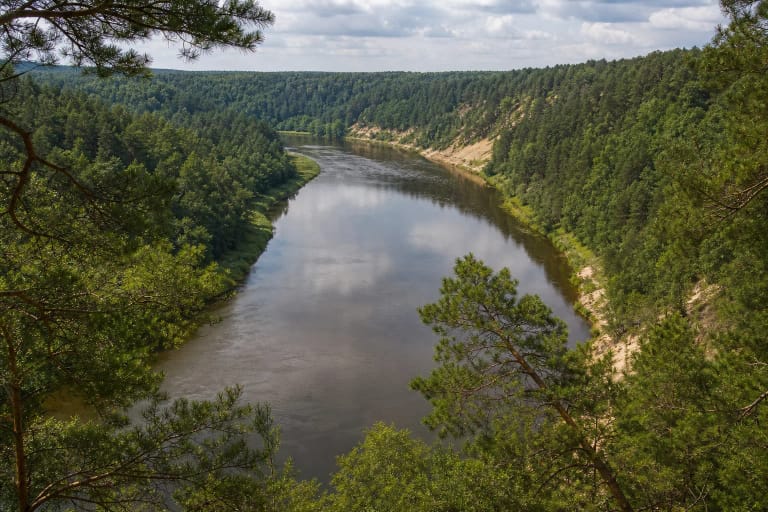
On the Kaišiadorys side, people call it the Padaliai Ferry; on the Širvintos side, it is the Čiobiškis Ferry. Both names describe the same route across the Neris between Padaliai village in Žasliai eldership and the edge of Čiobiškis. This is not a sightseeing cruise returning to its starting point, but a functioning road connection: board on one bank and disembark in another district.
The coordinate marks the north-eastern boarding ramp on the Čiobiškis side, at the continuation of Laisvės Street. The opposite terminal is in Padaliai. Routing applications can represent the ferry as a permanent road segment even though it disappears in winter and may stop for water or maintenance conditions, so never rely on a map alone.
Municipal pages describe the ferry as a Lithuanian engineering monument and the country's only surviving crossing of its kind. No direct standalone entry for it was found in the Cultural Heritage Register, so this page does not invent a register code. Its clearest heritage value lies in a traditional technology that still works and in a ferryman's craft passed through generations.
The cable restrains, the rudders set the angle, and the Neris supplies the power
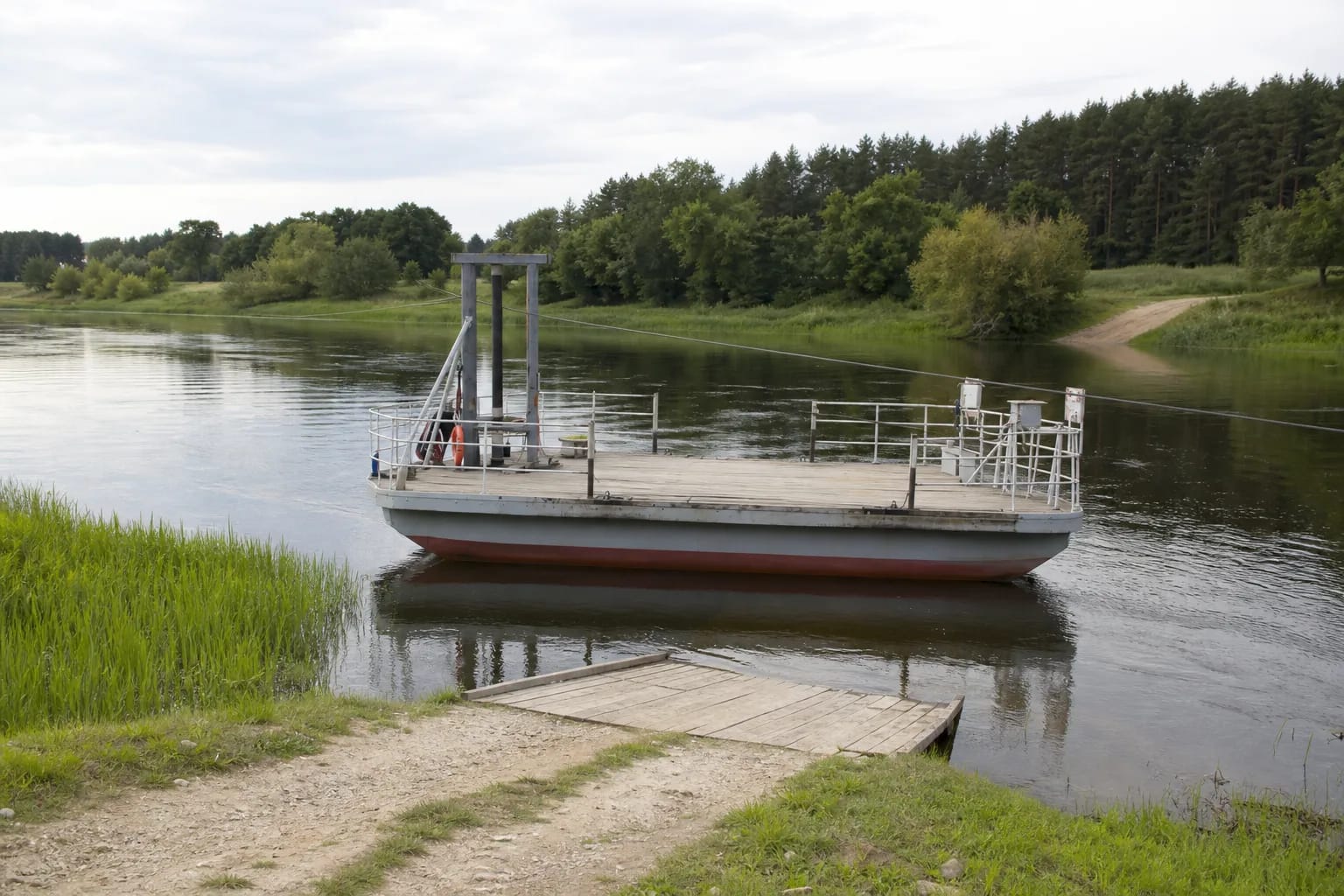
The ferry has no engine and is not hauled across by a shore rope. A steel cable stretched over the Neris, historically called a kardelis, touches a roller in the tall frame and prevents the platform from being swept downstream. The ferryman uses two rudders to turn the hulls at an angle to the flow. Water pressure against the pontoons then pushes the vessel towards the selected bank; reversing that angle reverses the direction of travel.
A scholarly expedition volume documented a 7.55 by 9.2 metre timber deck on two metal hulls in 2014, with one-metre rails and 3.9-metre openings for vehicles. Those dimensions explain its raft-like appearance, but they are not permission to load any vehicle today. Landing ramps, river level, weight distribution, and the ferryman's decision can impose tighter limits than theoretical deck area.
In favourable conditions, the crossing itself commonly takes about five minutes. Flow, river level, wind, and even vegetation accumulating on the hull can alter the speed, so a slower passage is not necessarily a fault. There is no minute-by-minute timetable; the ferry responds to passengers and safe operating conditions.
The record from 1784 is not the manufacture date of today's vessel
A topographical description of Čiobiškis parish already recorded a Padaliai ferry built on two large boats in 1784. Roads converged here from Vilnius, Kernavė, Musninkai, and Ukmergė on the right bank, and from Kaunas, Gegužinė, Žasliai, and Paparčiai on the left. This proves a long-lived crossing place, not an eighteenth-century date for today's metal and timber structure.
Construction of a timber bridge at Čiobiškis began in 1912. An archive-based Neris expedition study says retreating Russian troops destroyed it at the outbreak of the First World War, German forces rebuilt it, and it then decayed after the war. When the permanent link had again vanished, Padaliai residents Jurgis Dzeventauskas and Andrius Raudeliūnas commissioned a ferry around 1935, beginning the current family service's historical line.
A document from 1935 gives the ferry's capacity at that time as three tonnes or forty people. That is evidence about the historic vessel, not a present operating rule. It also confirms that the ferry was everyday transport infrastructure rather than merely a curiosity for visitors.
Wartime and post-war sources do not tell quite the same story
A Kaišiadorys Museum heritage guide says Soviet soldiers pursuing partisans blew up the ferry after the war. The archive-based Neris monograph gives a different sequence: Red Army engineers rebuilt the Čiobiškis bridge in autumn 1944, a ferry damaged by grenade holes lay unused on shore, and the flood of 1946 swept it away. Both accounts describe the old vessel as damaged and lost, but their details should not be merged into one certain narrative.
The crossing returned in 1956, after Jurgis Dzeventauskas persuaded the Neris collective farm to restore a ferry. The present structure was brought from Petrašiūnai around 1976, and the Dzeventauskas family acquired it around 1992. Its continuity therefore resides in the site, the reaction-ferry principle, and the work handed down in the family, not in an unchanged hull from 1935.
In 2026, a Kaišiadorys District Municipality page described Gediminas Dzeventauskas as a third-generation ferryman and a master of national heritage. This remains working transport, used by local residents, cyclists, motorists, and travellers following Neris valley routes.
A photograph cannot decide whether your vehicle is acceptable
The current Širvintos municipality description says the ferry can carry a larger group of people and one or two cars. In an earlier interview, the ferryman identified 3.5 tonnes as the practical limit imposed by the landing ramp, even though the vessel itself could bear more. Neither figure is permission for a camper van, minibus, lorry, or heavy trailer. Call first and give the vehicle's total mass, length, and height.
On arrival, stop before the ramp and wait for the ferryman's signal. Do not drive aboard independently, position a car or bicycle for a better photograph, or alter the instructed load distribution. Follow on-site instructions about the engine, parking brake, and whether passengers remain inside or step out. Keep children and animals close, and stay clear of the tensioned cable and moving roller.
No dependable audit of wheelchair accessibility was found. Approach gradients, joins in the timber ramps, and gaps change with the river level, so vehicle access does not by itself make this an independently step-free route. Discuss assistance needs by telephone before setting out.
Confirm the season, 08:00-20:00 hours, and fares on the day
Official municipality descriptions give the normal season as May to early November. On 18 July 2026, a public visitor listing showed daily operating hours of 08:00-20:00 during the warm season. Ice movement, unusually high or low water, storms, maintenance, and ferryman availability can still interrupt a summer day, so call +370 610 42112 before making a special detour.
The fares publicly displayed that day were EUR 2 for a pedestrian, EUR 3 for a cyclist, EUR 3.50 for a motorcycle, and EUR 5 for a passenger car including its occupants. Prices and payment methods can change, so confirm both by telephone and do not arrive after hours assuming the ferry will necessarily be launched. A website printed in older publications no longer contained ferry information in 2026 and is deliberately omitted here as a current source.
Do not plan a tight connection, booking, or event start on the opposite bank. Beyond the roughly five-minute voyage, you may wait for the ferry to return, for safe loading, or for the ramp to clear. If it is not operating, crossing the Neris requires a bridge and a substantially longer road route.