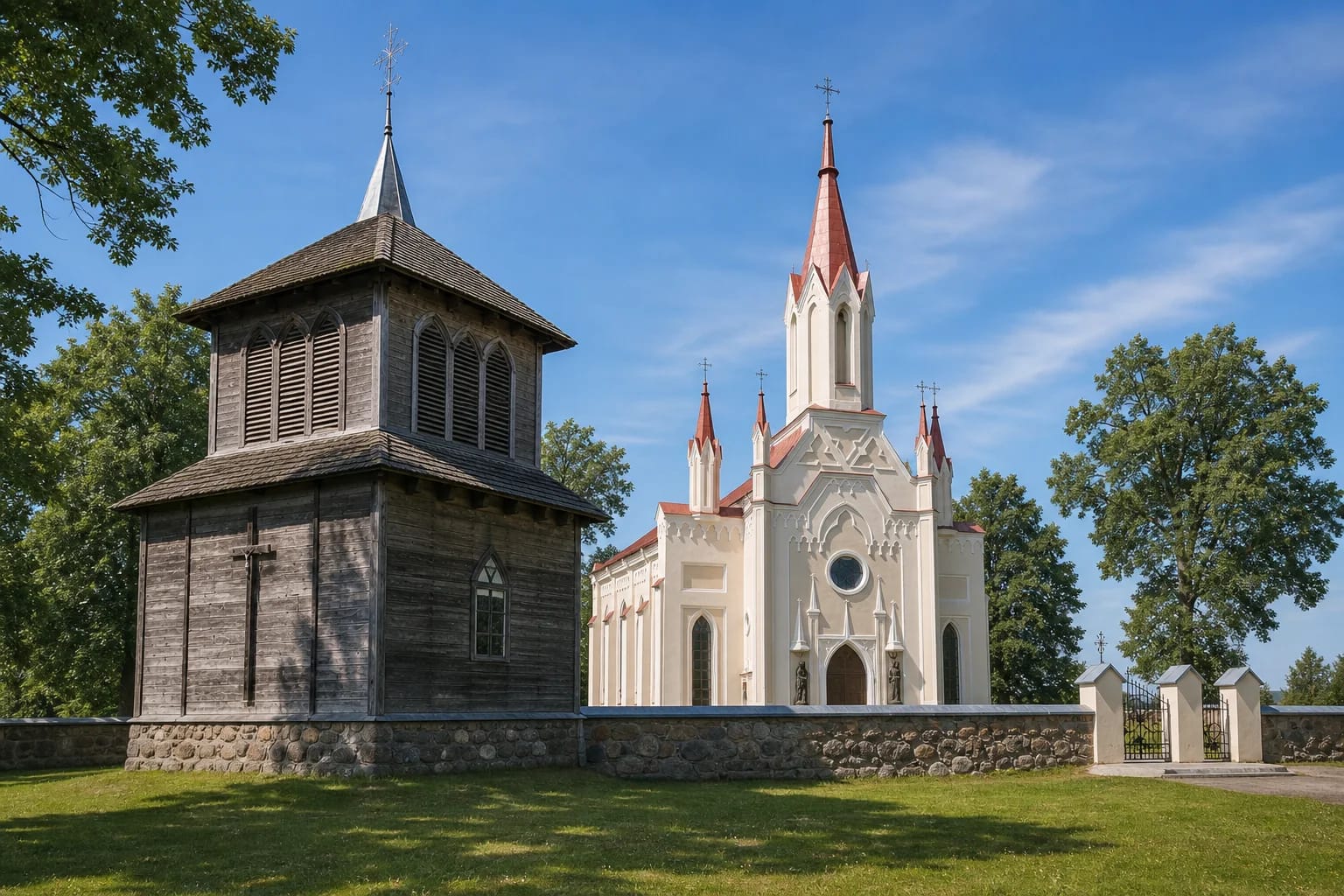
- Place
- Musninkai Eldership, Širvintos District Municipality
- Region
- Aukštaitija
- Type
- an active Catholic church and detached timber belfry within a registered sacred-architecture complex
- Address
- 3 Vilniaus Street, Musninkai, Širvintos District
- Coordinates
- 54.94920, 24.84119
- Visit duration
- 30-45 minutes for the church, belfry, churchyard, and Alfonsas Petrulis's grave from outside; about 60 minutes if interior access is arranged
- Best time
- in daylight; for the church interior, before an officially advertised service or by prior arrangement, with additional allowance for the 2026-2027 road reconstruction in the town centre
Musninkai Holy Trinity Church, Musninkai Church of the Holy Trinity complex, Musninkai wooden belfry, Musninkų Švč. Trejybės bažnyčia ir varpinė
Neo-Gothic design, folk building, and four registered components share one churchyard
The Musninkai Church of the Holy Trinity complex stands at 3 Vilniaus Street in the centre of the small town. A 2026 heritage decision identifies four components: the church, the churchyard wall and gates, the belfry, and the rectory. The coordinate on this page marks the principal church within the complex rather than a car park, a single official gate, or the belfry door.
The most revealing view places the two principal buildings side by side. The pale masonry church rises into a sharp tower, while the detached grey-brown belfry is low, broad, and built of timber. This contrast in material, proportion, and design language between professional Neo-Gothic architecture and vernacular carpentry makes the site more rewarding than a quick look at one façade.
The Chapel of St Barbara often appears in the same descriptions of Musninkai, but it is not part of this complex at 3 Vilniaus Street. The eighteenth-century masonry chapel stands separately on Čiobiškio Street, beyond the town centre. Treat its story about Barbara Radziwiłł as a different stop rather than searching for it inside the churchyard.
The church reaches upward while the timber belfry holds a massive silhouette
The present church has a rectangular plan, a square presbytery, two sacristies, and one tall tower over the main façade. A pointed portal, round window, corner turrets, stepped mouldings, and muted-red metal spires articulate the front. Inside, four pairs of columns divide three naves, so the restrained outer volume opens into a broader vaulted space.
The belfry of 1868 is square and two-stage, with a cellar and attic. Its broad lower stage is made from horizontal hewn logs on a fieldstone foundation, joined at the corners with dovetails. A wide shingled skirt separates the stages; the narrower upper level has groups of three pointed sound openings screened by horizontal timber louvers.
A four-sided shingle roof, small octagonal turret, and an ornate iron cross made in 1868 complete the belfry. The fieldstone churchyard wall incorporates fourteen small Stations of the Cross chapels dated to 1882. They are best understood by walking the perimeter rather than stopping only at the main gate.
Three dates for the present church describe three stages, not a contradiction
A church existed in Musninkai by 1522. It belonged to the Reformed community from 1554 until the middle of the 1610s, and Stanislovas Kiška, lord of Musninkai after returning to Catholicism, built a new timber church in 1614. These were earlier sanctuaries, so their dates must not be assigned to the masonry building seen today.
The dates 1855, 1861, and 1865 all describe the present church accurately at different stages. Father Ignacas Narkevičius began the masonry building in 1855; Mykolas Podbereskis, whose surname also appears as Podberskis, and the parishioners completed construction in 1861; the church was consecrated on 21 March 1865.
Art-historical research based on parish inventories reveals an unusual material continuity. The earlier timber church remained in use during construction, until 1865, then stood unused for roughly three years. It was dismantled around 1868 and its wood was reused in the present belfry. The belfry is therefore not a copy of the old church, but it carries part of that building's physical fabric.
Older altars and a 1901 painting add layers that the façade cannot show
VLE singles out the surviving timber Neo-Baroque altars, dated from the first half of the eighteenth century to the first half of the nineteenth. They are chronologically older than the present masonry church. Other works to notice include a nineteenth-century Assumption of the Virgin Mary and a mid-nineteenth-century carved Neo-Baroque Crucifix.
The stained-glass Coronation of the Virgin Mary, dated 1933, belongs to the church's interwar layer. These works are not the decoration of one unified building campaign. Together they let visitors read several centuries of accumulated art within one nineteenth-century sanctuary.
A 2022 art-history study examined a portrait of St Ignatius of Loyola bought in 1901 with funds from parish priest Juozapas Šimkūnas and the Kosinski family for the upper stage of the Rosary altar. The researcher leaves open whether it occupied that intended position for long, so the intriguing record should not be turned into an overly certain present-day display plan.
Alfonsas Petrulis's grave and a 2026 decision change how the register is read
Priest Alfonsas Petrulis, one of the twenty signatories of Lithuania's Act of Independence of 16 February 1918, was buried in the churchyard in 1928. His grave is a specific burial and memorial place within the grounds, not merely the similarly named public space nearby, and should be approached with cemetery etiquette.
On 30 June 2026, the heritage evaluation council decided to change Petrulis's grave, register code 22253, from a component of the church complex to an independent cultural heritage object. The same decision refined the valuable features of the complex and its components and reduced the registered boundary. This was a legal-record change, not the physical removal of the grave from the churchyard.
The council also removed separate legal protection from the Ornamented Cross, formerly code 14055, because the cross became a valuable feature of the belfry itself. The cross was not taken away; its registration logic changed. A municipal guide also records the Podbereskis family tomb beneath the belfry, so the building should never be treated as an empty tower open to unsupervised exploration.
A visit follows parish life and, in 2026-2027, major roadworks
This is an active parish in the Diocese of Kaišiadorys. On 19 July 2026, the official parish page listed Sunday Mass at 11:00, although feast days, funerals, and pastoral circumstances can change the timetable. No separate tourist ticket, daily interior opening hours, or regular exhibition schedule for the belfry is advertised; contact the parish before travelling if a quiet interior visit matters to you.
The belfry has hosted exhibitions and local community events, but that does not mean its doors will be open without an arrangement. Allow 30-45 minutes for the two exteriors, wall chapels, churchyard, and Petrulis's grave. During worship, do not interrupt the liturgy or photograph people without consent, and never attempt to enter or climb the belfry independently.
More than 1.3 km of the central Vilniaus, Širvintų, and Kernavės streets has been under reconstruction since 2026, with completion planned by summer 2027. Traffic can be restricted and signal-controlled, and no dedicated official visitor car park was confirmed beside the complex. Park only where temporary signs permit, leave the gates and rectory access clear, and discuss mobility needs with the parish because historic thresholds and changing work zones can affect step-free access.