- Place
- Čiobiškis, Širvintos District Municipality
- Region
- Aukštaitija
- Type
- late Classicist manor estate by the Neris and Musė confluence
- Address
- Vilties g. 1, Čiobiškis, Širvintos District
- Coordinates
- 54.95245, 24.65489
Čiobiškis manor estate, Czabiszki (historic Polish name)
Čiobiškis Manor by the Neris and Musė confluence
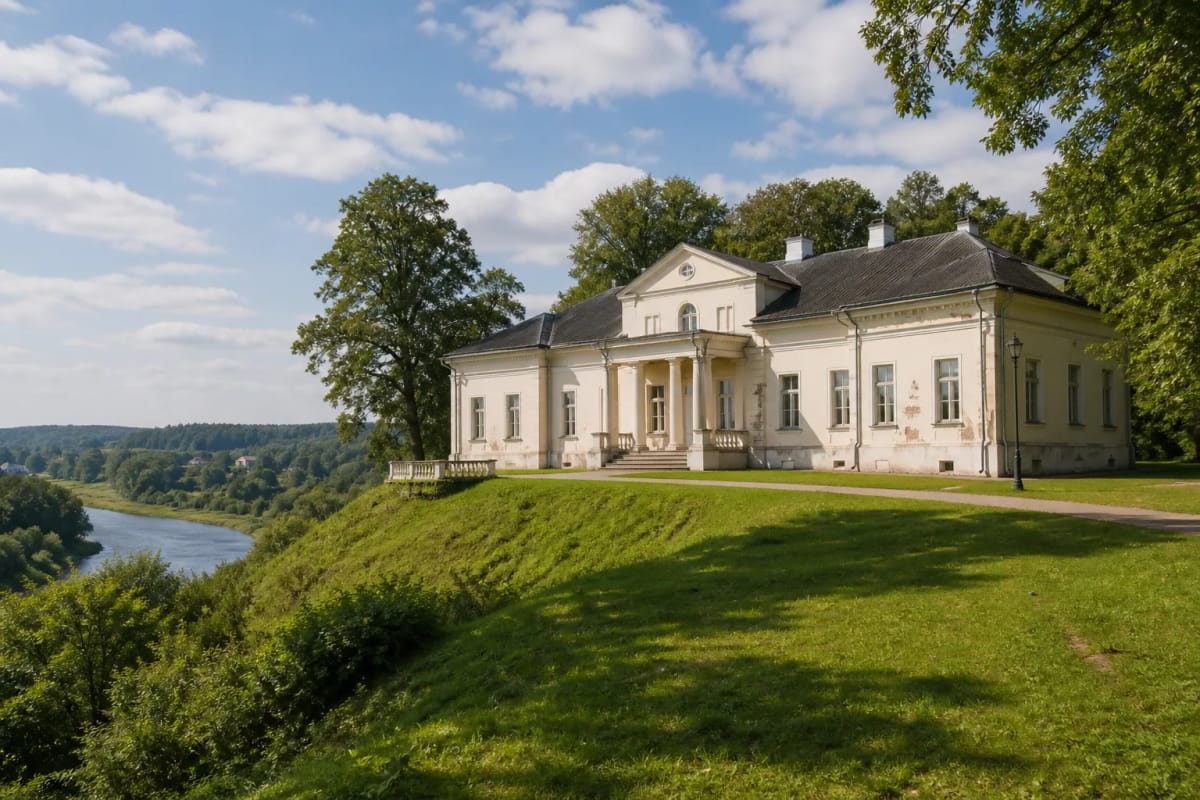
Čiobiškis Manor is in Širvintos District, in Čiobiškis town, on a high bluff by the confluence of the Neris and Musė rivers. The place is striking in itself: the palace rises above the two-river valley, so the manor is visible from afar and opens a broad view over a bend of the Neris.
Čiobiškis was important from early times. VLE notes that in the sixteenth century it was a trading town with Magdeburg rights, standing on water and land routes connecting Jonava, Kaunas, Kernavė, and Vilnius. This trading past helps explain the development of a large manor holding here.
The Piłsudski family and Classicist palace
The earlier manor was wooden and associated with the Radziwiłłs and Švikovskiai. In 1794 Čiobiškis was acquired by the Piłsudski family, who owned it until the early twentieth century. They built the surviving masonry late Classicist palace. VLE and architectural studies date the whole estate to the late eighteenth and early nineteenth centuries, while the palace itself was probably built in the early nineteenth century; 1794 is best understood as the acquisition date, not the building date.
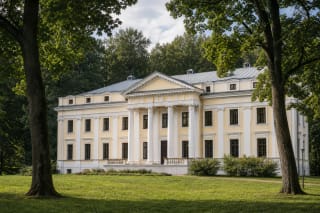
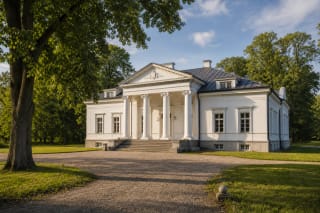
The palace is single-storey, with a mezzanine and porticoes. The raised central part has a portico with triangular pediment, while the east facade has a second-floor balcony. The interior was heavily altered in the twentieth century, so today the palace is valued mainly for its Classicist massing and facade composition in a dramatic confluence setting.
Did Gucevičius design it?
A popular assumption says the Čiobiškis palace may have been designed by Laurynas Stuoka-Gucevičius, a key figure of Lithuanian Classicism. This must be treated carefully: sources present it only as a supposition, using words such as 'it is thought', and the authorship remains unknown.
The chronology also complicates the claim. Gucevičius died in 1798, while the palace was probably built in the early nineteenth century. Direct authorship is therefore unlikely; the link is best treated as a local tradition rather than historical fact. Reliable Gucevičius works include Vilnius Cathedral and Verkiai Manor.
Children's shelter, partisans, and school
In the twentieth century the manor served several functions. In 1923 a children's shelter with a primary school opened here. In 1945 one headquarters of a Didžioji Kova district partisan unit operated in the manor, led by Jonas Misiūnas-Žalias Velnias, placing Čiobiškis within Lithuania's armed resistance history.
After the war the palace housed children's homes, a boarding school, and later a special school; care and educational institutions operated here for about nine decades. This helped preserve the building, although interiors were adapted to new uses.
Čiobiškis church and surroundings
Next to the manor stands Čiobiškis Church of St John the Baptist, built in 1810-1825. The Classicist church contains early nineteenth-century images of the apostles that, according to VLE, were painted by pupils of the Vilnius drawing school; late eighteenth-century bells hang in the towers. It is easy to view the church together with the manor.
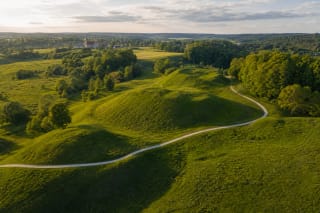
Nearby in a pine forest lies the Čiobiškis burial-mound cemetery, another protected regional value. The manor and church are freely viewed from outside; the core of Čiobiškis usually takes 30-45 minutes and fits well into a broader Neris valley route with Kernavė.