- Place
- Kernavė, Širvintos District Municipality
- Region
- Kernavė Cultural Reserve
- Type
- UNESCO archaeological landscape
- Address
- Kernius 4A, Kernavė, Širvintos district
- Coordinates
- 54.87860, 24.85640
State Kernavė Cultural Reserve, Kernavė hillforts, Pajauta Valley
More Than a Beautiful Panorama
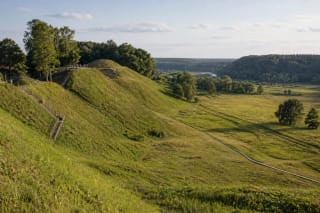
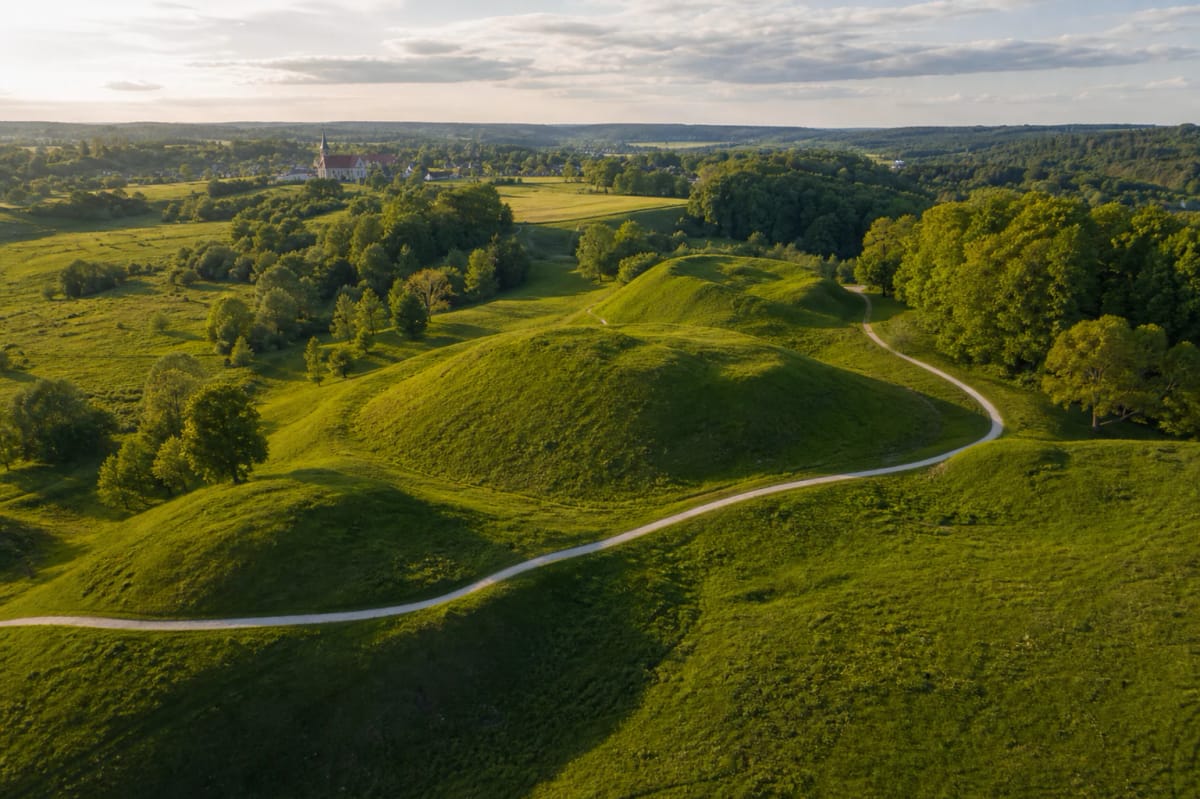
Kernavė is often remembered through its view: green hillforts, wide Pajauta Valley, the nearby Neris, and paths between hills. But its value is not only photogenic. It is one of Lithuania's clearest archaeological landscapes, where natural relief, defence, and urban traces overlap.
UNESCO and the reserve describe Kernavė as a cultural landscape testifying to a long development of Baltic-region settlements. The whole site matters: the five-hillfort system, the medieval town space in Pajauta Valley, burial grounds, old settlement layers, and the Neris valley relief.
UNESCO Value and Five Hillforts
Kernavė Archaeological Site was inscribed on the UNESCO World Heritage List in 2004. The reserve states that it was recognized under criteria iii and iv, as an exceptional testimony to settlement development in the Baltic region and an important example of pre-Christian settlements and hillfort development.
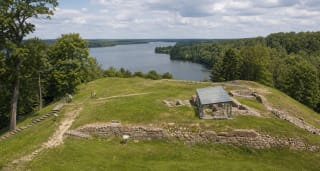
VLE names five hillforts: Aukuro Hill (also called Barščiai or Holy Hill), Mindaugo Sostas, Lizdeika Hill or Smailiakalnis, Pilies Hill, and the more distant Kriveikiškis Hillfort. Aukuro Hill is associated by researchers with the duke's residence, while Mindaugo Sostas and Lizdeika Hill protected it from the north and east.
Research shows how the system worked. On Aukuro Hill, archaeologists found a cultural layer up to 2.6 m thick, dated from the first century BC to the fourteenth century, with imported glass vessels from the Middle East, glass bracelets, and a bronze sword-pommel. Mindaugo Sostas was abandoned after the 1390 fire, and Pilies Hill, the craftsmen's and merchants' outer settlement, yielded a hoard of Lithuanian long coins.
Layers of History
The reserve writes that traces of life around Kernavė reach the Late Palaeolithic and show about 11,000 years of settlement development. VLE likewise notes ancient settlements from the ninth-seventh millennium BC.
Kernavė is first mentioned in written sources in 1279 in the Livonian Chronicle. In the thirteenth-fourteenth centuries it was one of the main political, economic, and defensive centres of the emerging Lithuanian state.
The Medieval Town in Pajauta Valley
Kernavė's strength is that the old town was not built over by a modern city. The reserve and VLE state that a merchants' and craftspeople's town stretched at the foot of the hillforts, in Pajauta Valley and on the upper Neris terrace.
The town included streets, fords, marketplaces, and urban plots of about 8-10 ares. VLE notes that Kernavė merchants appear in Riga debt books in 1290 and 1303, and that about 500 people may have lived here in the fourteenth century. VLE mentions the castle complex burned by crusaders in 1365 and, in 1390, burned by the defenders themselves during retreat. After that, the old valley town gradually emptied and the Neris alluvium covered its traces.
How to Visit Respectfully
Kernavė is a reserve, so use paths and stairs, do not climb slopes in unprepared places, and avoid causing erosion. Official rules prohibit damaging cultural heritage, polluting the environment, driving outside designated places, making excessive noise, camping, or lighting fires in undesignated places.
A practical route is simple: start at the museum or information centre, move to the hillfort panorama, descend to Pajauta Valley paths, and leave time to stop. For deeper understanding, use a guide or museum exhibition before walking.
In the warm season, from April to October, an open-air reconstructed fragment of the thirteenth- to fourteenth-century Kernavė town operates by the museum. The best-known annual event is the July Days of Living Archaeology, one of the largest experimental archaeology festivals in the Baltic region, and archaeological research has taken place here every year since 1979.