- Place
- Marcinkonys, Marcinkonys eldership, Varėna District Municipality
- Region
- Dzūkija
- Type
- a state-protected botanical natural heritage site in Dzūkija National Park
- Address
- compartment 127, plot 29 of Marcinkonys Forest District, Marcinkonys eldership, Varėna District
- Coordinates
- 54.07241, 24.38842
- Visit duration
- 10-25 minutes to view the tree safely from the roadside; longer only when combining it with routes around Marcinkonys
- Best time
- in calm, dry daylight; do not approach the dead tree or stand beneath its crown in strong winds
Drevėta pušis - Varėnos MU, Marcinkonių g-ja (127 kv., 29 skl.), Drevėta pušis, Hollow Pine of Forest Compartment 127
Compartment 127 and plot 29 distinguish this pine from every namesake
The complete Saugoma.lt name is Drevėta pušis - Varėnos MU, Marcinkonių g-ja (127 kv., 29 skl.). Its abbreviations identify the former forest enterprise, the forest district, the compartment, and the plot. This is an administrative identifier, not a conventional street address. VSTT's current list for Varėna District records the tree among botanical natural heritage sites under the same compartment 127 and plot 29 name.
The exact Google Maps listing titled Drevėta pušis, place ID ChIJlQhYWmMZ3kYRFQ7ljR-cDzg, marks 54.072407, 24.388423. Saugoma.lt publishes the rounded point 54.072, 24.388, only a few dozen metres away. On 15 July 2026, the Google average was exactly 4.5 out of 5 from two reviews. It meets the threshold, but a sample of two is extremely small and can change quickly.
Searching only for Drevėta pušis is not enough. Google shows other places with the same generic name around Marcinkonys, and VSTT lists many different hollow pines distinguished by their forest compartments and plots. The score, coordinates, and photograph on this page apply solely to the tree in compartment 127, plot 29 and must not be transferred to another namesake.
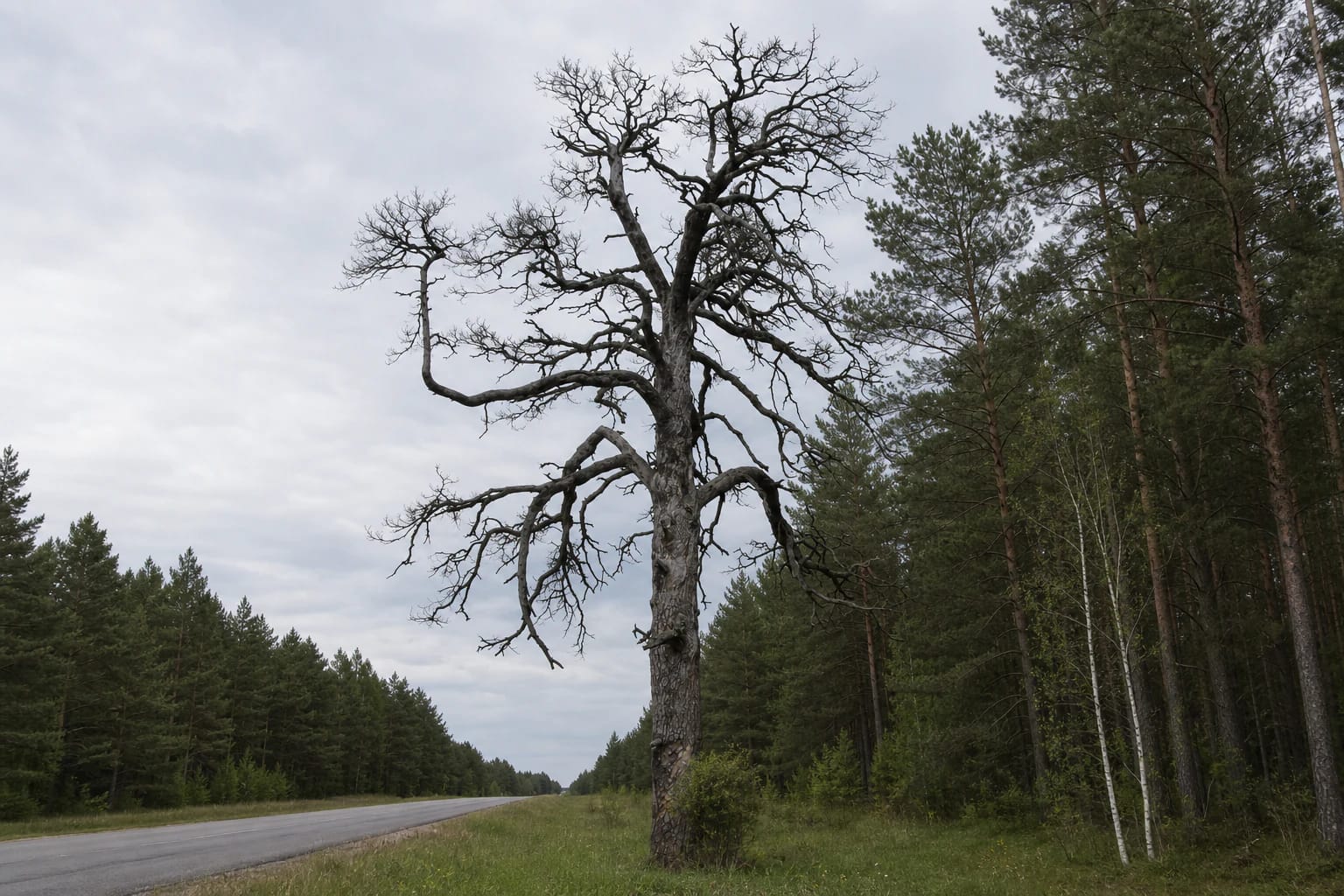
The official photograph shows a dead roadside tree, not a green veteran pine
In the vertical photograph published with the exact Saugoma.lt record, the pine stands on a grassy verge beside a paved road. Its trunk is tall and its crown spreads widely, but it bears no needles; thick contorted limbs divide into a web of dead twigs. Living pines rise nearby, making the protected tree's grey silhouette especially clear against the surrounding forest.
A Saugoma.lt maintenance report confirms more than the visual impression by explicitly calling the hollow pine dead. Arborists reduced dry branches liable to fall onto the road and adjusted the tree's centre of gravity. The accompanying work photograph shows an arborist in a lift beside the broad dead crown.
The exact object page, its data record, VSTT's list, and the maintenance report publish no height, trunk girth, precise age, or dimensions for the tree hive. None can be measured reliably from a photograph, so this guide does not manufacture figures. The official status, exact identity, surviving cavity, and connection to tree beekeeping establish its importance without an unsupported record claim.
The cavity records beekeeping history but does not prove that bees live here today
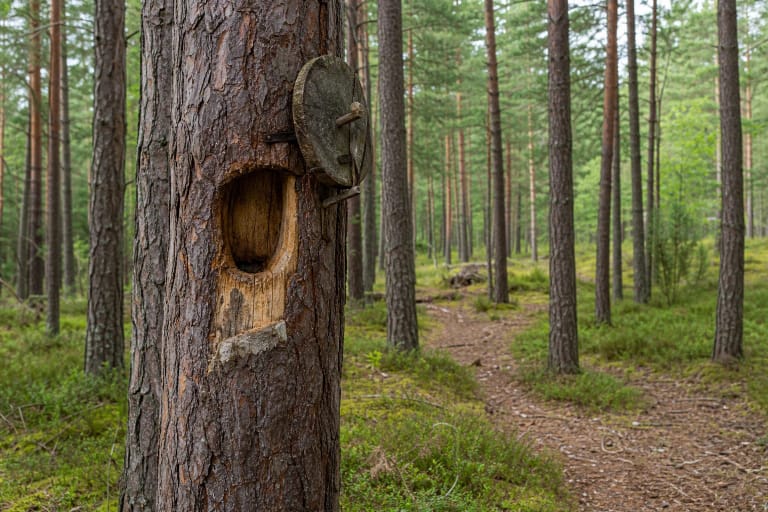
A drevė is a cavity in a tree trunk. Tree beekeepers used natural hollows or enlarged cavities to keep bee colonies. Saugoma.lt presents this exact pine as evidence of old beekeeping traditions in Dzūkija and mentions the geinys, a specialist device used by a beekeeper to climb the tree. A geinys displayed in the ethnographic museum at Marcinkonys helps explain the work; it is not visitor equipment for this pine.
The Saugoma.lt object text does not direct visitors to look for an active colony inside this dead tree. Instead, it points to the Ancient Beekeeping Trail around Musteika, where bees can be seen living in tree hives. Dzūkija National Park's Nuog dravės lig dravės route also describes old and newly cut cavities, but the public route description checked does not identify the compartment 127 pine as one of its thirteen trees.
The safest reading is therefore a preserved material witness to the tradition, not a working apiary or demonstration hive. Never put a hand or object into the cavity, try to open any cover, carve the trunk, or climb the tree. Dead wood can still provide habitat for insects and other animals.
Tree beekeeping flourished in the sixteenth and early seventeenth centuries and survived longest in Dzūkija
VLE divides the history of Lithuanian beekeeping into tree-hive and apiary-hive phases. Forest beekeepers who tended natural and artificial cavities were especially important during the Grand Duchy of Lithuania. Tree beekeeping flourished in the sixteenth century and the beginning of the seventeenth, then declined as forest clearance accelerated. Laws of the Russian Empire prohibited cutting new tree hives in 1804.
The old practice still survived in wooded south-eastern Lithuania during the second half of the nineteenth century. VLE says it had disappeared as an ordinary economic system by the mid-twentieth century. The national park route explains a different modern layer: surviving old cavities, newly prepared demonstration hives, and skills passed between practitioners now preserve and revive the tradition, although it is no longer a forest industry on its former scale.
The park directorate says that the Tree-Beekeeping Tradition of Varėna Region entered Lithuania's Inventory of Intangible Cultural Heritage in 2019. That recognition concerns living knowledge and skill. The compartment 127 pine is a material witness to the same history and, separately, a botanical natural heritage site - related but distinct layers of protection.
Botanical heritage status does not guarantee that the dead crown is permanently safe
VSTT includes this hollow pine in its list of botanical natural heritage sites for Varėna District, and the Saugoma.lt data record uses the same classification. The authoritative sources checked do not additionally call this exact tree a natural monument, so the two legal labels should not be treated as synonyms.
A dead tree can remain protected for its form, history, and biological value after growth has ceased. The maintenance work reduced the risk of breakage and helped retain the object; it did not restore a living crown. Removing the branches judged most hazardous at that time does not guarantee that every remaining limb will be stable after later storms.
Postpone a visit during strong winds, storms, sleet, and immediately afterwards. Spend no longer beneath the crown than necessary, do not touch supports or other maintenance equipment if any is present, and obey new fencing or signs. Report a fresh break or a visibly changed condition to the protected-area authority rather than attempting to work on the tree yourself.
This is a short roadside stop, but no official parking bay is confirmed
The Google point and Saugoma.lt photograph help identify the tree beside a paved road, but none of the official sources checked lists a dedicated car park, waymarked footpath, or step-free viewing platform at this spot. The pin identifies the tree itself, not a safe lay-by. Never stop in the carriageway or leave a vehicle on a narrow verge where it obstructs traffic or sight lines.
Public sources publish no ticket office, admission charge, or fixed opening hours for this single tree. Google displayed a 24-hour label on the review date, but that is not an official night-time visitor regime approved by the park. The verge is not lit like a visitor centre, and dead branches are harder to assess in darkness, so come only in daylight and check the park's latest notices before making a special journey.
If a lawful and safe stopping place is available, allow 10-25 minutes. View the tree from a position that does not require walking in the road or standing directly beneath the dead crown. For deeper context, choose the official 14.5 km route Nuog dravės lig dravės, to which the park allocates four to five hours, but do not automatically describe this brief roadside stop as a documented part of that circuit.