- Place
- Marcinkonys eldership, Varėna District Municipality
- Region
- Dzūkija National Park
- Type
- ethnographic village in Dzūkija National Park
- Coordinates
- 53.95500, 24.36800
Musteika ethnographic village
Musteika in remote southern Dzūkija
Musteika is in Varėna District, Marcinkonys eldership, within Dzūkija National Park. VLE states that the village lies 12 km south of Marcinkonys, that the Musteika stream flows through it, and that only 36 people lived here in 2021. It is one of the park's most remote villages, close to the state border and the Čepkeliai region.
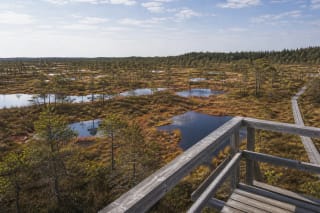
The village character is shaped by remoteness, forest setting, and the landscape of southern Dzūkija. Musteika is not only a pretty group of homesteads: it helps explain how people lived by forests, streams, wet places, and Čepkeliai Mire. The population has fluctuated: according to VLE, in 1959 there were as many as 241 people here, while by 2011 only 61 remained.
Mixed-plan ethnographic village
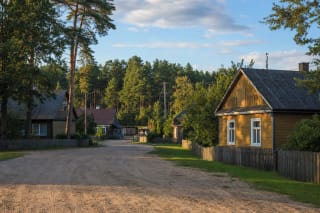
VLE describes Musteika as a mixed-plan village whose structure formed from the second half of the eighteenth century to the early twentieth century. It consists of 5 homestead groups: on the northern and eastern sides homesteads are scattered, while elsewhere street-village traits remain.
This mixture is very important. Musteika is not a regular museum model, so it should be read through the relationship between roads, stream, forest, and homesteads. Sometimes the more valuable feature is not one building but the way several yards form a forest-village space, which makes Musteika different from the street-plan village of Zervynos.
Houses, granaries, and barns
VLE notes that valuable late nineteenth and early twentieth-century ethnographic buildings survive in Musteika: one-ended and two-ended houses, granaries with porches, cowsheds, and barns. This is the main content of a visit, so look not only at facades but at the relationship between dwelling and farm buildings.
The wooden construction is simple but precise: buildings are small, adapted to local life, and their value lies in structure, proportions, and daily function. Musteika therefore complements Marcinkonys Ethnographic Homestead well, where the focus is more museum-based.
History, Tadas Ivanauskas, and a province border
VLE states that Musteika was first mentioned in 1785 in the Varėna manor land inventory. In the nineteenth century the border between the Vilnius and Grodno governorates ran through the village, an administrative line marking imperial divisions of Lithuania, and in the early twentieth century the village expanded.
Musteika also has a science-history layer. VLE notes that in 1918-1919 the naturalist and zoologist Tadas Ivanauskas, one of Lithuania's leading nature researchers, lived here and founded a school. This link with nature knowledge fits Musteika's identity as a forest and bee-keeping village.
A tree-beekeeping village
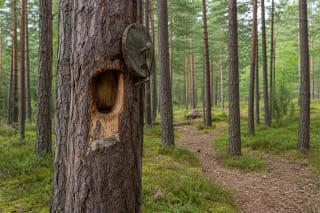
Musteika is most famous for the old tradition of tree beekeeping, in which bees are kept in drevės, cavities carved into thick pine trunks. VLE states that the Old Dzūkian Beekeeping Museum was established here in 2006, making the village one of Lithuania's key centres for this forest craft. Hollow pines declared natural monuments also stand in the surroundings.
Tree beekeeping is not only a relic of the past: it shows how Dzūkians knew how to live from the forest without destroying it. The museum, climbing tools called geiniai, tree hives, and honey routes let Musteika be understood not as a disappearing village but as a living example of traditional forest economy, now part of Lithuania's intangible-heritage field.
Visiting and respect for the village
Musteika is a living village, not a decorative exhibition. There is no opening time for the village itself, but the tree-beekeeping museum or other park-object hours and prices can change, so check Dzūkija National Park information before travelling.
Walk public roads, do not enter yards without permission, and do not drive over grass or private land. If you combine the village with the tree-beekeeping exhibition and Hollow Pine in Musteika, allow more time, because Musteika's meaning opens through the link between homesteads, forest, and craft.