- Place
- Margionys, Marcinkonys eldership, Varėna District Municipality
- Region
- Dzūkija
- Type
- a botanical natural heritage object and natural monument on a private homestead in Margionys
- Address
- a private homestead in Margionys, Marcinkonys eldership, Varėna District
- Coordinates
- 53.99945, 24.28760
- Visit duration
- 10-20 minutes at the tree; 1-2 hours when combined with Margionys and the Skroblus springs
- Best time
- in daylight, when respectful access can be agreed; summer reveals the crown, while leafless months show the three trunks and support system more clearly
Lietuvio liepa, Margionys Lietuvio Lime Tree
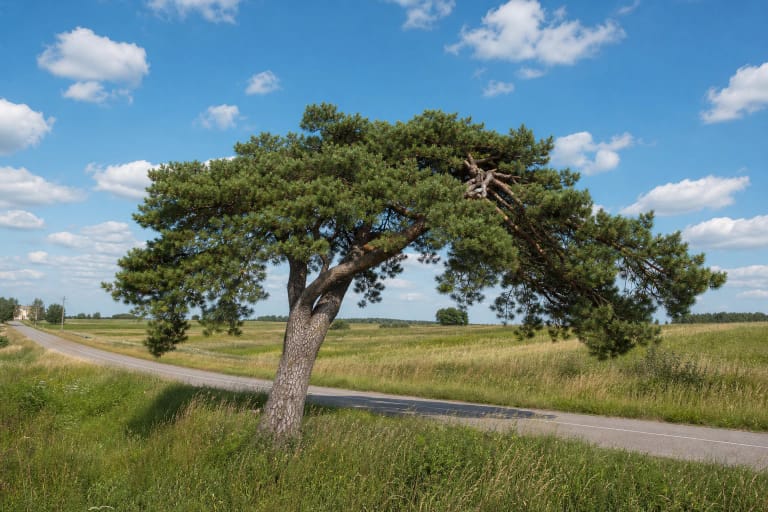
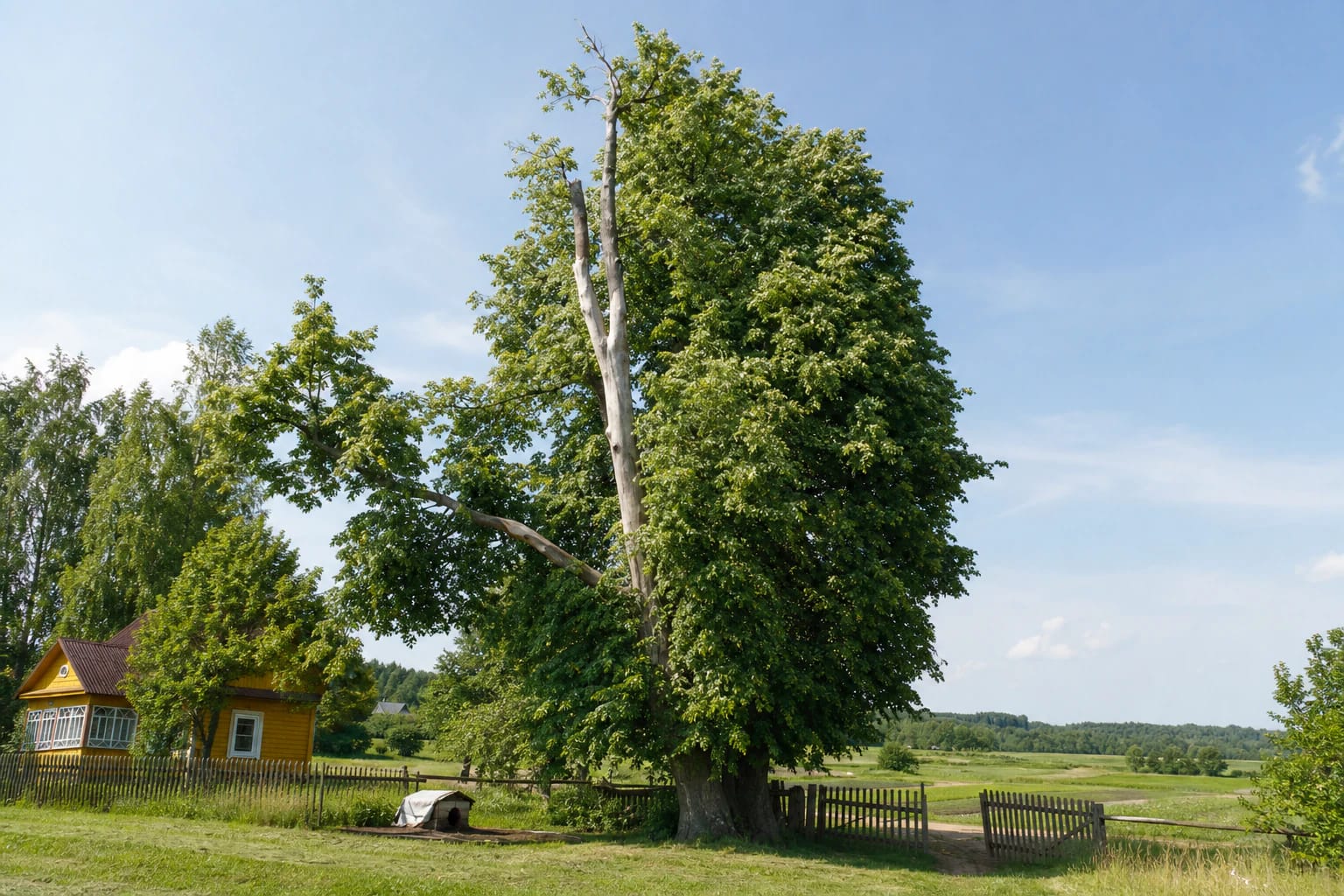
The 22.5-metre tree is remarkable for its three-trunk structure as well as its age
Lietuvio Lime Tree is a small-leaved lime, Tilia cordata. VLE gives an age of more than 80 years, a height of 22.5 metres, and three trunks with circumferences of 2.2, 1.8, and 1.7 metres. The source does not state when or at what height those circumferences were measured, so they are best treated as published tree data rather than a new 2026 arboricultural survey.
The lime formerly had four trunks. A storm damaged one of the remaining stems, and the present tree clearly shows three unequal sections rising from the base. It is not a single giant trunk, so the separate 2.2, 1.8, and 1.7-metre figures should not be added together to create a misleading total girth.
An age of more than 80 years means that this is not a woodland relic many centuries old. Its significance instead combines an unusual multi-trunk form, a documented family history, six decades of statutory protection, and the challenge of preserving a living structure after storm damage.
Its name recalls Pranas Kvaraciejus crossing the region's former political boundary
VLE records that the lime grows on the homestead of Vincas Kvaraciejus and was planted by his father, Pranas Kvaraciejus. Pranas had come from Lithuania to settle in a district that then belonged to Poland. No exact planting year is given, and it cannot be derived simply from the approximate age of more than 80 years.
In this account, the name Lietuvio liepa is a proper name rather than a botanical label. It recalls a period when interwar Margionys lay on the other side of a political border and a newcomer from Lithuania planted a tree there. The authoritative sources checked offer no separate miracle story or legend, so the recorded family origin should not be replaced with romantic invention.
The lime remains part of a homestead rather than a freestanding public park. The owner's name helps explain continuity in the tree's story, but a visitor must observe the present boundary: the presence of a state-protected object does not automatically make a private yard open to unrestricted entry.
Protection begun in 1960 developed into natural-monument and botanical-heritage status
Lietuvio Lime Tree has been protected since 1960. VLE says it entered the then Soviet Lithuanian list of natural monuments of national significance in 1987 and was classified as a natural landscape object from 1999 to 2003. These labels belong to different periods of the protection system and should not be compressed into one supposed designation date.
The tree has been a natural monument since 2000 and a botanical natural heritage object since 2003. It stands within Kapiniškiai Landscape Reserve in Dzūkija National Park. The current Saugoma.lt object card gives the point 53.999, 24.288 and retains Lietuvio liepa as its official catalogue name.
Natural-monument status does not mean that visitors may touch or embrace the trunk, or disregard the homestead boundary to circle it. Protection applies to the tree's health and root environment as well as its visible form, so any visit must respect both property rights and current instructions on the ground.
Braces, crown reduction, and an uncovered hollow reveal active arboricultural care
The storm-affected trunks support one another through rigid connections low above the ground and flexible connections several metres higher. Branches have been pruned to reduce the load carried by the stems. These braces are conservation equipment, not steps, handrails, or decoration, and must never be moved or used as a photo prop.
A Saugoma.lt account of the care work says arborists installed three additional connections and pruned the crown to reduce the risk of failure. They also uncovered a hollow that had previously been crudely closed with sheet metal, allowing the cavity and trunk to resume more natural defensive processes.
Dzūkija National Park's 2023 activity report names Lietuvio Lime Tree and the Hollow Pine as two botanical natural heritage objects treated that year. This confirms completed care, but does not provide a permanent safety certificate. A later storm can alter a tree's condition, so visitors should obey fresh notices and stay away from the crown in high winds.
The exact card shows 4.7, but the average rests on only seven reviews
The exact Google Maps card Lietuvio liepa, place ID ChIJ1xJqVqoj3kYRuknIB5uL_Gg, marks 53.9994492, 24.2875983. The official Saugoma.lt point is 53.999, 24.288, while VLE's map point is 53.999465, 24.287553. The small differences fall within the homestead setting, and all three datasets identify the same tree.
On 15 July 2026, the Google card displayed an average of 4.7 out of 5 from seven reviews. This clears the specified 4.5 threshold, but seven votes remain a small sample and the mean can change noticeably. A rating confirms neither permission to enter the yard nor the tree's condition on a particular day.
Google also labelled the place open 24 hours. VLE, Saugoma.lt, and the park documents publish no dedicated ticket office, admission charge, or official schedule for the lime. The 24-hour label is map metadata, not the household's consent and not authority to enter a private yard at any hour.
A good visit is brief, made in daylight, and respectful of the homestead boundary
Before approaching, establish whether the tree can be seen clearly from a public road or another publicly accessible place. If a closer view would require opening a gate, crossing a fence, or entering the yard, ask the residents first. Do not obstruct the driveway with a vehicle or publish unrelated details of the private home.
Do not climb the lime, score its bark, touch its supports, or place objects in the hollow. Summer best reveals the broad green crown; late autumn and early spring expose the three stems and their support system. Postpone the visit during storms or strong winds.
Ten to twenty minutes is normally sufficient at the tree, making it sensible to combine the stop with Margionys village, the Bobos daržas springs of the Skroblus, and the marked valley route. That is not an invitation to take a straight shortcut across private land: move between sites on public roads and marked trails, and check current protected-area conditions before travelling.