- Place
- Straigiškė, Seirijai eldership, Lazdijai District Municipality
- Region
- Dzūkija
- Type
- a state-protected botanical natural heritage object in Trakas Forest
- Address
- Trakas Forest near Straigiškė and Žagariai, Seirijai eldership, Lazdijai District
- Coordinates
- 54.23763, 23.76739
- Visit duration
- 20-30 minutes at the tree; longer if the final forest-road section must be walked
- Best time
- a dry, bright day in spring or autumn; avoid storms, strong winds, and waterlogged forest roads
Trako pušis, Trako miško pušis, Trakas Forest Pine
The 25.5-metre height is joined by three reliable identification clues
VSTT's nomination dossier records Trakas Pine as 25.5 metres high, with a trunk circumference of 2.92 metres and a crown diameter of 10 metres. The document supplies neither a measurement date nor the height at which the circumference was taken. These are therefore measurements recorded in the official proposal, not a newly completed arboricultural survey.
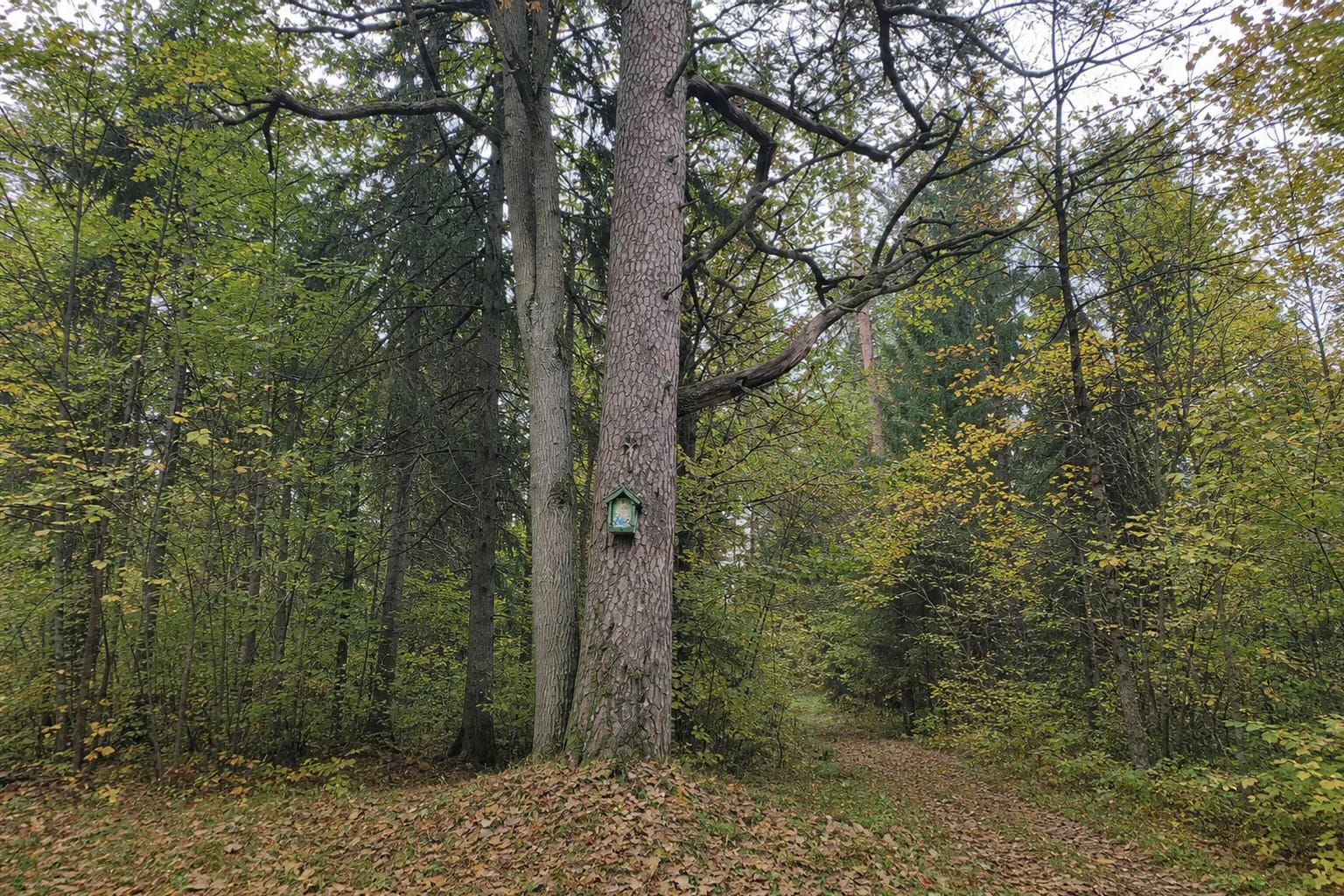
The official Saugoma.lt page and the directorate's 2025 photograph identify the tree by its exceptionally thick, straight trunk and pinkish-grey plates of bark. A grey deciduous trunk rises immediately beside it, while a small shrine with a green roof is fixed low on the pine. Its irregular crown starts high and mingles with neighbouring branches, so a close view does not always reveal where the pine's own canopy ends.
None of the official sources checked gives a dendrochronological study or an exact age for Trakas Pine. Its size justifies calling it a veteran in ordinary description, but one dependable germination date cannot be calculated from circumference alone.
A nomination became legally binding state protection in 2025
The VSTT file containing the dimensions and assessment is explicitly supporting material for a nomination. It judged the pine to meet quantitative rarity criteria in a completely natural setting and to carry natural, educational, aesthetic, ecological, and historical value. That dossier explains why the tree was selected, but it was not itself the final protection decision.
The legal status followed through Environment Minister Order D1-131 of 10 September 2025. VSTT's current legal register names Trakas Pine among 80 natural heritage objects declared state-protected by that order, with site plans approved for them. The Dzūkija-Suvalkija Protected Areas Directorate now lists the pine among the natural heritage visitor sites of Meteliai Regional Park.
The directorate explains that buffer zones around the new botanical objects follow crown width and cannot be less than 5 metres. Ground works, off-road driving, parking in undesignated places, tents, and fires are restricted in these zones. Protection therefore concerns the root area and woodland setting as well as the visible trunk.
The shrine records cultural memory, but its missing story should not be invented
The little shrine on the trunk is a real identifying feature of the site today. It is clearly visible in the winter photographs published by Saugoma.lt and in the directorate's 2025 photograph. Those official pages do not say when it was installed, who made it, to whom it was dedicated, or which figure it contains.
Vykintas Vaitkevičius's study of sacred pines identifies the pine in Trakas Forest as a sacred tree documented in Dzūkija. Its reference points to Juozas Petrauskas's 1993 local history Seirijų praeities takais and a field survey made in 2011. This establishes cultural recognition well before statutory protection arrived in 2025.
The study discusses shrines and crosses on pines in the broader Lithuanian tradition, but that context cannot supply this tree with a specific miracle, vow, or legend. Visitors can recognise the shrine as evidence of a relationship between people and the tree while leaving its undocumented origin honestly unresolved.
Trakas Forest is a 700-hectare mosaic in which pine stands account for only 17 percent
VLE places Trakas Forest roughly 2 kilometres west of Seirijai and gives a total area of 700 hectares, 625 of them wooded. The terrain is hilly, with small wetlands in its hollows. Spruce stands account for 30 percent of the woods, birch 19 percent, pine 17 percent, alder 13 percent, and oak 12 percent. The mixed conifers and broadleaves around the protected pine are therefore characteristic of the forest rather than incidental clutter.
Parts of the forest belong to the Trakas Strict Nature Reserve and botanical-zoological reserve. They protect Lithuania's unique community of sessile oaks, sites of rare plants, and breeding areas of rare birds. The pine gives a traveller a clear destination, but it belongs to a much larger and more sensitive ecosystem.
VLE also records a nature trail in Trakas Forest and the activity of the Dainava partisan district's Šarūnas unit in the forest from 1944 to 1953. These are facts about the wider forest, not proof that the marked trail passes the pine or that a specific partisan event occurred at its trunk.
The exact Google point marks the tree, not a car park
The exact Google Maps card Trako pušis, place ID ChIJ60sQPwC_4EYRyNbUz69v0d8, marks 54.237634, 23.7673914. Saugoma.lt's directions button leads to the nearly identical point 54.237584, 23.767443. A difference of only a few metres is normal under woodland cover, and both pins identify the tree itself rather than a guaranteed stopping or turning place.
The VSTT nomination says the pine stands immediately beside a forest track, about 1.5 kilometres from State Road 132 and roughly 1 kilometre from Žagariai. The same dossier says adaptation for visitors would be worthwhile. That is a proposal for improvement, not evidence of a present car park, hard-surfaced path, signs, or step-free access.
On 15 July 2026, the Google card showed a perfect 5.0 out of 5 average from exactly one review. One rating clears the specified 4.5 threshold, but it conveys almost no stable statistical evidence about visitor experience and can change with a single new vote. Plan by coordinates and official guidance, not by one star entry.
A 24-hour map listing does not override forest rules or weather risk
Google described the site as open 24 hours on the verification date. The VSTT, Saugoma.lt, VLE, and directorate pages checked publish no separate ticket office, mandatory admission charge, or fixed opening hours for Trakas Pine. It is an outdoor site, but visitors should recheck directorate notices, temporary forest restrictions, road conditions, and signs before setting out.
Drive only where motor access is permitted and never park over the root zone or block a narrow forest track. Rain and thaw can leave an unsealed route waterlogged. Because the pin marks the tree rather than an official entrance, save the map before travelling; if no safe legal approach is apparent, walk the final section.
Do not touch or attempt to repair the shrine, carve the bark, climb the tree, or disturb the forest floor. Do not linger beneath the large crown in strong winds or a storm, because an attractive photograph cannot certify branch safety. Allow about 20-30 minutes at the tree itself, excluding the forest-road approach.