- Place
- Varėna District Municipality
- Region
- Dzūkija National Park
- Type
- gateway village to Dzūkija National Park
- Address
- Miškininkų g. 61, Marcinkonys
- Coordinates
- 54.06153, 24.39835
Marcinkonys village
Marcinkonys as the gateway to Dzūkija National Park
Marcinkonys is a village in Varėna District, an eldership and parish centre, and one of the key settlements of Dzūkija National Park. VLE states that the village lies 21 km southwest of Varėna, inside Dzūkija National Park, with the Grūda, a tributary of the Merkys, flowing along its western edge. In 2021 it had 493 residents, still alive as a settlement but much smaller than in the Soviet period, when VLE records 1,217 residents in 1959 and 1,111 in 1970.
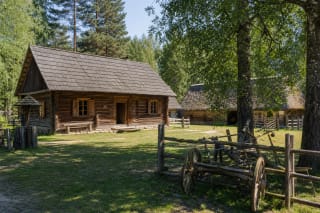
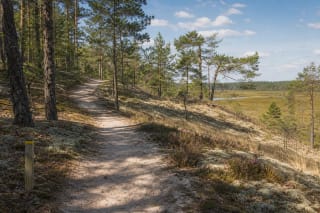
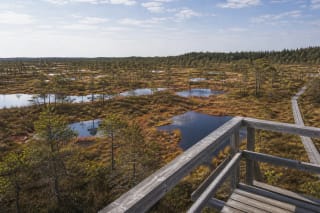
For a trip, Marcinkonys works as a starting point. VLE notes that when Dzūkija National Park was established in 1991, its directorate settled in Marcinkonys. That makes the village a practical place to stop at the visitor centre, check routes, visit the ethnography museum and ethnographic ensemble, walk to the Zackagiris trail, or plan outings to Čepkeliai, Zervynos, Musteika, and the Skroblus valley.
One of Lithuania's largest villages by area
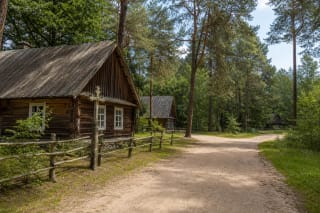
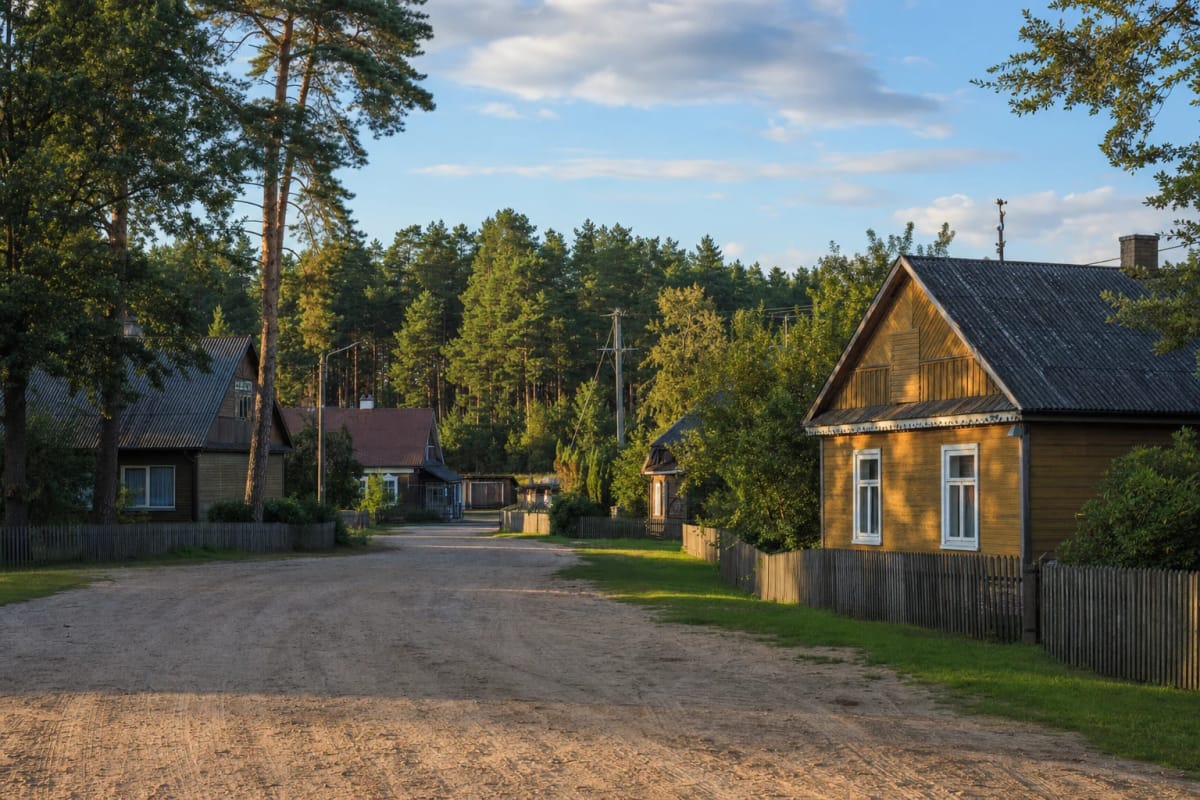
VLE stresses that by area Marcinkonys is one of the largest villages in Lithuania. This matters for visitors: it is not a compact old town where everything fits around one square, but a broad forest village with several directions and different layers. On the sandy village edges VLE also marks natural monuments: hollow pines that recall old forest beekeeping.
The main orientation points are the railway station, the wooden twin-towered Church of Sts Simon and Jude Thaddeus, the Dzūkija National Park visitor centre area, the ethnography museum, and roads leading into pinewoods. Memory sites, including cemeteries of victims of Nazism and Lithuanian partisans, show that this calm forest village carries a difficult twentieth-century history. It is best planned not as a quick stop but as a slow combination of village and trail.
History: forest scouts, railway, and forest products
VLE records a Marcinkonys forest-scout settlement of 8 households in 1637. In 1770 a wooden church was built here as a branch of Merkinė, a parish was founded in 1777, and in 1838 the village had 37 households. After the Saint Petersburg-Warsaw railway was built in the second half of the nineteenth century, a separate settlement grew around Marcinkonys station and merged with the old village only in the second half of the twentieth century.
Arable land was scarce, so VLE writes that people relied on forest work, crafts, and, from the late nineteenth century, mushroom and cranberry gathering. Forest produce was carried by train as far as Saint Petersburg and Warsaw, Jewish intermediaries settled here because of the trade, and in 1912 a small mushroom-drying enterprise was founded. VLE notes that in the late twentieth century the forest-products business flourished again, which is why Marcinkonys remains one of the centres of mushroom and berry country.
War and resistance memory
Marcinkonys history reflects the full twentieth century of southeastern Lithuania. VLE states that in 1915 the German occupation administration built a narrow-gauge railway from Marcinkonys to the Katra River to transport timber; it operated until mid-century. In 1920-1939 the village belonged to the Polish-occupied Vilnius region, where Polish border troops suppressed Lithuanian identity; in 1920 priest P. Raštutis was tortured to death.
According to VLE, in September 1941 Nazis murdered about 600 Jews from Marcinkonys and Varėna in a forest near the village. After the Second World War, the Marcinkonys Battalion of the Merkys unit of Lithuanian partisans operated in the area, and Soviet authorities deported 103 residents in 1940-1941 and 1944-1953. Partisan and victims-of-Nazism cemeteries and small burial places at the village edges preserve this memory today.
Church, museums, and the park centre
The clearest village landmark is the wooden twin-towered neo-Gothic Church of Sts Simon and Jude Thaddeus, built around 1880. VLE notes paintings inside, including St Roch around 1710, St Barbara from the eighteenth century, and St Francis from the early nineteenth century; a wooden Crucifix from the nineteenth century; and a brass bell cast in 1805 by J. S. Vėneris. The churchyard is enclosed by a stone wall with 14 Stations of the Cross from the early twentieth century, and contains a wooden belfry and a 1933 wooden cross with iron elements.
The village is also important for ethnography and nature education. VLE notes that Marcinkonys has an Ethnography Museum, established in 1994, and a Čepkeliai Reserve Nature Museum, established in 1996, while the Marcinkonys ethnographic ensemble, known for Dzūkian singing, has existed since 1971. Marcinkonys is therefore not only a settlement but an informational and cultural node of Dzūkija National Park.
Opening times and planning
The village itself is an open settlement and has no single opening time or ticket. However, the visitor centre, ethnography and Čepkeliai Reserve museums, ethnographic homestead, and education programmes have changing hours and prices, so check official Dzūkija National Park information before travelling.
If you have only an hour, visit the visitor centre area, the church, and a sandy village road. If you have half a day, combine Marcinkonys with the Zackagiris trail, ethnographic homestead, and Čepkeliai Mire, because then the relationship between village, forest, and protected nature becomes clear.