- Place
- Klaipėda, Klaipėda City Municipality
- Region
- Klaipėda
- Type
- historic city square with a fountain-monument and drama theatre
- Coordinates
- 55.70780, 21.13160
Taravos Anikė, Ännchen von Tharau, Simon Dach Monument, Theatre Square
Theatre Square: the heart of Klaipėda Old Town
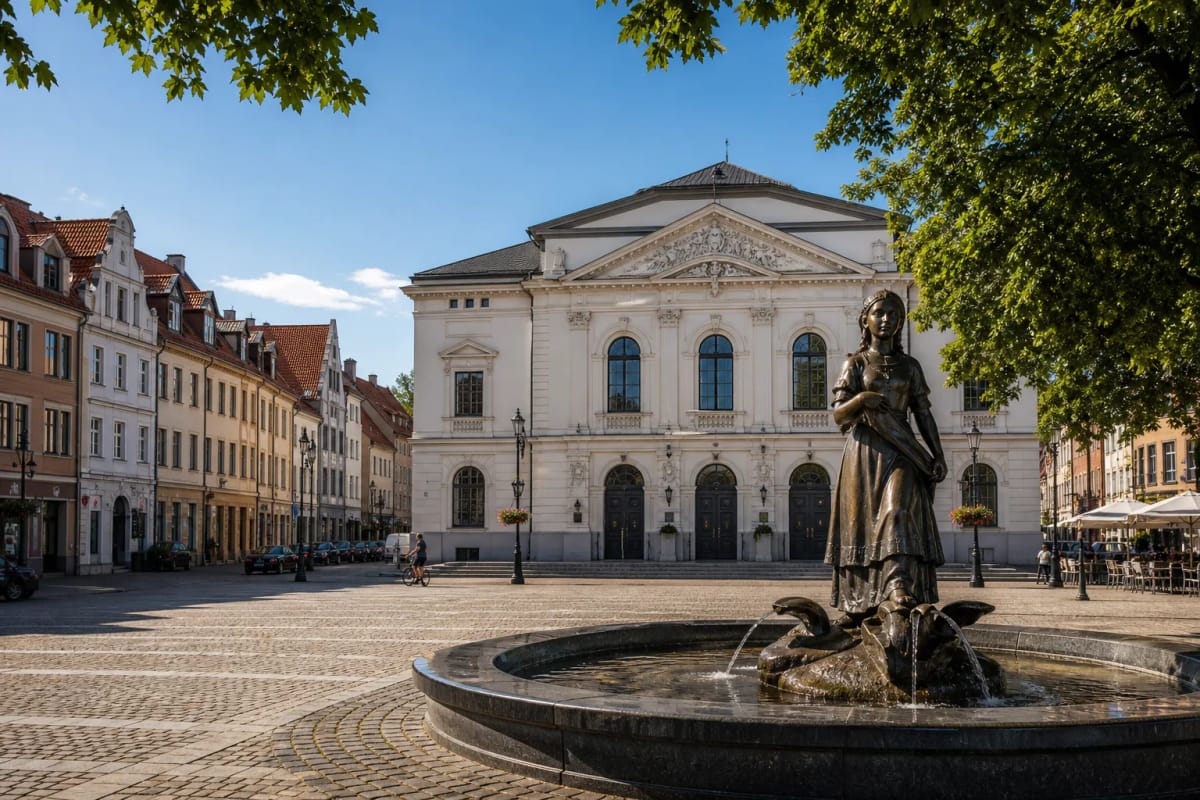
Theatre Square is one of the most representative spaces in Klaipėda Old Town, on the left bank of the Danė. Two important objects meet here: Klaipėda Drama Theatre and the Ännchen of Tharau Fountain in front of it. The square has an irregular triangular shape, and the barefoot girl sculpture at its centre has become one of the city's most recognizable symbols.
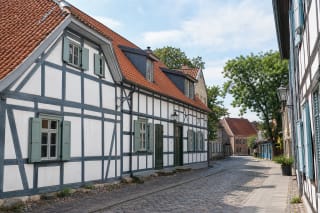
For visitors, it is important to feel that this is not only a pretty square. It is a place where Klaipėda architecture, maritime culture, and complicated twentieth-century history intertwine. Theatre Square is best read together with the whole old town and the port city's past.
Klaipėda Drama Theatre
VLE states that the first theatre building on this site was built in 1819 as a Classical structure. After the 1854 fire, it was rebuilt in 1857; in 1893 it passed into city ownership and was reconstructed in 1895-1898, gaining neo-Classical features and facade balconies. The theatre was later reconstructed several more times, most recently by 2015, restoring the authentic red-brick facade.
A painful historical episode is also tied to this building: historical accounts widely say that in March 1939, after Germany annexed Klaipėda Region, Adolf Hitler spoke from the theatre balcony to the crowd gathered in the square. This often-retold city-history episode makes the square a place of culture and of twentieth-century political memory.
The Ännchen of Tharau Fountain and Simon Dach
The girl at the centre of the fountain represents Ännchen of Tharau, the heroine of the song Ännchen von Tharau by poet Simon Dach. Simon Dach was born in Klaipėda, then Memel, at the beginning of the seventeenth century and became a well-known Baroque poet, so the fountain also honours the city's literary past.
VLE states that the fountain with the Ännchen sculpture was installed in 1912 by sculptor Alfred Künne, demolished after 1939, and restored in 1989. The current sculpture is therefore a reconstruction, not the original. It is another example of how twentieth-century events changed Klaipėda's urban face.
A song that became a city symbol
The song about faithful love, Ännchen of Tharau, became famous throughout German culture in the seventeenth century, and in Klaipėda it turned into a city symbol. The barefoot girl on the fountain is not a specific historical person but the image of a song, connecting the city with its literary and musical memory.
Because of this layer, Theatre Square is more than an architectural space. The fountain recalls Klaipėda's deep roots in the meeting of German and Lithuanian cultures, and a monument to a song character is a rare and graceful case in the city.
Visiting: how to see the square
Theatre Square is an open public space, freely accessible and without a ticket. The fountain operates in the warm season, so the square is most attractive in summer; at that time it also becomes a focus for events, especially the Sea Festival. A short visit takes 15-30 minutes.
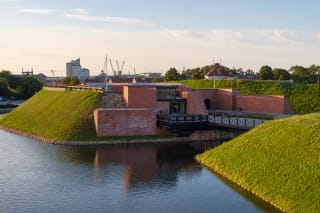
The square is easiest to see together with Klaipėda Old Town, the castle site, and other port-city landmarks. If you want to attend a performance, check Klaipėda Drama Theatre's official page for repertoire and tickets.