- Place
- Klaipėda City Municipality
- Region
- Klaipėda
- Type
- medieval castle site, bastion system, and museum in posterns and curtain-wall spaces
- Address
- Priešpilio g. 2, Klaipėda
- Coordinates
- 55.70560, 21.12890
Klaipėda Castle, Memelburg, Mimelburg, Castle Museum
The place where Klaipėda's story begins
The Klaipėda castle site is not just a museum beside the old town. It is the city's beginning. VLE states that Klaipėda Castle, called Mimelburg or Memelburg in German, was built in 1252 in a strategically important place in Curonian land: on the left bank of the Danė mouth, near the Klaipėda Strait.
For that reason, it is worth visiting this place before a longer old-town walk. The castle site explains why the city formed by the water, why the Danė and the port matter to Klaipėda's identity, and why old Memel was long not only a trading place but also a defensive point.
The 1252 castle: an Order base in Curonian land
VLE writes that the castle's construction was initiated by Eberhard von Seyne, Master of the Livonian Order, and Bishop Heinrich of Courland. Until 1328 the castle belonged to the Livonian Order, and later to the Teutonic Order. At first it was a wooden castle with two outer baileys, moats, and a defensive wall.
In 1253-1254, a masonry enclosure castle was built beside the wooden castle. It was protected by water-filled moats, ramparts, and a gate bridge. VLE emphasizes that the castle became one of the German Orders' invasion bases into Baltic lands and the centre of a commandery.
Attacks, rebuilding, and bastions
Klaipėda Castle was attacked repeatedly by Samogitians, Skalvians, Sambians, and the army of the Grand Duchy of Lithuania. VLE mentions attacks in 1307, 1323, 1360, 1379, 1393, 1402, and 1409; in 1360 and 1379 the castle burned, and in 1393 it was destroyed. After 1360 it was rebuilt and had four towers.
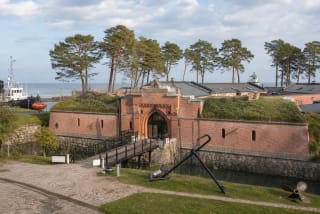
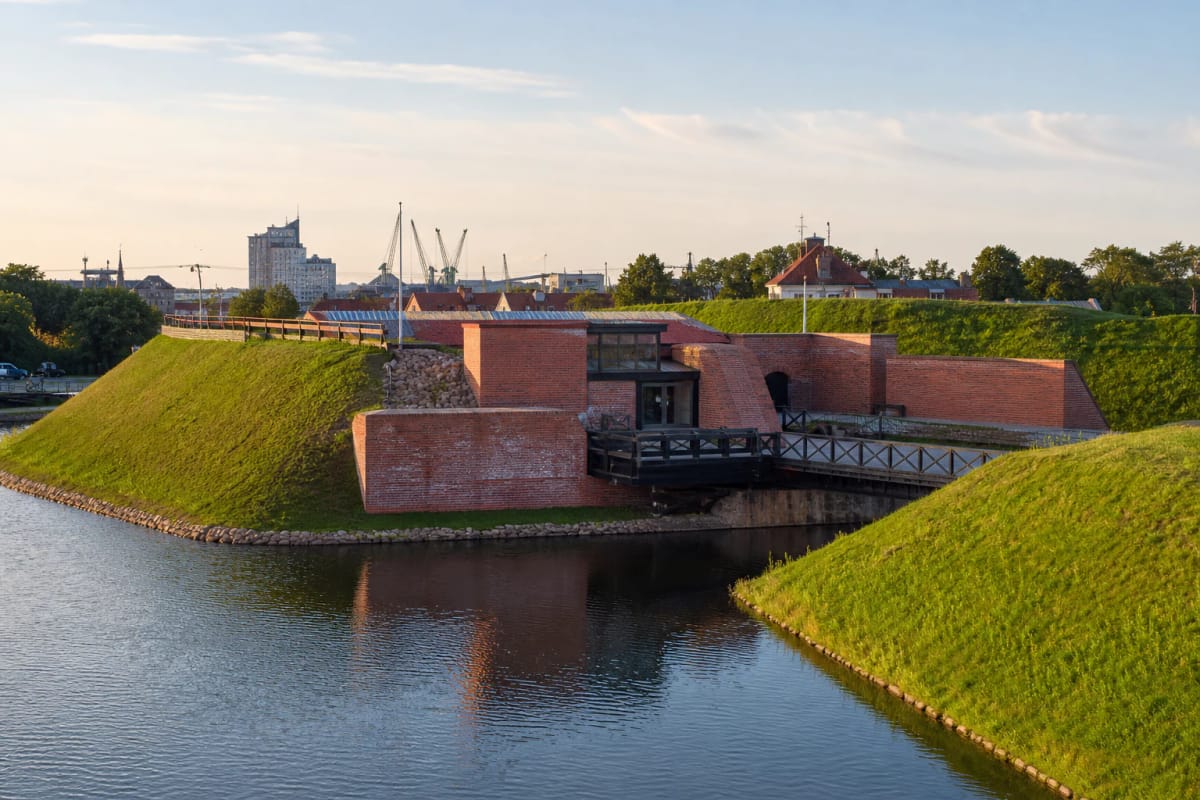
In the early sixteenth century the castle was strengthened with earth ramparts and bastions, and in the early seventeenth century it was encircled by old Dutch-system bastions to a design by J. Putkamer and H. P. Fuchs. In the present castle site, the earth ramparts, water moats, posterns, and restored curtain-wall spaces best convey the scale of the fortress.
Decline and the rediscovered castle site
In 1757, during the Seven Years' War, Klaipėda was occupied by Russian forces, and VLE states that in 1763 the castle was abandoned and gradually deteriorated. In the nineteenth century towers, vaults, and walls collapsed; after 1888 the most important masonry castle buildings were sold for demolition.
After the Second World War, ship-repair companies operated in the former castle territory. That is an important nuance: the site visible today is not simply a surviving medieval fortress. It is a city layer that was long covered, used for industry, and later returned through archaeology and museum work.
Castle Museum: posterns, curtain walls, and archaeology
VLE states that the Castle Museum, a branch of the History Museum of Lithuania Minor, was opened in 2002 in the restored Prince Friedrich postern and expanded in 2006. The official museum now lists four exhibitions.
Two exhibitions are installed in the authentic sixteenth- to eighteenth-century posterns of Princes Friedrich and Karl. In the restored northern curtain wall, the archaeological exhibition Kurtina has operated since 2021. The museum lists a collection of about 5,000 finds, 800 sq m of exhibition space, and modern interactive solutions.
Museum 39/45: war and a break in identity
The Castle Museum is not only medieval archaeology. On the site of the eastern castle curtain wall is Museum 39/45, an exhibition dedicated to the tragedy of Klaipėda Region during the Second World War. It addresses pre-war moods, the ruins of the city in late 1944 and January 1945, the withdrawal of local residents, post-war clearance, and the creation of a new Soviet identity.
This is one of the museum's strongest layers because it presents Klaipėda's history not as a smooth sequence of dates, but as a complex experience of shifting political borders, languages, wars, and population change.
How to visit the castle site
Start by walking around the exterior: water moats, ramparts, red-brick curtain-wall structures, the approach from Priešpilio Street, and the relationship with the old town. Only then enter the exhibitions; the museum story will then have a clear landscape context.
If you have only an hour, choose the Kurtina archaeology exhibition and a short outdoor walk. With more time, add the posterns and Museum 39/45. With children, decide in advance how much of the war theme is appropriate to discuss.
What to notice on site
Do not expect tall romantic towers. The strength of the Klaipėda castle site is not a fairy-tale silhouette but fortress topography: water moats, earth ramparts, bastion logic, posterns, and archaeological layers.
The best photographs often come from the moat side, where the red-brick structures, green ramparts, and port-city background can all be seen. That captures precisely how the Klaipėda castle site differs from Trakai or Kaunas castles.