- Place
- Kėdainiai, Kėdainiai District Municipality
- Region
- Aukštaitija
- Type
- central recreation park incorporating the protected park component of the former Kėdainiai Manor Estate
- Address
- main approach from J. Basanavičiaus Street and the Minareto Street side, Kėdainiai
- Coordinates
- 55.30309, 23.97798
- Visit duration
- 1-2.5 hours for a walk around the pond and islands; longer with an event, pedal boat, or a separate minaret visit
- Best time
- a dry weekday afternoon or summer evening; check the event calendar and seasonal-service schedule before travelling
Kėdainiai City Park, Old Kėdainiai City Park, Kėdainiai Manor Park, Kėdainių miesto parkas
The 39.6-hectare city park and protected manor estate do not share one boundary
Kėdainiai Central Park is the map-friendly name for the green space more often called Kėdainiai City Park in official Lithuanian texts. It occupies both sides of the Dotnuvėlė and its pond, immediately north of the old town. The principal entrance is from J. Basanavičiaus Street, while the northern approach comes across the railway crossing towards the minaret.
The current Kėdainiai general plan lists Kėdainiai Park as a 39.6-hectare central recreation park. An older official visitor description gives 37.26 hectares for the Kėdainiai Manor Estate, while the Cultural Heritage Register treats the park as a separately registered component of the estate, unique code 30759. These figures define different planning and heritage objects rather than correcting one another.
The coordinates 55.3030937, 23.9779773 mark a representative point in the middle of the park, not a gate, stage, car park, or pedal-boat desk. The park is also not a synonym for Kėdainiai Old Town, Vytautas Park, or Skongalis Park. Choose your approach according to the intended route, because the pond, islands, and path junctions separate its two ends.
The landscape park developed around the Czapski and Totleben manor from 1844
The documented manor story begins in 1811, when Kėdainiai passed to Count Stanisław Czapski. He established an estate beside the Dotnuvėlė on a former manor-farm site. The municipality's city history dates the fundamental rebuilding to 1844, when his son Marian constructed a three-storey masonry palace with a tower and orangery, planted a landscape park to the north, widened the stream, and formed ponds.
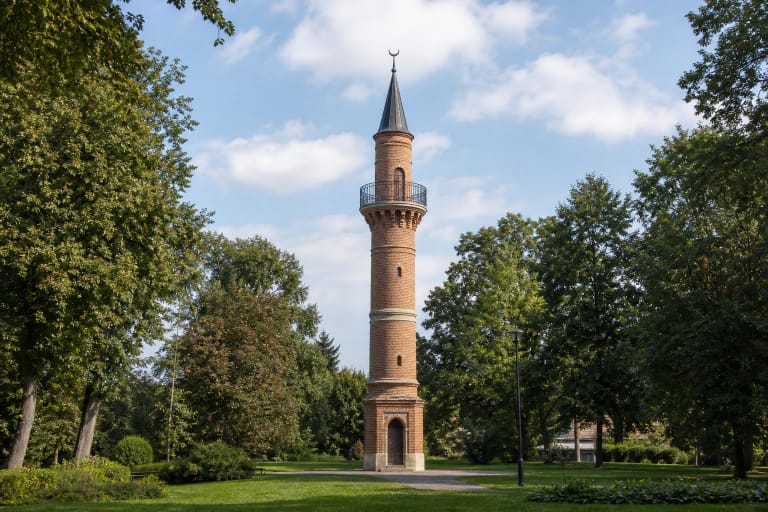
The estate was confiscated from Marian Czapski after the 1863 uprising and transferred a few years later to Eduard Totleben, a Russian-army general and military engineer. Totleben enlarged the palace, expanded the flower gardens, and redesigned the park. The minaret built near the northern edge around 1880 is its most conspicuous surviving feature, but stories that it commemorated a Muslim lover belong to legend rather than documented estate history.
The estate was nationalised after 1918. A teacher-training seminary and later a school of land engineering and geodesy occupied the palace. The Kėdainiai public library's historical route records that retreating German forces blew it up on 30 July 1944. The palace stood around today's stage and amphitheatre site, so no intact facade remains to find. The registered ensemble retains the park, two cellars, gates, and minaret.
The Dotnuvėlė pond, wooded islands, and white bridges shape the principal walk
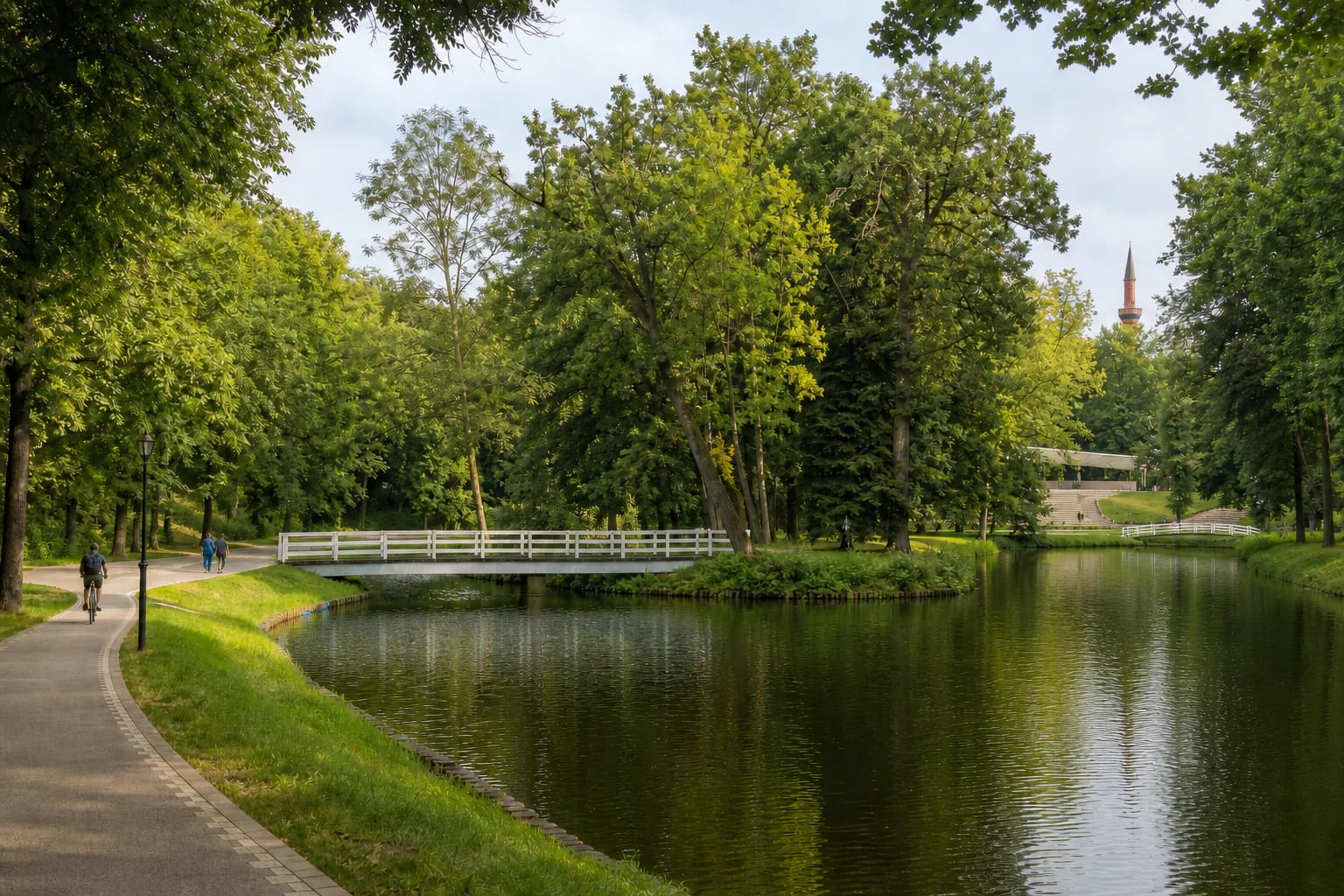
The water in the park is not the Nevėžis. It is the Dotnuvėlė, a tributary of the Nevėžis, whose channel was widened in the nineteenth century to create ponds, islands, and bridges. The long stretch of dark water and tree-covered islands forms the landscape's principal axis. Modest white footbridges let visitors change banks and read the same scene from several angles.
The current official Kėdainiai cycling-route publication gives roughly 6.5 km as the total length of walking and cycling paths inside the park. That is the combined internal network, not one guaranteed, waymarked 6.5 km loop. For a short visit, walk from the main gates past the amphitheatre and islands. For a longer route, continue to the minaret and return along the opposite bank.
Mature lime, oak, ash, and birch canopies preserve the scale of a landscape park, but this is not an enclosed botanic garden with a label beside every tree. Some water edges are steep or unguarded, while lawns and minor paths can soften after rain. Keep children close beside the pond and bridges even where the main path surface is smooth.
Modernisation in 2019-2021 created two stages across three different zones
A modernisation project begun in 2019, valued at about EUR 1.84 million, divided the park into cultural-representational, active-recreation, and minaret-approach zones. The design placed a 1,100-seat amphitheatre, pergola, and terraces near the main entrance, while the former open-air stage deeper in the park became a smaller venue for about 300 people beneath a canopy. In 2021, the municipality described the project as implemented and the rebuilt stage as being prepared for summer events.
Banks and island approaches were also repaired, with renewed bridges, paths, lighting, benches, and planting. The active area gained spaces suitable for roller skates and skateboards, while the minaret side gained a children's area and parking approach. The two stages are easily confused: the large amphitheatre by the main gates serves bigger cultural events, while the former stage deeper in the park is a separate, smaller space.
Planning notices from 2018-2019 proposed further amenities, including a cafe, several kinds of hire, and a public toilet. Inclusion in a project notice does not guarantee a permanent operator or daily opening in 2026. No current public schedule for a park-wide toilet was found during this review, so do not make it the basis of a long visit without checking locally.
An ordinary walk, an amphitheatre event, and pedal-boat hire follow different rules
The municipality publishes no single admission ticket or gate schedule for the shared outdoor park, so an independent walk on its paths is free. The amphitheatre is not a performance that runs every day: on an event day, organisers may prepare the stage, seating, service access, or adjoining paths, and the time and ticket terms belong to that particular concert or festival.
On 16 July 2026, the municipality announced a seasonal pedal-boat schedule of Thursday to Sunday, 14:00-20:00. A two-seat boat cost EUR 5 for 30 minutes, while the four-seat Flamingo cost EUR 6 for 30 minutes. This was a dated summer service, not a permanent park guarantee. Recheck the official notice before travelling because season, weather, events, or the operator can change availability.
Official park descriptions present the pond for pedal boats, not as a designated city beach. Do not assume swimming is permitted simply because paths and a landing stage reach the water. Interior access to the minaret is also separate from the park and may involve seasonal hours, a ticket, and visitor-number limits shown on that site's own page.
Plan the approach by the end of the park you want, not by one street address
From the old town, the simplest approach is on foot to the main J. Basanavičiaus Street entrance. Rail passengers can cross the level crossing and enter on the minaret side. A car park was developed at the Minareto Street approach, but it can fill quickly during events, and the area around the principal gates should not be treated as guaranteed parking.
Modernised main paths are smooth and some are lit, but the park lies on both sides of water and includes bridges, lawns, minor surfaces, and event infrastructure. No published step-free audit or adapted-toilet assessment covers all 39.6 hectares. For specific mobility needs, the J. Basanavičiaus side is the clearest starting point, and event organisers should be asked about the exact route to reserved seating.
On 21 July 2026, the search-visible Google place listing showed 4.7 out of 5 from roughly 1,100 reviews. Those figures change and do not confirm any particular amenity, but they show that this is an actively used city space rather than a forgotten manor remnant. Choose a non-event day for a quiet landscape walk or a verified amphitheatre programme for a lively city evening.