- Place
- Kėdainiai, Kėdainiai District Municipality
- Region
- Aukštaitija
- Type
- single-artist museum with a permanent collection of painting, printmaking and textile art, alongside changing contemporary exhibitions
- Address
- 45 J. Basanavičiaus Street, Kėdainiai
- Coordinates
- 55.29182, 23.97793
- Visit duration
- 60-90 minutes for the exhibitions; add 90-120 minutes only for a pre-booked workshop
- Best time
- the first half of the day from Wednesday to Friday; verify the dates of the changing exhibition before travelling
Janinos Monkutės-Marks muziejus-galerija, Janina Monkutė-Marks Museum, Janina Monkute-Marks Museum-Gallery, JMM Museum-Gallery
This is a working Kėdainiai Regional Museum art branch, not an obsolete listing for a closed private gallery
Since 2023, Janina Monkutė-Marks Museum-Gallery has operated as a branch of Kėdainiai Regional Museum at 45 J. Basanavičiaus Street. The main Regional Museum is at 19 Didžioji Street, so the two addresses, displays and admission arrangements should not be conflated. This branch continuously presents the legacy of Janina Monkutė-Marks and stages changing art exhibitions; it is not a shared entrance to every museum venue.
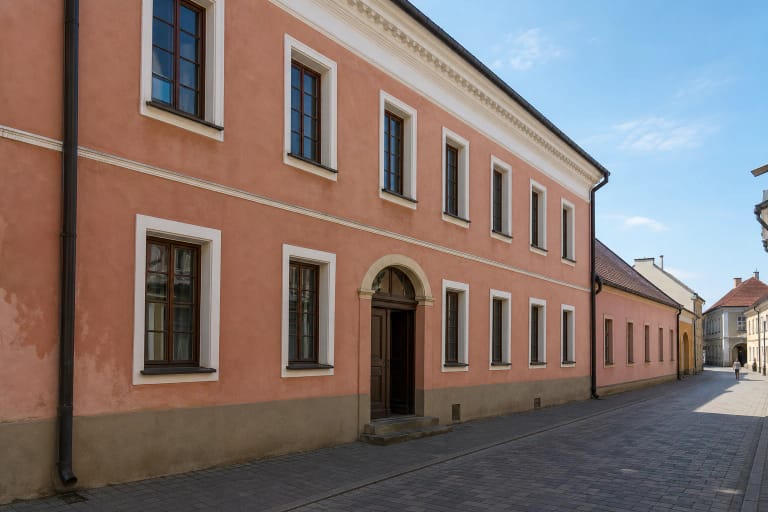
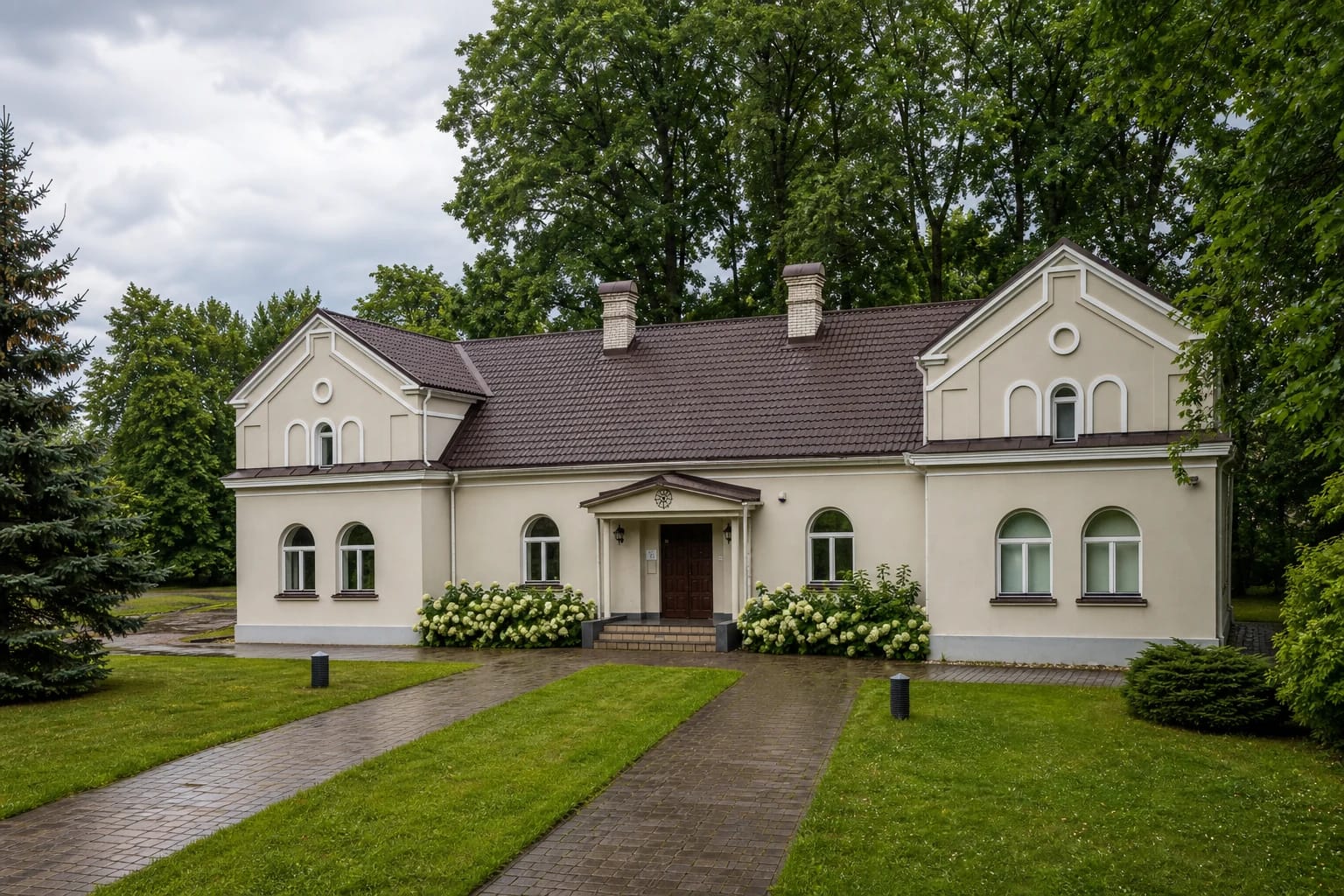
Recognise the building by its long pale-grey facade, two projecting gabled wings, circular recesses, arched windows, dark roof and pair of masonry chimneys. The central doors face a park divided by paths, a low clipped hedge, lawn and mature trees. This page's coordinate marks those front doors, not a parking place.
Allow 60-90 minutes for an ordinary exhibition visit, depending on the size of the temporary show and how closely you read the work. The gallery stands slightly north of the principal old-town squares, so it combines easily on foot or by a short drive with the Regional Museum, Old Market and Arnetai House. Verify each branch's hours separately.
The municipality acquired the museum in 2023 after the artist's family decided to sell it
LIMIS dates the building to the late nineteenth century, while the museum's own timeline places it within the Juozapava estate farmstead from the early twentieth century until the First World War. A notary's office occupied the reconstructed house between the wars, followed by a pupils' centre in the early Soviet decades and Kėdainiai Regional Museum from 1967 to 2000. The present ceremonial facade is the product of reconstruction rather than an untouched manor-era exterior.
In 2000, Janina Monkutė-Marks established a non-profit organisation, purchased the former regional museum building and adapted it for art exhibitions. The new museum opened on 20 October 2001 with the exhibition Dovana Tėviškei, or A Gift to the Homeland. The artist, her sons Paul and Peter Marks, US Ambassador John Tefft and representatives of Kėdainiai attended the opening.
Monkutė-Marks became an Honorary Citizen of the Kėdainiai Region in 2007. After her family decided to sell the museum in 2022, Kėdainiai District Municipality acquired it in 2023 and made the gallery a Regional Museum branch. That change matters when planning: an old private-museum website or timetable may be obsolete, so use the current kedainiumuziejus.lt branch page.
The Radviliškis-born artist reached Chicago's art world through post-war Austria and Germany
Janina Monkutė-Marks was born in Radviliškis on 21 September 1923 and died in Chicago on 13 November 2010; she is buried in Kėdainiai. She left Lithuania for Austria in 1944 and later moved to Germany. In 1945-1946 she studied art history, archaeology and Italian at the University of Innsbruck, then weaving and painting at Freiburg's School of Arts and Crafts from 1947 to 1949.
She deepened her textile training with Antanas Tamošaitis and Anastazija Tamošaitienė. After moving to the United States in 1949, she settled in Chicago in 1950, studying painting and printmaking at the Hyde Park Art Center, design, ceramics and industrial art at a YMCA college, and printmaking in Viktoras Petravičius's studio. From 1974 she took part in the Lithuanian Women Artists' Association in Chicago and organised exhibitions.
The museum is therefore more than a memorial display about an émigré. It shows how European craft training, wartime displacement, Chicago's avant-garde and a deliberate return to Lithuanian folklore interacted in one career. Her decision to donate a substantial body of work to Kėdainiai and create her museum in the town turns that journey into a concrete collection rather than a symbolic homecoming alone.
Read the collection chronologically, from dark early paintings to the journey motif in tapestry
In the paintings of 1958-1962, war and migration surface as tension, dark fields and enclosure; the museum relates this phase to the Art Brut environment then current in Chicago. Pop works from 1962-1966 introduce large formats, intense colour, text, collage and grotesque juxtapositions of everyday and consumer signs. These are sharply different moods, so look for a turning point rather than a single 'typical' style.
Works from 1960-1970 transform Lithuanian folklore, folk song, mythic beings and ornament from world cultures into vivid compositions, often based on a circle divided into four. Linocut is central to the prints: weighty black silhouettes, cut white lines and all-over ornament reveal the influence of her teacher Viktoras Petravičius, while hand-coloured proofs establish their own almost stained-glass rhythm.
In the tapestries and rugs of 1970-2010, colour becomes the physical texture of thread. A recurring road or journey in works such as Man and His World, Longing for Freedom, Going Home and My Road connects migration with a search for place and meaning. LIMIS states that the continuously displayed collection spans textile art, painting and prints, although the exact selection of works in the rooms can change.
The permanent artist collection is joined by changing exhibitions and separately booked practical workshops
The museum also presents Lithuanian and international artists in textile, painting, photography, ceramics and contemporary art. That turnover means works visible in an earlier visitor's photographs may not be on the wall when you arrive. Check the official exhibition calendar first, then decide whether your priority is the Monkutė-Marks collection or a particular guest show.
On 18 July 2026, the calendar listed Janina Monkutė-Marks's Dovana Tėviškei from 4 to 30 July, followed by Nijolė Šivickas de Mockus: Visata iš spiralės from 31 July to 15 October. Those are a dated programme snapshot, not a permanent promise; later visitors should consult the updated listing.
Workshops are separate from free self-guided exhibition admission. On 18 July 2026, Printmaking Secrets and Drawing with Coloured Sand each cost €6 and lasted 90-120 minutes, while Painting on Water cost €6 and lasted 90 minutes; all were listed for every age group. The print session examines original linocut and woodcut impressions before participants make prints themselves. Booking was required on +370 347 57398 or +370 638 41648; confirm the current price and time when reserving.
Ordinary admission is free in 2026, but holiday hours and accessible floors have clear limits
On 18 July 2026, the official branch page listed opening hours as Wednesday-Friday 11 am-6 pm, Saturday 10 am-5 pm and Sunday 10 am-3 pm; no public hours were listed for Monday or Tuesday. The museum closes on public holidays and shuts one hour earlier on the day before a holiday. Check again before setting out, particularly around national holidays and exhibition changeovers.
The same page stated that admission was free. That covers ordinary exhibition entry, not automatically workshops, special events or Kėdainiai Regional Museum displays at another address. If you are attending a group activity or paid workshop, confirm its fee and payment arrangements when registering.
The official access sheet identifies a ramp at the entrance, an adapted toilet and designated spaces in the hall, but explicitly says that only the ground floor is adapted. The entire museum should therefore not be described as unconditionally wheelchair accessible. Call +370 347 57398 before travelling to ask which part of the current exhibition is on the ground floor and to arrange entrance assistance if needed.