- Place
- Kaunas City Municipality
- Region
- Kaunas
- Type
- interwar ensemble of urban stairs, terraces, and fountains
- Address
- 5 Kauko Avenue, between Žemaičių and Aukštaičių streets, Kaunas
- Coordinates
- 54.90106, 23.92513
- Visit duration
- 30-60 minutes; about 1.5 hours when combined with a Žaliakalnis modernist architecture walk
- Best time
- a dry spring, summer, or autumn morning; check fountain operation and winter surface conditions on site
Kauko laiptai, Kaukas Stairway, Kauko Stairs ensemble
Kaukas Stairs: the actual site and its boundaries
Kaukas Stairs is a complete linear public-space ensemble laid out in a natural ravine on the Žaliakalnis slope. It rises from the historic fountain on the Žemaičių Street side, continues along a broad axis of granite flights and terraces, and reaches the former pool area by Aukštaičių Street. The marker at 54.90106, 23.92513 identifies a point on the main middle stair axis, not the only entrance to this long complex.
Kauko Avenue is a street name associated with the space, but the street section alone is not the whole Kaukas Stairs ensemble. The historic lower fountain and the pavement fountain installed on the upper terrace in 2019 are also separate features. Other hillside stairways in Kaunas, including those by Žemaičių Street, Vytautas Park, and on the Aleksotas side, have their own alignments and histories.
The Google Maps card checked on 2026-07-15 is named Kauko laiptai, has place ID ChIJ93oLoJ0Y50YRlMX_661NFtM, and showed a rating of 4.7/5. The rating can change. The card location and documented landmarks match the stair and terrace complex between Žemaičių and Aukštaičių streets, so it has not been confused with another Kaunas stairway.
A 1935-1936 project joining water and urban landscape
Kaukas Stairs was not designed for an empty plot. It occupied a natural ravine closely tied to Žaliakalnis water-supply infrastructure and drainage from the former gunpowder magazine area. The UNESCO nomination dossier states that in 1935-1936 the ravine was reorganised as a composition of an open reservoir, planted terraces, and stairs. The covered watercourse emerged again at the foot of the slope in a decorative fountain.
Kaunas municipality distinguishes two design roles: engineer Feliksas Vizbaras prepared the overall plan, while architect Stasys Kudokas designed the stairway. The UNESCO dossier names Kudokas as the architect of the ensemble. This resolves an authorship that is often oversimplified: Vizbaras's engineering planning and Kudokas's architectural composition belonged to the same municipal infrastructure project.
The nomination dossier describes the principal stair route as roughly 100 m long and 4 m wide. This is not the full length of the present public space from one street to the other. Broad flights of dressed granite, resting places, retaining walls, planting, and water features formed a planned pedestrian connection between the approaches to the city centre and the rapidly expanding Žaliakalnis district.
Two fountains, a lost pool, and the Poilsis sculpture
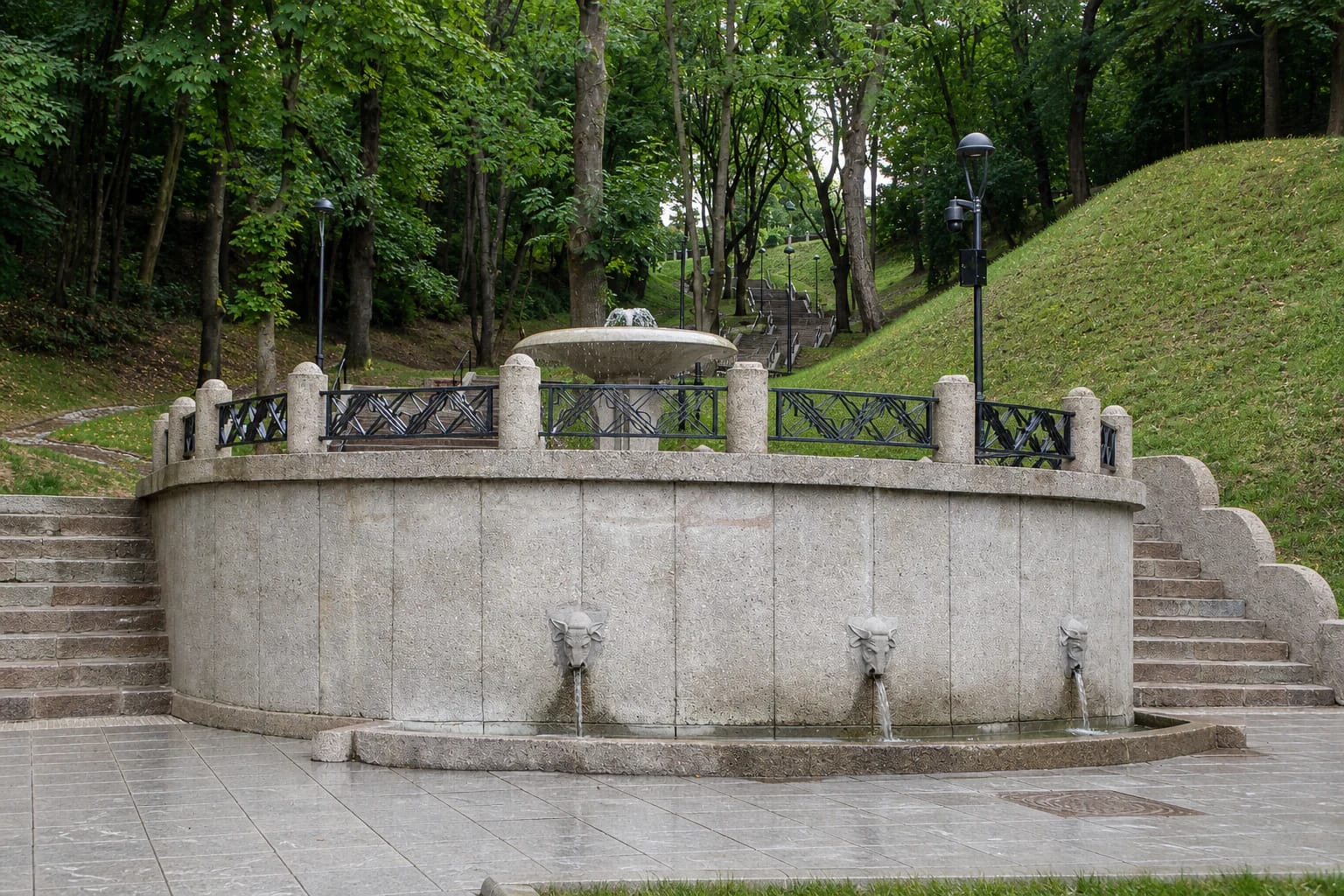
The historic fountain composition survives at the lower end near Žemaičių Street: a curved stone basin wall, balustrade, metal railings, central bowl, bull-head reliefs, and a trough. This is the fountain connected with the interwar water system, not the seasonal jets on the upper terrace. Its architectural details were restored during the 2018-2020 reconstruction.
The upper level originally held a three-part pool and cascade composition. It did not survive unchanged: wartime and postwar alterations transformed the water features, and a single pool later operated here. Today the outline of the former three-part pool is marked in the granite paving, with warm-season water jets integrated into the surface. This is a new layer of the reconstruction, not a literal rebuilding of the 1936 pool.
The stone sculpture Poilsis on the upper terrace is not part of the original interwar composition either. A sculpture guide published by Ąžuolynas Library records that Bronius Zalensas made it in 1962 and that it was installed on the Kauko terrace in 1974. The reclining female figure does not depict the mythological kaukas; official sources call the work Poilsis, meaning Rest, so it should not be confused with the place name or fountain ornament.
What survived and what was recreated in 2018-2020
The municipal public-space project, worth about EUR 1.4 million, ran from 2018 to 2020, with the renewed complex presented to visitors in 2019. The designers retained authentic granite steps and some historic metal railings, repaired structural elements and slopes, and restored both the lower fountain and the Poilsis sculpture. The present site is therefore neither an entirely new replica nor an untouched 1936 ensemble.
Some railings, concrete posts, and semicircular resting places were recreated from surviving examples. A tulip motif was repeated in their paving. At the same time, the former upper pool area became a new granite plaza that traces the old outline and incorporates a seasonal pavement fountain, while new benches, bins, four-metre lights, and security cameras were added.
The landscape was not simply cleared but recomposed: slopes were stabilised, hedges replanted, rows of mature trees retained, and a small green amphitheatre created by Aukštaičių Street. The site is best read as several periods together: the interwar granite axis and water concept, the postwar sculpture, and twenty-first-century measures for access, lighting, and a seasonal fountain.
How to visit and what to expect
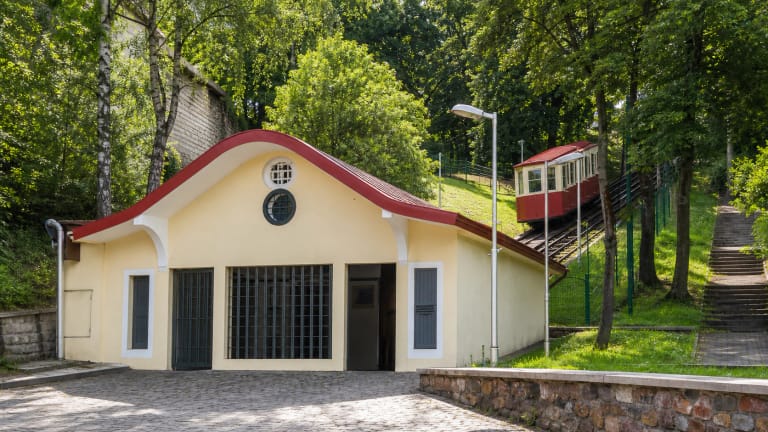
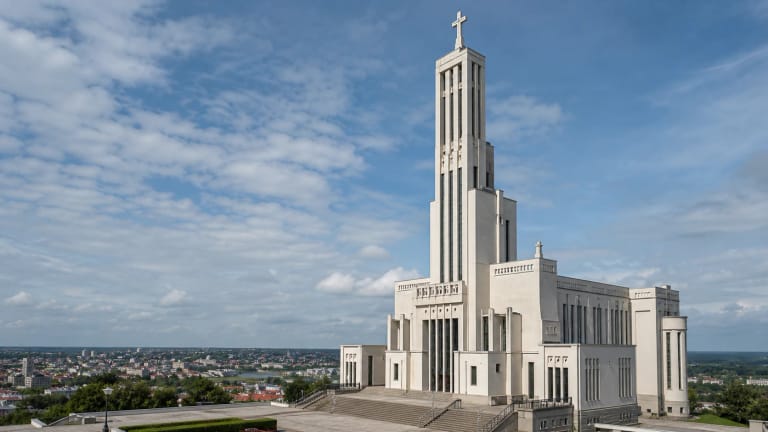
The clearest way to understand the whole ensemble is to walk in one direction between Žemaičių and Aukštaičių streets. Starting at the bottom, you first encounter the historic fountain, then long granite flights and semicircular resting terraces, and finally the former pool plaza, pavement fountain, and Poilsis sculpture at the top. A careful visit takes 30-60 minutes, while the walk can easily continue to Žaliakalnis Funicular and Christ's Resurrection Basilica.
The reconstruction improved partial accessibility. Tactile surfaces were added, ramps reach some terraces from Lietuvių and Aguonų streets, and the upper pool area has a sloping path. The central axis still contains many steps, however, and there is no continuous step-free route from Žemaičių to Aukštaičių Street. Wheelchair users and families with pushchairs should choose a specific upper or side approach rather than plan to traverse the entire route.
Kaukas Stairs is an open urban space for which official sources publish neither an admission charge nor standard opening hours. The fountains operate seasonally, and weather, maintenance, or municipal decisions can change their schedule, so check current Kaunas municipality notices and the situation on site before making a special trip. Granite steps can be slippery after rain, during a thaw, or in icy conditions. No dedicated visitor car park is documented at the complex, so use only legal spaces on surrounding streets.