- Place
- Kaunas City Municipality
- Region
- Kaunas
- Type
- memorial house of the Lithuanian playwright with authentic family interiors, a library, and a theatre exhibition
- Address
- Kalniečių g. 93, Kaunas
- Coordinates
- 54.90996, 23.92636
- Visit duration
- 45-60 minutes independently; about 1 hour with a pre-booked guided tour
- Best time
- Tuesday, Wednesday, Friday, or Saturday before 16:30; Thursday offers later evening access, while only the last Sunday of each month is open
Juozo Grušo namai-muziejus, Juozas Grušas Memorial Museum, J. Grušas House-Museum
The writer-planned 1938 house is the first exhibit
Pulcherija and Juozas Grušas acquired an empty plot in 1936 in what was still a semi-rural part of Žaliakalnis. Museum material says the writer devised the practical plan and building technician J. Miknevičius committed it to drawings. The family began settling during construction and the house was completed in 1938; accounts of a 1936 housewarming and 1938 completion therefore describe different stages.
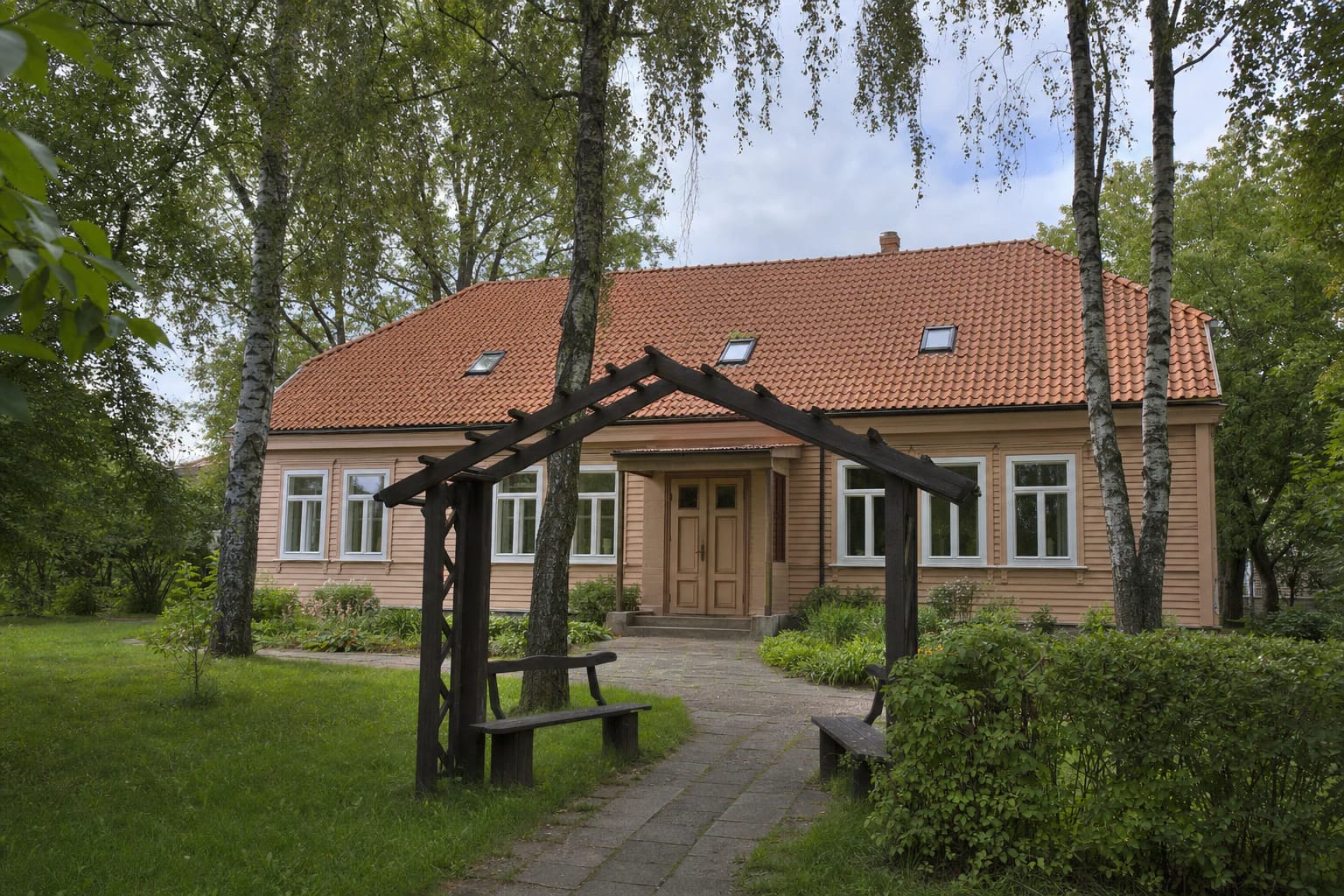
The timber house, one storey with a habitable attic, stands back from the street in a garden of mature birches. It has a rectangular plan, horizontal weatherboarding, broad ground-floor windows, a red-tiled gable roof, and narrow rooflights illuminating the attic rooms. An arched pergola on the entrance path reinforces its character as an urban homestead.
The building is entered in the Cultural Heritage Register under code 16568. Its value extends beyond association with a famous resident: it is an interwar Žaliakalnis house combining modernist influence with the idea of a comfortable suburban homestead. Walk the garden path before entering to read the proportions of volume, roof, and broad windows.
The study and living room preserve the scale of family life
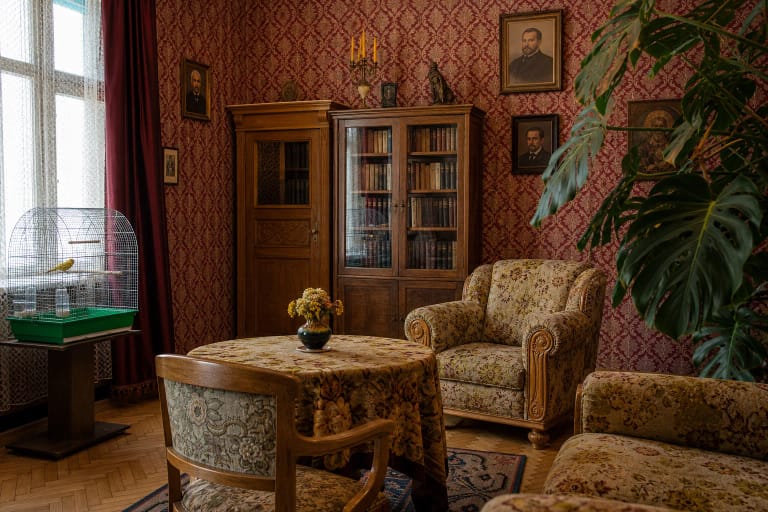
The two largest rooms held both everyday family life and the writer's work. A bookcase, sideboard, mirrored chest, wardrobe, period lights, artworks, and part of the library survive. This is not a generic interwar interior assembled from different estates; many objects belonged to the Grušas family.
Three Grušas children grew up here, while writers, painters, actors, and directors gathered in the rooms. The authentic living room shows how a private interior could operate as an informal Kaunas cultural salon. Guided visits discuss Grušas's friendships with Vincas Mykolaitis-Putinas, Salomėja Nėris, Juozas Miltinis, Rūta Staliliūnaitė, and other artists.
The memorial library matters for more than its quantity. Its books carry dedications, translators' autographs, and traces of family reading; the collection also holds manuscripts, letters to Pulcherija, photographs, and personal objects. Not every item is exhibited at once, so contact the curators in advance if your interest is highly specific.
From Herkus Mantas to Barbora Radvilaitė
The Universal Lithuanian Encyclopedia describes Grušas as one of Lithuania's leading playwrights. His historical dramas use figures of powerful passion and tragic fate to examine statehood, responsibility, and moral choice. Herkus Mantas was published and staged in 1957, Barbora Radvilaitė in 1972, and Švitrigaila reached the stage in 1975.
The museum's Barbora room is not an unchanged family room frozen in 1938. It was purpose-built as a theatre display and focuses on Jonas Jurašas's 1972 Kaunas Drama Theatre production of Barbora Radvilaitė, later named a performance of the century. Distinguishing memorial interior from curated theatre room prevents the entire museum being mistaken for one untouched domestic setting.
The theatre material also reveals a wider creative range. Love, Jazz and the Devil confronted contemporary youth conflict in 1967, while later works combined domestic situations, grotesque, and philosophical reflection. Production photographs, set-design sketches, and relationships with actors trace a text's journey from the writing desk to the stage.
From family home to a branch of the Maironis museum
Juozas Grušas was born in Žadžiūnai on 29 November 1901, came to study in Kaunas in 1924, and died in the city on 21 May 1986. Although he spent part of the post-war period in Šiauliai, the Kalniečių Street house remained the family's and his creative centre for almost five decades.
LIMIS biographical material states that a branch of the Maironis Lithuanian Literature Museum began operating here in 1989. Later building works, transfer of collections, and display development proceeded in stages; museum staff were still cataloguing books found throughout the house in 2000-2001. The branch's beginning should therefore not be confused with completion of today's displays.
It is now one of the Maironis Lithuanian Literature Museum's branches, not a separate municipal institution. The main museum is at Rotušės a. 13 and the Grušas house at Kalniečių g. 93. Tickets, schedules, and events appear on the same institutional site, but each branch has different hours and prices.
Opening hours, €2 admission, and access limits
On 27 July 2026 the official site listed Tuesday, Wednesday, Friday, and Saturday 09:00-17:00, Thursday 11:00-19:00, and the last Sunday of each month 10:00-16:00. Final admission is 30 minutes before closing. The museum normally closes on Mondays and other Sundays; check holiday exceptions officially.
On the same date, standard admission to the Grušas house was €2 and the reduced ticket €1. For groups of up to 25, a 45-60-minute Lithuanian tour cost €15 and an English tour €25, plus an admission ticket for every participant. Tours and educational sessions require advance booking, and tariffs can change.
The museum's official FAQ identifies the Grušas house as inaccessible to visitors with mobility disabilities. Historic thresholds, tighter rooms, and displays on different levels are relevant. Animals are not allowed inside, except assistance animals under applicable rules; the garden has a drinking station for pets. Telephone +370 667 28768 to discuss individual access needs.