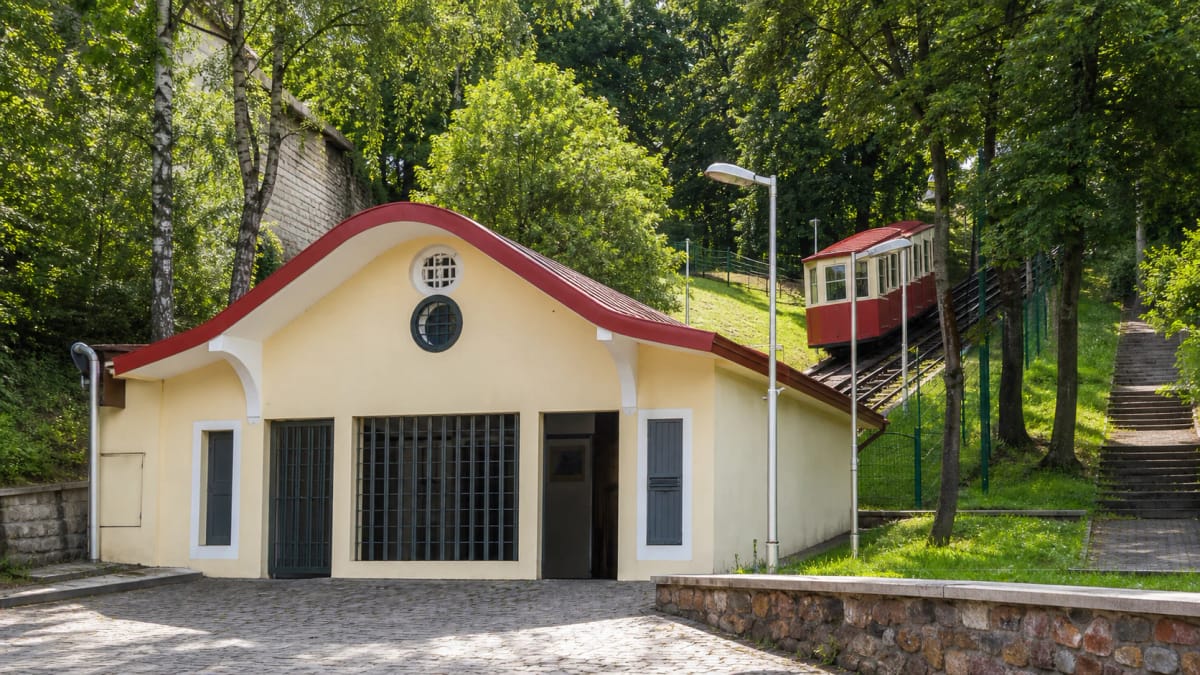
- Place
- Kaunas City Municipality
- Region
- Kaunas
- Type
- working interwar funicular and technical heritage object
- Address
- Aušros g. 6 ir V. Putvinskio g. prie A. Mickevičiaus g., Kaunas
- Coordinates
- 54.90138, 23.91786
Kaunas Žaliakalnis Funicular, Žaliakalnis lift, Žaliakalnis funicular structures complex
The shortest trip to Žaliakalnis
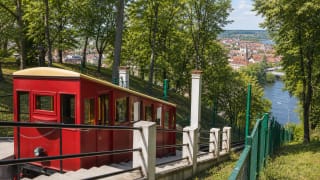
Žaliakalnis Funicular is one of those Kaunas places where the visit lasts only a few minutes, but many layers of city history fit inside. The lower station is near V. Putvinskio and A. Mickevičiaus streets, the upper station is on Aušros Street, and between them is a steep green slope that was a real everyday transport problem in the interwar period. It is one of two Kaunas funiculars still operating today; opened in 1931, the Žaliakalnis lift is older than the Aleksotas Funicular, which began operating in 1935.
The operator states that the distance between stations is 142 m, the rail incline is 14 degrees, one car can carry up to 25 people, and the climb or descent takes about 1.5 minutes. The place therefore works both as transport and as a short live exhibition of technical heritage.
Why Kaunas needed it
AUTC explains Žaliakalnis Funicular through the modernization of interwar Kaunas. The city was growing, the upper districts were expanding, but the connection between Žaliakalnis and the centre was made difficult by the slopes. This was not only a matter of convenience: transport directly influenced where people built houses, how much plots cost, and how the city joined into one daily organism.
According to the historical context given by AUTC, in 1927 a decision was made to build the funicular from Aušros takas to Kalnų Street. Before choosing the place, people walking up and down the stairs were even counted: source mentions of flows in the Kauko, Žemaičių, and Aušros directions show that the decision came not only from representation, but from a very practical analysis of urban load.
Opening in 1931
UAB Kauno liftai gives the exact start date: August 8, 1931. The operator writes that German specialists were consulted during design, and the Leipzig engineering company Curt Rudolph Transportanlagen prepared the project and manufactured the funicular. Electrical equipment was supplied by AEG, and chassis were acquired from the Swiss company T. Bell.
AUTC adds an important early detail: at first passengers were lifted by one wooden car clad in sheet metal, while the second, loaded with stones, acted as a counterweight. In 1932 Kaunas City Municipality decided to convert the control-weight car into a passenger car.
Reconstruction and the visible form today
Žaliakalnis Funicular changed quickly. The operator states that the rail branch was modernized in 1933, and in 1935-1937 the lift was reconstructed: passengers began to be carried in larger cars designed by N. Dobkevičius, with chassis ordered from the Swiss company T. Bell.
In the same period the lower passenger-station canopy was built on V. Putvinskio Street and is worth viewing separately. It is a small structure, but its scale clearly shows that the funicular was not an amusement ride, but an everyday city transport node.
How the lift works
The technical principle is visible right in front of visitors. The operator writes that the route consists of one pair of rails that branches into two pairs in the middle so the ascending and descending cars can pass each other.
The funicular is controlled from the upper station, where mechanisms are installed in the basement, and an electric motor drives the cable wheels through a gearbox. The cars have automatic brakes that would grip the rails if the cable broke and prevent them from rolling downhill. This matters because the heritage value here is not just nostalgia, but mechanical solutions.
Soviet period, protection, and the 2003 revival
The operator states that during the Soviet period the funicular belonged to local-utilities structures, in 1966 it was transferred to the Trolleybus Board, and in 1986 a complex repair was carried out. In 1998 it received immovable cultural-property status.
In spring 2003 the funicular was acquired by UAB Kauno liftai. The same year, on November 3, it began operating again after technical equipment was renewed. The operator emphasizes that the aim was to restore an appearance as close as possible to the original: staff uniforms, pre-war melodies, and music specially created by Giedrius Kuprevičius in the cars now work as deliberate historical atmosphere.
What to do at the top and bottom
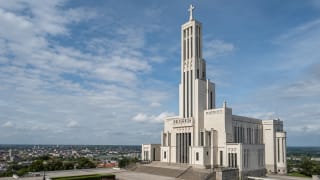
The lower side is convenient for starting from V. Putvinskio Street, the museum quarter, and Laisvės aleja. At the top, the funicular naturally leads toward Christ's Resurrection Basilica, from which you can continue a Žaliakalnis walk or return downhill by the same lift.
The operator notes that the photography art gallery F operates at the Aušros Street station, and tourists often use this funicular to reach the monumental Resurrection Church. Before planning a specific programme, check current operation, because hours, tickets, and events are changeable.
Accessibility and visiting caution
Plan this object as a working but small historic transport node. It is not enough to know that the funicular exists: check operator information before going, especially if your trip depends on exact hours.
Accessibility should be assessed carefully. The operator writes that the cars are prepared for disabled passengers, but the same text also mentions the possibility that a ramp may still be needed at the lower pavilion. If the trip must be step-free or wheelchair-accessible, confirm boarding conditions directly before visiting.