- Place
- Šiauliai City Municipality
- Region
- Samogitia
- Type
- historic central square, civic event space, and developing city-history exhibition site
- Address
- Junction of Tilžės Street and Aušros Avenue, Šiauliai
- Coordinates
- 55.93295, 23.31672
- Visit duration
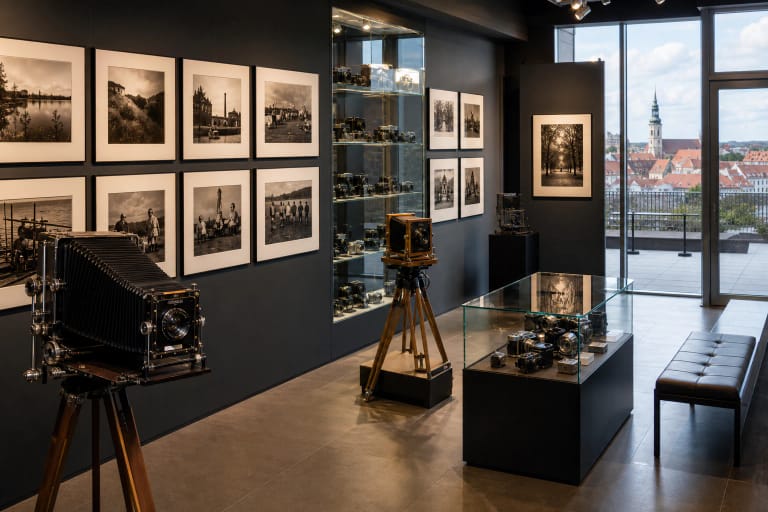
- 30-60 minutes for the square and the first stage of the observation-building exhibition; 1.5-3 hours with the cathedral, Photography Museum, and Vilniaus Street pedestrian boulevard
- Best time
- in daylight throughout the year; in the warm season for the fountains and after dark for lighting, but only after checking events, maintenance, and current barriers
Prisikėlimo aikštė, Šiauliai central square, Market Square, Freedom Square, Victory Square
A central square between the cathedral, City Hall, and active streets
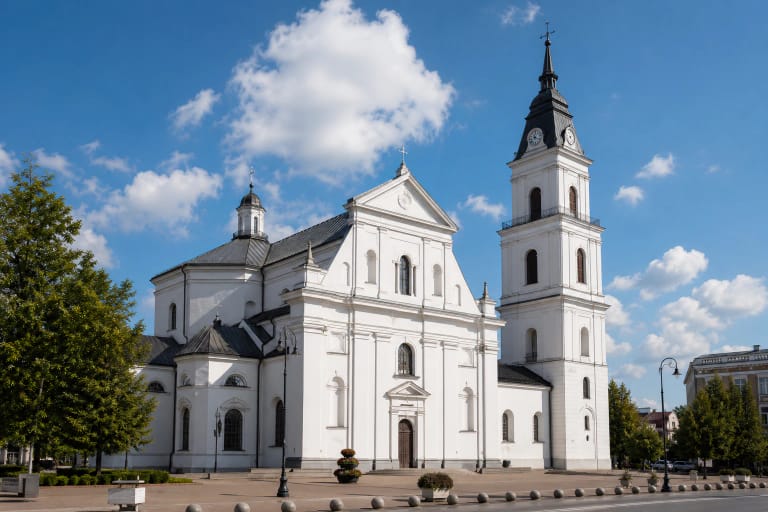
Resurrection Square occupies the heart of Šiauliai at the junction of Tilžės Street and Aušros Avenue. One linked civic composition contains the approaches to the Cathedral of St Peter and St Paul, a planted garden, the broad event plaza, and the City Hall side. Coordinates 55.932949, 23.316718 identify a representative point within the main square rather than the sole entrance, a fountain jet, the observation-building door, or a parking bay.
The word square can be misleading here: this is not a single uninterrupted pedestrian rectangle. Traffic uses Tilžės Street and Aušros Avenue, so visitors cross between the cathedral, principal paved area, and adjoining gardens at marked crossings. The relationship between streets and open spaces belongs to the inherited city plan, but it also sets a practical pace for families with children.
Aušra Museum describes the cathedral and its adjoining square as enduring landmarks of Šiauliai's spiritual and civic life. The Classicist urban core formed in the eighteenth century acquired Neoclassical, often called Stalinist Empire, buildings around it in the second half of the twentieth. The site rewards attention to this frame of successive periods rather than to one facade alone.
From a fifteenth-century market to the Classicist civic core begun in 1774
The first timber church was built here in 1445 beside an important road towards Riga. A settlement centre and market ground developed around the church. Records from 1589 list 26 houses around the square and, across the town, forty merchants, the same number of craftspeople and bakers, and nine butcheries. Those figures describe an early commercial nucleus; the present paving and street furniture are not surviving fabric from a sixteenth-century market.
By 1755, roughly thirty homesteads, the church, rectory, and a charitable hospital stood around the old market. Antoni Tyzenhaus became administrator of the royal estates in 1765 and introduced economic and urban reforms. Reconstruction of central Šiauliai began in 1774: a more regular rectangular street grid replaced much of the earlier radial arrangement, and the market area was enlarged.
The renewed marketplace contained merchants' shops, craft workshops, two drive-through trading ranges, and a two-storey coaching inn. A plan drawn in 1800-1801 clearly records the church, market, streets, and surrounding buildings. The First World War destroyed the Tyzenhaus-era trading ranges, so the square's market story survives through the direction of the city plan and the archaeological layer rather than intact stalls or market halls.
Market Square became Freedom, Victory, and finally Resurrection Square
By the early twentieth century, a market in the centre increasingly caused traffic and sanitation problems. The city council decided to move it on 9 December 1936, and the transfer was implemented in January 1938. The former trading ground was remade for public events and recreation, then named Freedom Square on 1 December 1938. On New Year's Eve that year, residents gathered around an illuminated tree here for the city's first communal open-air celebration of the coming year.
The Soviet occupation renamed the space Victory Square and used it for ideological ceremony. A reviewing stand, memorial signs, and Soviet military burials altered its setting. Those political features were gradually removed after Lithuania restored independence, and the city council adopted the present name, Resurrection Square, in 1998. It marks a new phase in the identity of the civic centre rather than one literal resurrection event that happened on this ground.
The sequence explains why old photographs, maps, and family memories use several names for the same place. Market Square describes its centuries of trade, Freedom Square the representative interwar space, Victory Square the Soviet period, and Resurrection Square the post-independence identity now attached to the centre of Šiauliai.
The 2018-2021 renewal reached far beyond the decorative paving
The technical-design and supervision contract with RS studija was signed in 2016, followed by the construction contract with Šiaulių plentas in February 2018. Architect Vytenis Rudokas conceived a relationship between history and the contemporary city: the cathedral and garden side carries the historical emphasis, while a broad, striped paved surface accommodates everyday movement and large events. Project activity under the funding agreement concluded in 2021.
The scheme was much wider than the main plaza. The official project record lists sections of Tilžės, Varpo, Aušros Avenue, and Vasario 16-osios streets, the Aušros pedestrian route, and the adjoining garden. It provided event-service infrastructure, new paving and lighting, landscaping, children's play areas, a surface car park, public-transport improvements, and road-safety measures.
The total project value exceeded €7 million, including €5.202 million from European Union funds and €459,000 from the national budget. That figure should not be described as the price of the square's patterned paving: it funded a broad program of connecting streets, engineering works, traffic infrastructure, and public spaces. The fountains and event fittings are only part of the whole.
The observation-building display is growing in stages, and the proposed freedom monument does not exist
The concrete screen and observation building is not a completed conventional city museum. An exhibition scheme was prepared in 2025 and its first relief element installed using material from the Aušra Museum collections. Impressions derived from keys, stove tiles, mechanisms, uprising emblems, and other traces of city life are being integrated into concrete, while historic plans explain the changing central square.
The Šiauliai Culture Centre planned a further three or four elements for 2026 and full activation of the observation building in 2027. Visitors therefore see an initial stage, not the finished display. An official notice updated on 23 March 2026 listed opening from Tuesday to Sunday, 12:00-22:00, but check this free-access timetable before travelling: it has changed in previous years.
The Tautos Laisvei, or To the Freedom of the Nation, monument long discussed for the City Hall garden was never built. A 2006 decision, later competitions, and a selected concept did not produce a structure. On 5 June 2025 the city council revoked the earlier decision and resolved not to erect the monument, so renderings and older promises found online do not describe the current square.
Works in 2026, seasonal fountains, and a realistic visitor plan
On 12 May 2026, the municipality announced the completion of archaeological work at the former Soviet military-burial site. The remains of 49 people had been recovered, while the landscape proposal provides a five-metre-wide continuation of the Aušros route, benches, low planting, Japanese rowans, and views towards the cathedral. At that date, the design documentation was still under expert review and part of the approach remained fenced. This did not mean closure of the whole square, but the condition of that specific section must be read from the latest signs.
The principal square is a public outdoor space without an overall ticket or gate hours. Its ground-level fountains operate seasonally and can stop for weather, maintenance, or events; no dependable permanent daily schedule for 2026 was found in the authoritative sources reviewed. Stay outside maintenance areas, keep children away from moving traffic, and expect wet paving to become slippery. Fountain water should not be treated as drinking water or a supervised bathing facility.
The reconstruction included accessible routes and firm paving, but work zones, event barriers, and temporary equipment can still change circulation in 2026. An open observation-building door also does not guarantee access to every component or to the upper level on every visit. Leave a car only in signed spaces: the page's pin marks the square, not parking, and charges or event restrictions can change.
For a short visit, walk the principal paved area, study the visual axis towards the cathedral, inspect the first exhibition relief, and cross into the planted section. For a fuller circuit, add the cathedral, Photography Museum, and Vilniaus Street pedestrian boulevard. The square then becomes an introduction to Šiauliai's urban history rather than merely a broad backdrop for events.