- Place
- Kaunas City Municipality
- Region
- Kaunas
- Type
- interwar healthcare modernism building, now the Centre branch of Kaunas City Polyclinic
- Address
- A. Mickevičiaus g. 4 / Miško g. 29, Kaunas
- Coordinates
- 54.89358, 23.91746
Sickness Funds, Sickness Funds in Kaunas, Kaunas City Sickness Fund building, Kaunas City Sickness Fund Palace, Kaunas Centre Polyclinic, Centre branch of Kaunas City Polyclinic
A healthcare-modernism corner
Kaunas City Sickness Fund Palace stands at the corner of A. Mickevičiaus g. 4 and Miško g. 29, where the Naujamiestis street grid begins to soften toward the quieter Karmelitų side. At first glance it is a small, restrained building, but its theme is rare on the Kaunas modernism map: healthcare and social-insurance infrastructure.
The AUTC entry directly links the building with the Sickness Funds and the present Kaunas Centre Polyclinic. OSM today marks the Centre branch of Kaunas City Polyclinic here, and the official polyclinic contact page gives the same A. Mickevičiaus g. 4 address. This is not an emptied heritage shell: the medical function remains very close to the original idea.
Why it is not just an office building
Interwar Lithuania did not have many larger and architecturally expressive medical-purpose buildings. AUTC, drawing on healthcare-history sources, stresses that the republic's hospitals then had about 3,000 beds in total, while smaller-town hospitals were often wooden and poorly reflected a modernizing society.
For that reason the Kaunas Sickness Fund building matters not only as a handsome modernist corner. It shows the moment when the city's healthcare system, social insurance, and everyday outpatient care began receiving an architecturally considered, visible form in the city centre.
Sickness Fund and workers' outpatient clinics
AUTC describes the building's function very specifically: a Sickness Fund building with outpatient clinics for the working population. That detail matters because the object was tied not to grand hospital representation, but to practical healthcare for city workers.
The Cultural Heritage Register explains the function even more precisely: sickness funds were social-insurance institutions and outpatient medical centres. In the Republic of Lithuania, the Sickness Funds Law was published in 1926, but the institutions themselves began to be established at the end of 1928, first in Kaunas and several county centres.
The building at the corner of A. Mickevičiaus and Miško streets joined bureaucratic, medical, and social functions in one institution. The register states that administrative premises were on the second floor of the present A. Mickevičiaus Street block, the Miško Street block held the insurance-operations hall, now the registration desk, and the same block included an isolated department with a separate entrance for patients with tuberculosis.
Dates and authors
The AUTC database dates the Sickness Fund building to 1933-1935, while the public entry shows 1933 as the starting year. The Cultural Heritage Register uses the wording built in 1933-1935 and 1938, and names Vytautas Landsbergis-Žemkalnis and Antanas Novickis as authors. The register also explains that in 1938, a children's centre and pharmacy extension was added to the southern block according to Novickis's design.
VLE describes Landsbergis-Žemkalnis as a Lithuanian architect, public figure, and one of the pioneers of modernist architecture in Lithuania. It also emphasizes his projects' functional clarity, constructive generalized forms, harmonious proportions, and repeated-element rhythm, all easy to recognize on the Sickness Fund facades.
Form adapted to function
The building is not radically avant-garde. AUTC describes its architecture as a balance between historicism and restrained modernism. That is visible on the facades: ornament is almost muted, but the volumes are not yet completely abstract.
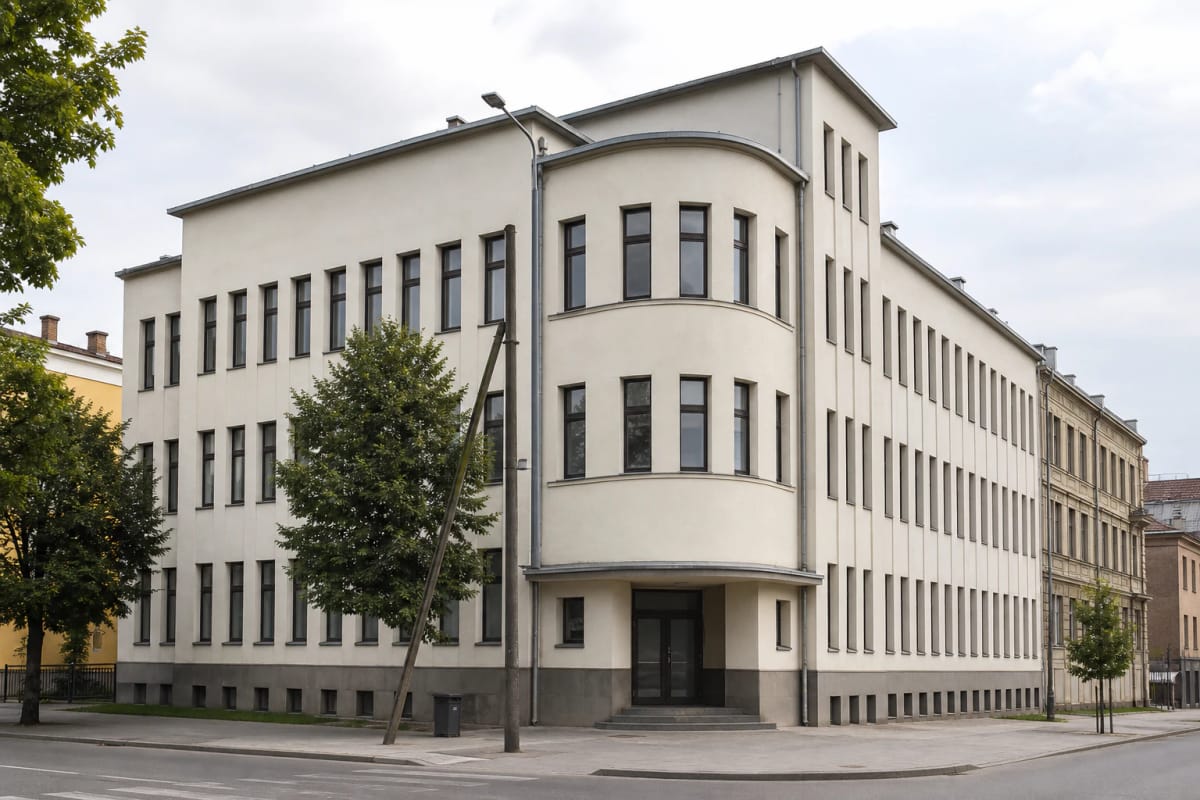
The register describes the composition as an L-shaped plan with a rounded corner, three storeys, attic, and basement under the whole building. The most important features visible from the street are the narrow vertical window rows, curved volumes, implied projections, emphasized corner part, and reinforced-concrete flat canopies above entrances.
The corner as an architectural decision
The A. Mickevičiaus and Miško street corner is not an accidental plot simply filled by the building. The curved corner volume with its window band focuses the view on the intersection, while the longer facades give rhythm to both streets. It is a smaller-scale but very urbanistically aware gesture of Kaunas modernism.
To see the building best, stop opposite the corner and look at how the vertical windows, rounded corner, and entrance canopy join the representative and practical sides. This object is not designed to impress with decoration. Its strength lies in proportion and functional clarity.
Healthcare construction context
AUTC stresses that medical-purpose construction in Lithuania intensified only as the country recovered from the economic crisis. The source mentions county hospitals opened in Kėdainiai, Zarasai, and Šakiai in 1937, along with other county hospitals then being built or designed.
The Kaunas City Sickness Fund building was one of the earlier signs in that context. It is not a massive hospital, but a city social-insurance and outpatient-clinic building, which is exactly why it shows everyday modernity well: how the interwar state and municipal environment tried to organize healthcare services more rationally.
Use today
The building is still used for healthcare. The official Kaunas City Polyclinic contact page lists the Centre branch, registration phone, and A. Mickevičiaus g. 4 address. A visitor should therefore approach it respectfully: this is an active medical institution where people come for healthcare services.
For architecture, an exterior walk and observation from the pavement are enough. If you do not have a medical reason, it is not worth looking for the interior as a tourist object. The best way to experience it is to understand why the function itself is part of the heritage.
KVR and UNESCO context
In the Cultural Heritage Register, the object is called the Sickness Fund building. Its unique code is 45560, status is registered, significance level is regional, and type is individual object. The register states architectural and historical significance, and the protected territory covers 1,023 square metres.
The register also notes that the object lies within the Kaunas city historical part called Naujamiestis, code 22149. This matters because the building's value works on two levels: as a separate registered object and as part of Naujamiestis modernist heritage.
The UNESCO World Heritage property Modernist Kaunas: Architecture of Optimism, 1919-1939 covers the broader Kaunas modernism phenomenon. It is therefore accurate to call the Sickness Fund Palace an object in the Kaunas modernism context, but not to present it as a separately, individually inscribed UNESCO building.
What to notice on site
First look for the corner: the rounded volume and modest canopy show how a small architectural gesture can create a clear address for a public institution. Then notice the window rhythm, which gives the facade discipline while recalling the administrative-medical work of the building.
Finally, it is worth mentally comparing the Sickness Fund building with larger interwar representative objects in Kaunas. There is no bank monumentality or ministry solemnity here, but there is another kind of modernity: functional social-care architecture that remains part of the city's healthcare infrastructure.