- Place
- Kasčiūnai, Merkinė Eldership, Varėna District Municipality
- Region
- Dzūkija
- Type
- state-protected Lithuanian partisan command-post site with a bunker rebuilt in 1997 and reconstructed in 2022
- Address
- Kasčiūnai, Merkinė Eldership, Varėna District
- Coordinates
- 54.11692, 24.27987
- Visit duration
- about 30-60 minutes for the command-post site alone; roughly 4-7 hours for the 14 km circuit or a full day for the 28 km route
- Best time
- daylight and dry weather from spring to autumn; check trail conditions and available daylight before attempting a longer route
Adolfas Ramanauskas-Vanagas Command Post, Kasčiūnai Bunker, Jakavonis Farmstead Partisan Command Post, Lietuvos partizanų vadų vadavietė Kasčiūnuose
The precise command-post site is in the farmstead setting, not on nearby Oath Hill
The exact Google Maps entry places the Lithuanian partisan command post at 54.116921, 24.2798657 in Kasčiūnai. The point marks the historic bunker site by the Merkys bluff, not guaranteed public parking. Oath Hill is a separate stop about one kilometre to the west, so do not confuse the two entries when navigating.
Allow about 30-60 minutes to see the reconstruction and understand its historical setting. The site stands within the farmstead environment, so use only permitted access, follow local signs, and do not enter unmarked residential or working areas.
Merkinė Regional Museum includes the command post in publicly described walking routes, but the checked sources publish no daily timetable, ticket office, or admission for the bunker interior. Photographs from the 2022 ceremony show the hatch open during the event, but they do not prove that the underground chamber is accessible without arrangement every day. Check the museum or municipality for the latest information before making a special journey.
The site is authentic, while the bunker visible today is a reconstruction
The Cultural Heritage Register lists the site under code 25459 as state-protected heritage of national significance. Its valuable properties include the shelter-bunker site, terrain, historical and memorial associations with the partisan commanders, and the Merkys landscape. The registered area covers 113 square metres and lies within the Merkys Landscape Reserve.
The Register clearly distinguishes the place from the present structure: a reconstruction stands on the original bunker site. The bunker was rebuilt in 1997 through the initiative of Auksutė Ramanauskaitė-Skokauskienė, Vytautas Kaziulionis, and the owners of the farmstead, and reconstructed again in 2022. On 23 July that year, the Ministry of National Defence documented an opening ceremony at the command post.
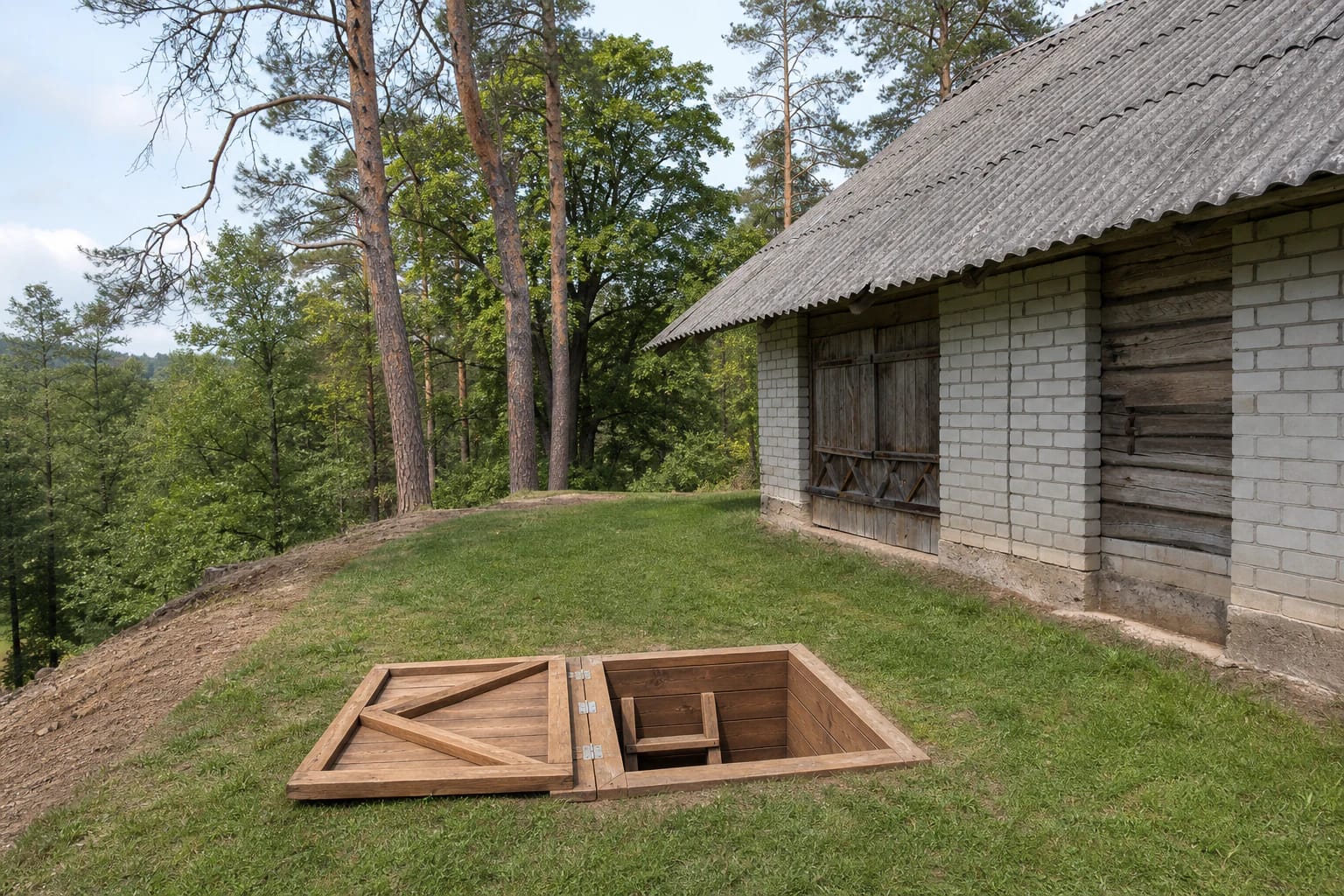
The accurate description is therefore an authentic historical site with a reconstructed bunker, not an unchanged 1945 interior. The timber hatch, steps, and underground chamber convey the scale of a shelter, but their current boards, structural elements, and display objects are not automatically original items used by the partisans.
The winter shelter was concealed between farm buildings and the Merkys bluff
The municipal guide, quoting Vanagas's memoirs, explains that as winter approached Tigras's parents allowed a shelter to be dug beside their buildings on the bank of the Merkys. Its entrance began in a shed and the access passage was about eight metres long. That distance muffled voices, radio sound, and even a test shot, allowing the daily life of the farm to conceal underground work.
A small trusted group dug the bunker and concealed its roof with turf. The memoir describes the alarm caused by unexpected partisans and a neighbour's school-age child appearing while work was under way. Secrecy was not picturesque background; it was the essential defence of the shelter and everyone connected with it.
Official sources do not give an identical time span. The 2025 municipal guide states that Vanagas used this bunker from 1 December 1945 until May 1946. The current Register description associates the command-post site with the wider period from June 1945 to July 1946. That broader register range should not be treated as proof that the same people occupied the bunker continuously for all thirteen months.
The command post supported the Merkinė operation, underground press, and organisational work
In December 1945, news reached the command post that partisans had died beside the Merkys. Vanagas proposed attacking Merkinė, and Kazimieraitis approved the idea and offered advice. Coordination of units, communications, and assignments began here, and the attack took place on 15 December 1945. It was a complex military operation, not simply a spontaneous raid launched from the bunker.
The municipal guide and Cultural Heritage Register state that Laisvės varpas was printed here, public appeals were prepared, and rules for partisan awards were drafted. The Register specifically identifies appeals opposing the 9 February 1946 election to the Supreme Soviet of the USSR and later texts concerning its results.
One of the most dramatic memoir episodes concerns a search of the farm. Eight Soviet soldiers were inspecting the property; four entered the building where the bunker passage began while the partisans below were still talking loudly and testing a machine gun. The roughly eight-metre approach muffled the noise, and the open entrance went unnoticed. This is an episode documented in Vanagas's memoir, not a local legend.
Kazimieraitis was Vanagas's commander, colleague, and mentor here
The Varėna guide and the LGGRTC route description agree on the dates of Kazimieraitis's stay: at Vanagas's invitation he moved into the command post on 4 January 1946 and worked here until the end of March. At the time, Juozas Vitkus-Kazimieraitis commanded A District, while Vanagas led the Merkys Formation.
Vanagas's memoir presents their time together as more than a chain of command. He recalled long working days that exhausted Kazimieraitis, brief walks in the forest, and partisan songs as moments of relief. Vanagas described him as a kindred spirit and a guide for his later work in the resistance.
Both commanders therefore belong in the site's name, but their later ranks should not be projected backwards onto the winter of 1945-1946. Vanagas reached the highest LLKS leadership posts later, and Kazimieraitis became commander of the Southern Lithuania partisan region in spring 1946. Kasčiūnai preserves the earlier period of their direct collaboration.
The command post is a junction for three routes of different lengths
Merkinė Regional Museum publishes a 28 km full circuit and a 14 km short circuit of the Vanagas Trails. The full route starts at the Dainava District partisan memorial in Merkinė and ends on Merkinė Hillfort, while the short circuit begins and ends at the Kasčiūnai command post. The routes are marked with grenade symbols and concrete arrows.
The museum also publishes a separate 22 km Puvočiai-Kasčiūnai-Puvočiai loop. This is not a short access path from parking but a self-contained hiking route. Markers, footbridges, and forest tracks can change, so download the latest guide or GPX file before setting out and allow enough time to return in daylight.
A short visit does not require completing an entire circuit. Even so, pairing the bunker with Oath Hill and Merkinė reveals the difference between a secret command post, a remembered oath site, the planning of an armed operation, and the later landscape of commemoration.