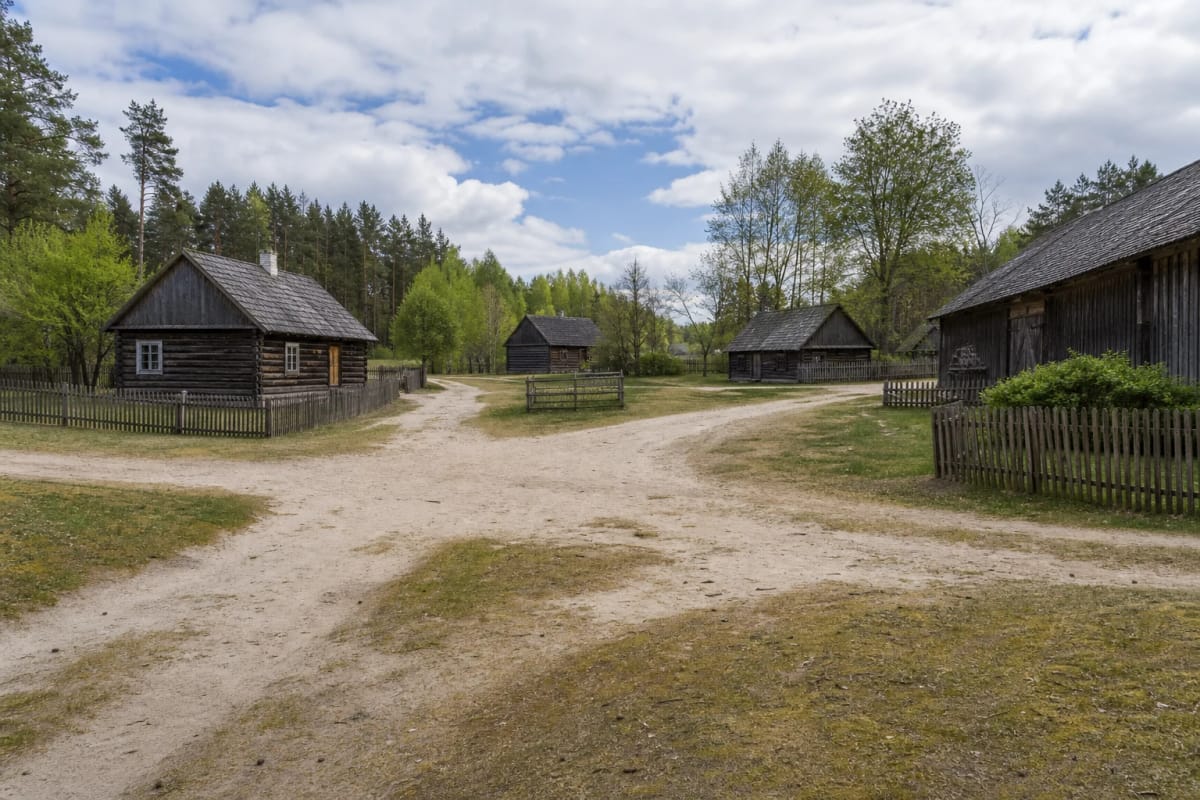
- Place
- Marcinkonys eldership, Varėna District Municipality
- Region
- Dzūkija National Park
- Type
- ethnographic village by the Skroblus in Dzūkija National Park
- Coordinates
- 54.09500, 24.28200
Dubininkas, Dubininkas ethnographic village
A small village by the lower Skroblus
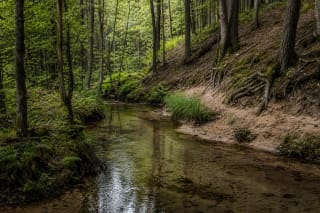
Dubininkas is in Varėna District, Marcinkonys eldership, within Dzūkija National Park, about 8 km northwest of Marcinkonys. VLE notes that the Skroblus, a left tributary of the Merkys, flows through the village. This is already the lower Skroblus setting: VLE notes that the stream's discharge was measured at Dubininkas, with an average of 0.64 and a maximum of 1.73 m3/s, and that Skroblus as a whole is considered one of Lithuania's cleanest rivers.
The place matters not because of size, but because of form. VLE records only 4 residents in 2021, so Dubininkas must be visited very sensitively: it is a small settlement where a heritage view overlaps with real private life. According to Dzūkija National Park data, Dubininkas belongs to the park's ethnocultural villages together with Margionys, Musteika, Zervynos, and others.
A rare scattered plan with four streets
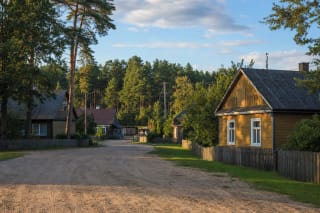
VLE describes Dubininkas as a scattered-plan village with traits of a street village and stresses that few villages of this plan remain in Lithuania. The homesteads stand around a rectangular square into which four streets converge. Saugoma.lt also identifies Dubininkas as a protected ethnographic village, valuable for its authentic plan and wooden architecture.
This plan is exactly what is worth seeing on site. Instead of looking for one prettiest house, stop at the relationship between the square and the four streets: it shows how a small community arranged space among the stream, roads, and homesteads. This scattered plan is a rare variant of the street village, making Dubininkas important as a living example of a traditional Lithuanian settlement.
Homestead buildings and their layers
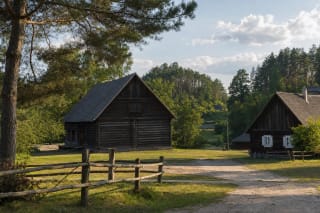
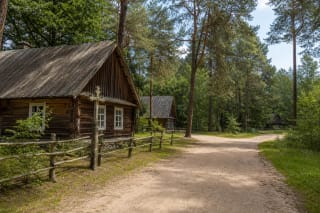
VLE writes that Dubininkas houses were usually reconstructed several times, granaries have side or end porches, and barns have one or two threshing floors. This does not show a frozen old-time picture, but a long history of adaptation and use: traditional Dzūkian buildings were continually repaired according to family needs.
In places like this, reconstruction is not automatically the enemy of heritage. It testifies that houses were used, repaired, and altered, so visitors should read both older and newer layers. Granary porches and barn threshing floors are practical details that tell of farm life by forest and stream.
History from 1742
VLE notes that Dubininkas formed in the early eighteenth century on the lands of the Margionys manor farm and has been mentioned since 1742. This connects the village with nearby Margionys at the Skroblus source: both settlements belong to the same valley cultural landscape, but Dubininkas lies downstream.
VLE also gives population changes: in 1907 there were 92 residents and 6 homesteads; in 1959, 62; in 1970, 48; in 1979, 26; in 1989 and 2001, 10 each; and in 2011 and 2021, only 4 residents each. This steady decline changes the visitor's perspective: Dubininkas is not just a pretty Dzūkija photograph, but also a question of village decline, memory, and heritage protection: how to preserve a place plan and dignity when a settlement is very small.
Dubininkas on the Skroblus valley route
VLE states that the Skroblus valley is distinct, in places wide, 600-700 m, marshy, with spring-rich and forested banks. Dubininkas is one stop on the 13 km loop Skroblus Nature Trail, which links the stream sources near Margionys, the mid-course nature reserve, and the lower course at Trasninkas, where Skroblus flows into the Merkys.
Dubininkas is therefore best understood not separately, but as part of the whole Skroblus valley. When linked with the Skroblus springs, Margionys, and the nature trail, the scattered village plan becomes not a curiosity, but a logical example of a forest-region settlement by a clean, protected stream.
How to visit Dubininkas
Dubininkas has no museum opening hours or ticket. Stay on public roads, do not enter homestead yards without permission, do not photograph residents close up, and do not park in a way that blocks access. This is living outdoor heritage, where respect for people matters most.
It is best to combine Dubininkas with the Skroblus theme: the Skroblus springs, Margionys, and the Skroblus Nature Trail, and for wider context with Marcinkonys and Zervynos. Then the village plan becomes part of the whole ethnocultural landscape of Dzūkija National Park.