- Place
- Varėna District Municipality
- Region
- Dzūkija National Park
- Type
- landscape reserve with Stone Age settlements
- Address
- Merkinė eldership, about 6.5 km east of Merkinė, Varėna District
- Coordinates
- 54.15300, 24.28800
Glyno landšaftinis draustinis, Glynas Landscape Reserve
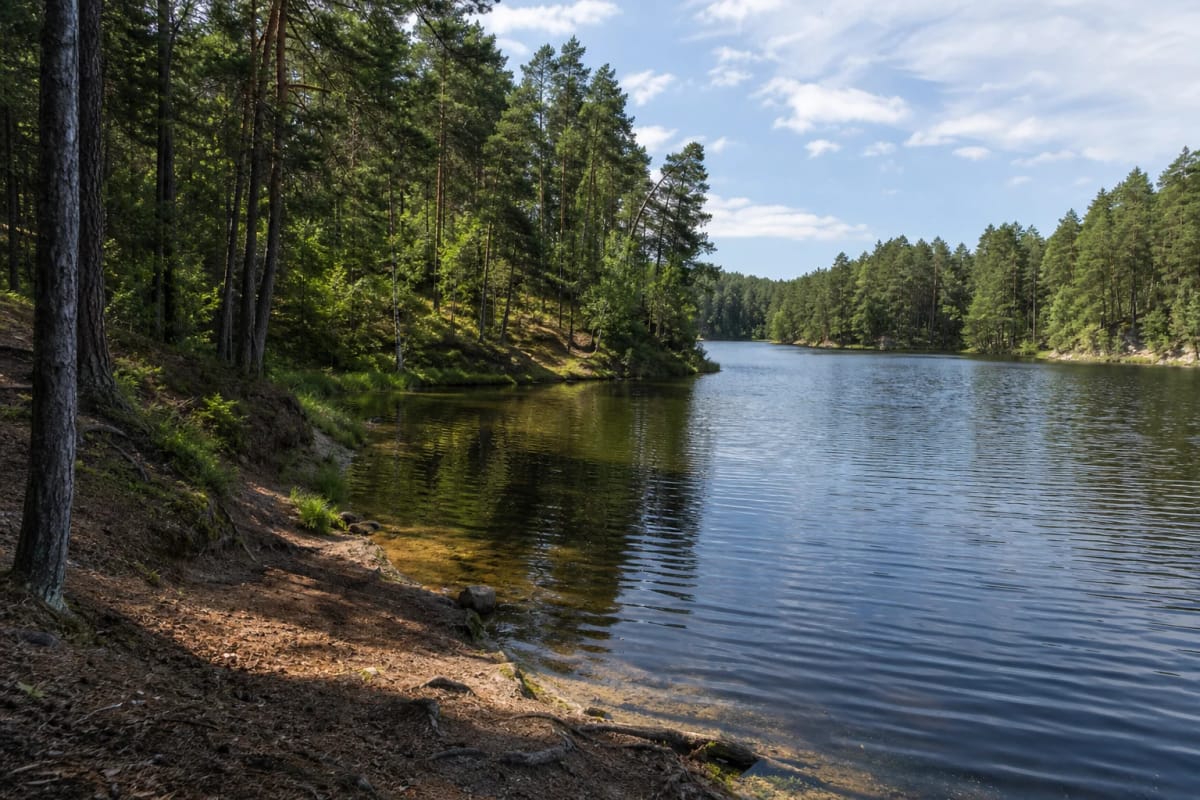
Glynas Landscape Reserve: a lake in Dainava Forest
Glynas Landscape Reserve is a 281 ha protected area in the north-central part of Dzūkija National Park, in Dainava Forest, about 6.5 km east of Merkinė. Despite occasional confusion, it is not by Druskininkai but in Varėna District, Merkinė eldership, near Mardasavas.
The older Lithuanian name of the area is Glyno landšaftinis draustinis; landšaftinis and kraštovaizdžio mean the same kind of landscape reserve. The reserve protects the expressive hollow of Lake Glynas, the natural Glynupis stream, a cluster of Stone Age settlements, and wetland and forest habitats of European Community importance.
Lake Glynas and the hollow
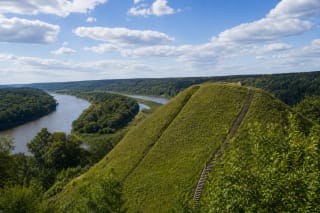
Lake Glynas is small, about 16 ha, elongated from northeast to southwest, with high wooded banks. It lies in a deep hollow, so the landscape here feels distinct and calm; a stream flows out from the lake toward the northeast.
Dainava Forest pinewoods ring the lake, while Glynas Mire adjoins it from the south. Campsites stand on the northern and southern shores. This is a place for quiet walking and nature observation, not loud recreation.
Stone Age settlements
The reserve's most important value is the cluster of Stone Age settlements around the lake, one of the richest in Lithuania. Konstantinas Jablonskis found the settlements in 1938-1940, and later archaeologists Rimutė Rimantienė and Algirdas Girininkas studied them. About eleven flint-working places and camps were found, mostly on the high western banks of the lake.
The finds cover the Paleolithic, Mesolithic, and Neolithic: flint arrowheads, scrapers, and burins. Especially significant is that one of the oldest Magdalenian-type flint arrowheads in Lithuania was found in a dune by Glynas Mire. Some finds are kept in the National Museum of Lithuania, and individual Glynas settlements are listed in the Register of Cultural Property.
Protected habitats and nature
Beyond archaeology, the reserve protects valuable wetland and forest habitats and rare species. Saugoma.lt mentions Liparis loeselii, a bog orchid, the flat bark beetle, and the bitterling, species sensitive to habitat change.
The reserve is part of Dzūkija National Park, established in 1991 and the largest in Lithuania. Public sources do not give a precise separate establishment date for this reserve, so it is better to connect it with the national park context rather than name unsupported separate years.
Visiting
The reserve is an open, free protected area without opening hours or tickets. Lake Glynas is reached by forest roads from Mardasavas or from the Merkinė-Mardasavas direction; it is also a stop on one Varėna-region cycling route. Camping is allowed only in designated campsites.
There is no separate visitor centre by the reserve. The nearest Dzūkija National Park centres are in Merkinė and Marcinkonys. It is convenient to combine the visit with Merkinė, Liškiava, and other park sites; the best season is late spring to autumn.