- Place
- Kasčiūnai village, Merkinė Eldership, Varėna District Municipality
- Region
- Dzūkija
- Type
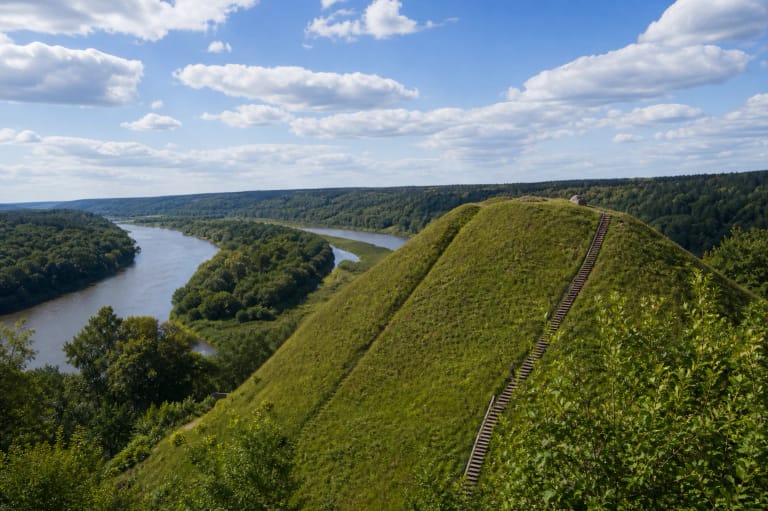
- a natural hill above the Merkys valley and a documented Lithuanian partisan oath site on the Vanagas battle-trail route
- Address
- Kasčiūnai, LT-65343 Varėna District Municipality
- Coordinates
- 54.11254, 24.26487
- Visit duration
- 20-45 minutes as a separate stop; 4-7 hours for the selected 14 or 28 km Vanago kovų takais route, depending on pace and stops
- Best time
- a dry day from late spring to autumn, when paths in the Merkys valley are easier; make a first visit in daylight
Priesaikos kalnas, Partisan Oath Hill, Kasčiūnai oath site
The 4.9 Google marker identifies the hill, not a car park or official trailhead
The exact Google Maps listing Priesaikos kalnas, place ID ChIJ94vyV_Mf3kYRJFlURjypVUE, marks the hill at 54.1125416, 24.2648684 in Kasčiūnai. On 15 July 2026, it averaged 4.9 out of 5 from eight reviews. It clears the selection threshold, but eight votes are a very small sample, so one new score can noticeably change the average.
The marker identifies the historical site, not an officially confirmed car park, visitor centre, or gated entrance. No formal parking area immediately beside the hill was found in the checked authoritative accounts. Leave a vehicle only where signs permit, keep local roads clear, and never drive across a meadow in an attempt to reach the pin itself.
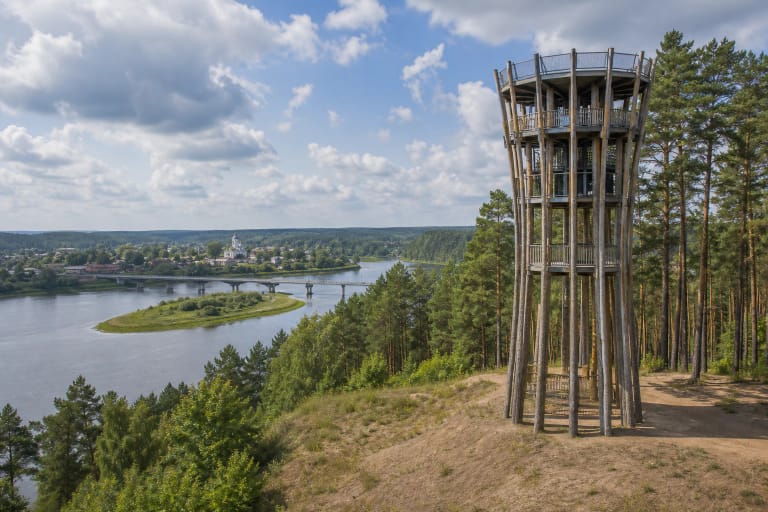
Allow 20-45 minutes for an unhurried standalone stop. The value here is not a large monument or a built panoramic platform. It lies in the terrain, the pines, the proximity of the Merkys valley, and one participant's carefully recorded testimony. A saved copy of the official route guide makes the place much easier to read on a first visit.
Jonas Jakavonis-Dobilas took the oath here in Vanagas's presence
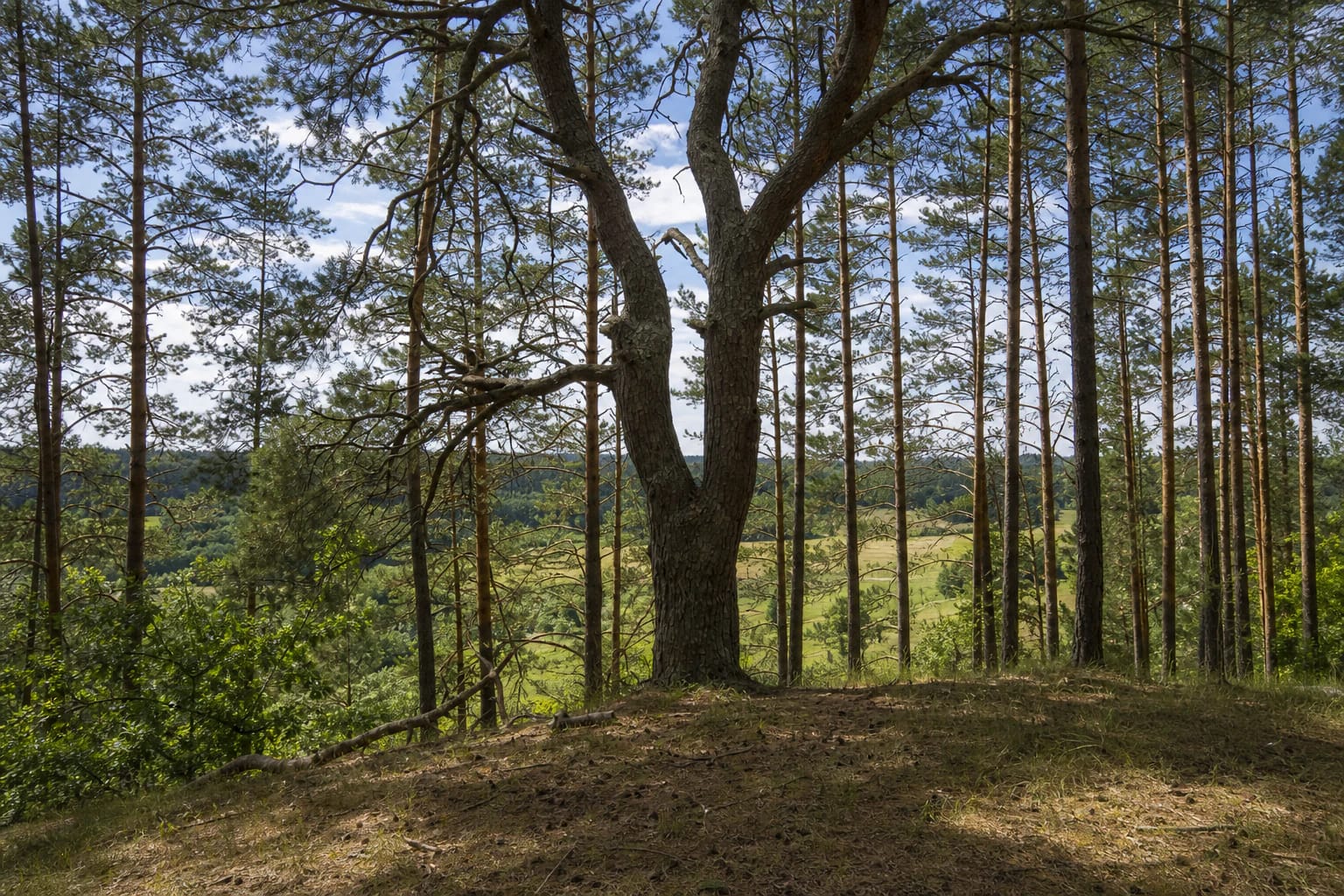
The 2025 Varėna District Municipality guide preserves the recollection of Jonas Jakavonis-Dobilas. He said that he took the partisan oath on this hillside beside the only forked pine then growing here, in the presence of Adolfas Ramanauskas-Vanagas. Vanagas recited the oath from memory and the candidates repeated it aloud.
The precise account therefore says that Jakavonis and other unnamed candidates swore, while Vanagas administered the ritual. The common shorthand that Vanagas himself swore here changes the meaning of the official source. Nor does the guide say how many candidates attended the ceremony remembered by Jakavonis, so a number should not be guessed.
The source also gives no exact date for the ceremony on this hill. A general oath text signed by Adolfas Ramanauskas-Vanagas on 18 July 1945 is reproduced alongside the place account and provides essential context. Its position on the page does not demonstrate that Jakavonis took his oath here on 18 July. These are related but distinct pieces of evidence.
The 1945 document explains what the oath meant, but does not date the hill ceremony
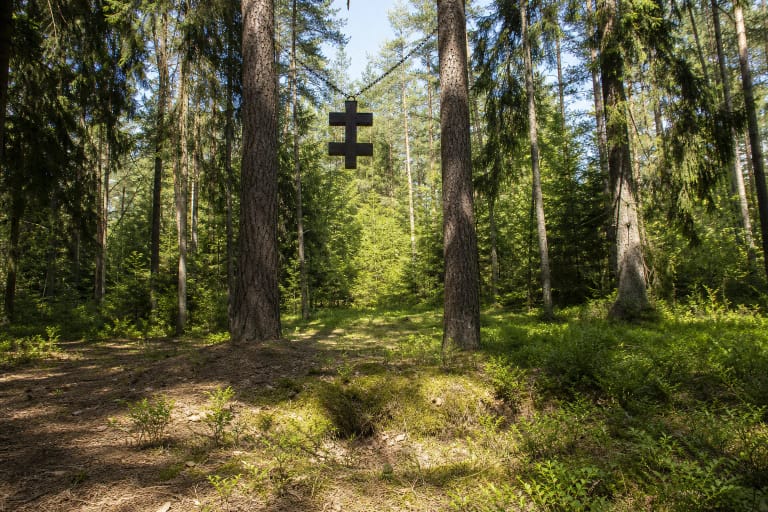
The oath document summarised in the official guide committed a new partisan to defend Lithuania's statehood, national welfare, and independence, obey the resistance leadership, and protect entrusted secrets. Its notes also describe the ritual: a prayer preceded the repeated words, the right hand was raised, and the candidate kissed a cross at the end.
Adolfas Ramanauskas-Vanagas signed this document on 18 July 1945, and the guide identifies the original as part of the Museum of Occupations and Freedom Fights collection. The oath was not a ceremonial attraction. It marked entry into a clandestine organisation and carried obligations of discipline, secrecy, and personal danger.
Vanagas's biography clarifies why he was administering oaths. VLE records that the teacher Adolfas Ramanauskas joined the partisans on 25 April 1945, became commander of the Merkys detachment and later the Dainava Partisan District, and signed the Lithuanian Freedom Fighters Movement Council declaration of 16 February 1949. Oath Hill belongs to the early resistance network in Dzūkija; it is not intended as a memorial to every stage of his life.
An almost bare slope, a forked pine, and the Merkys formed the wartime landscape
Jakavonis recalled that the hill was almost bare when the oath was taken. One forked pine stood on it, while the Merkys flowed in front of them beyond a mown meadow. That detail explains why today's more wooded slope can look unlike the underground years and how the oath site once opened visually towards the river valley.
The municipality's 2025 guide reproduces a photograph of the forked pine made by the Černiauskas brothers in 1995. It shows a tree splitting low among pines that had grown around it, and the guide also includes their portrait of Jonas Jakavonis-Dobilas from the same year. These are valuable historical images, not a 2026 arboricultural survey or a guarantee that every stem and branch remains unchanged.
Do not climb the tree, break branches, or try to mark a supposed exact standing point with stones or carvings. The site's authenticity rests on its natural ground, the old pine, and the documented account, not on a visitor's token. Photograph from the publicly accessible trail side and do not enter neighbouring homesteads or fields without permission.
Oath Hill is stop 12 on the Vanago kovų takais route
The 2025 guide describes a 28 km main circuit and a 14 km short circuit. The shorter route begins and ends at Kasčiūnai in the surroundings of the home of Karolina and Julius Jakavonis, parents of the partisan Tigras. The long route starts at the Merkinė Hill of Crosses and finishes on Merkinė Hillfort.
Oath Hill is numbered 12. It follows the Jakavonis family farm, where Vanagas's winter headquarters was established in autumn 1945, and precedes Kasčiūnai cemetery and the ambush and battle site associated with the eve of the attack on Merkinė. That sequence reveals the hill not as an isolated memorial but as one point in a dense underground network along the Merkys.
The latest municipal guide describes the shorter route as marked by red grenade symbols and concrete arrows. Older accounts may show a different waymarking system, and physical signs change, so download the current map before setting out. LGGRTC has also published broader historical-route sections. Always attach a distance to the specific itinerary selected instead of adding figures from separate route descriptions.
There is no listed ticket or gate, but the natural slope is not confirmed as step-free
The checked official descriptions of Oath Hill and the route publish no separate admission charge, ticket office, gate, or opening schedule. The Google listing also shows no formal timetable. That does not make a night visit sensible: there is no advertised lighting, natural ground and waymarks are harder to read in darkness, and homes and privately used land lie nearby.
No authoritative source checked confirms a toilet, drinking water, bins, or a visitor centre at the hill. Carry water, wear closed footwear, use tick protection, and take every piece of waste away. For either full circuit, consider daylight, weather, and your pace. The 14 km route normally occupies several hours, while 28 km requires much of a day.
A natural hillside, forest floor, roots, and possible mud do not make a reliably barrier-free surface. The sources do not claim that a wheelchair-adapted route runs from a vehicle to the site. Visitors with mobility requirements should contact Merkinė Eldership or the route organisers before travelling to ask about current access.