- Place
- Minaičiai, Radviliškis District Municipality
- Region
- Radviliškis District
- Type
- nationally significant partisan-war memorial site with a reconstructed headquarters bunker, granary, exhibition, and monument to the LLKS declaration
- Address
- Partizanų Street, Minaičiai, Grinkiškis Eldership, Radviliškis District
- Coordinates
- 55.62774, 23.55291
Minaičių partizanų bunkeris, Minaičiai bunker museum, Minaičiai headquarters, Movement of the Struggle for Freedom of Lithuania Memorial in Minaičiai
The bunker interior is advance-booked even though Google lists the outdoor memorial as open around the clock
The headquarters site is on Partizanų Street in the village of Minaičiai, Grinkiškis Eldership, at 55.62774, 23.55291. Baisogala Culture Centre states that tour times are individually agreed with guide Rima on +370 698 25197. The 08:00-17:00 and 08:00-18:00 hours in the page footer belong to the culture centre's office at 46 Maironio Street in Baisogala, not to the Minaičiai bunker, and must not be treated as museum opening hours.
On 13 July 2026, the operator listed a EUR 3 adult admission including a guide and EUR 2 for children, school pupils, students, disabled visitors, and pensioners. Confirm the price, payment method, group size, and tour language by telephone before travelling, because there is no ticket desk operating fixed daily hours and the tariff can change.
Google marks the outdoor attraction as open 24 hours, but that does not imply unrestricted access to the granary, exhibition, or bunker. Allow about 45-60 minutes with a guide. The bunker is only 1.35 metres high, so visitors must stoop; discuss the descent, mobility requirements, and adaptations when booking.
The event site and farmstead landscape are authentic, while the granary and bunker were reconstructed in 2012
The protected Mikniai-Pėtrėčiai farmstead encompasses much more than an underground room. The Register of Cultural Property identifies the bunker and former granary locations, traces of the farm plan, the well, old orchard, and level rural landscape falling towards the Gomerta stream. Here, the work of a partisan command was concealed beneath the routine appearance of a supporter's working farm.
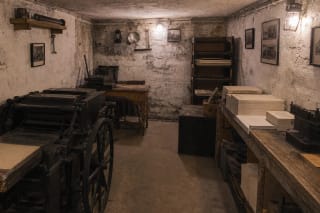
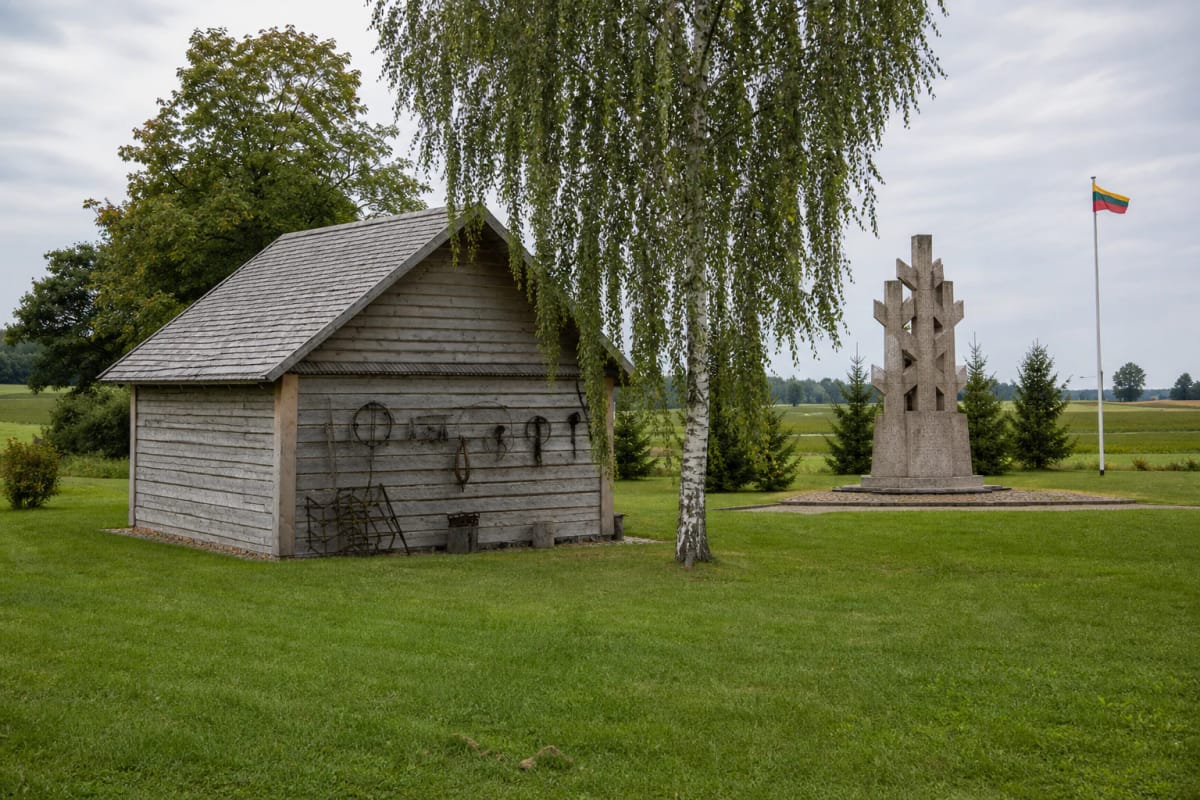
The present grey timber granary and bunker beneath its floor are not unchanged buildings preserved since 1949. After the hiding place fell out of use, water undermined it; it collapsed in 1953 and the owners filled it in. What visitors enter today was reconstructed in 2012 from archaeology, archives, and witness testimony.
A stone monument by sculptor Jonas Jagėla stands nearby, dedicated to the LLKS declaration and its signatories. Its vertical composition carries partisan codenames and the memory of the document. A meaningful route therefore begins with the monument and farm layout, moves through the exhibition in the granary, and only then descends into the cramped headquarters.
The hiding place was dug beneath Stanislovas Miknius's granary in autumn 1948 for the Resurrection District staff
In autumn 1948, the staff of the partisan Resurrection District sought a winter base and selected the farm of supporters Stanislovas and Amelija Miknius. A hiding place intended initially for about six people was dug beneath the granary in October. The ordinary farm building above helped conceal underground command work in a village setting.
The district was commanded by Leonardas Grigonis-Užpalis. This was more than sleeping accommodation: documents had to be drafted, communications maintained, press material stored, and decisions made when any compromised contact could expose the command. The bunker remained in use after the 1949 congress, and wounded partisan Laurynas Mingilas-Džiugas was treated there.
The granary exhibition Atiduok Tėvynei, ką privalai explains this daily layer through documents, photographs, clothing, and reconstructed partisan material culture. It rewards a guided interpretation: some objects illustrate the period, while the bunker itself is an evidence-based reconstruction, so not every displayed item is an original recovered from the farm in 1949.
Eight commanders created a unified underground leadership and signed the declaration of 16 February at Minaičiai
In February 1949, Jonas Žemaitis-Vytautas, Adolfas Ramanauskas-Vanagas, Aleksandras Grybinas-Faustas, Vytautas Gužas-Kardas, Leonardas Grigonis-Užpalis, Bronius Liesis-Naktis, Juozas Šibaila-Merainis, and Petras Bartkus-Žadgaila arrived in central Lithuania from different partisan regions. The cultural-property record dates the Minaičiai sessions to 10-22 February; an earlier stage of the gathering took place at the Sajus farm in Balandiškiai on 2-10 February.
At Minaičiai, the Movement of the Struggle for Freedom of Lithuania was consolidated, its Council designated the supreme political and military authority, and Jonas Žemaitis-Vytautas elected chairman of the Council Presidium and granted the partisan rank of general. The eight men worked in a chamber measured by archaeologists at 2 metres wide, 3 metres long, and only 1.35 metres high.
The congress's most important document was signed on 16 February 1949. The declaration envisaged a democratic parliamentary Republic of Lithuania, free elections, equal citizenship, human-rights protection, a Western orientation, and rejection of both fascist and communist dictatorship. It was a political programme for a future state drawn up under Soviet occupation, not simply a military unit's proclamation.
A 1999 law recognised the declaration as a legal act of the Lithuanian state
On 12 January 1999, the Seimas adopted Law No. VIII-1021 on the LLKS Council declaration of 16 February 1949. It recognised the declaration as a legal act of the Lithuanian state and defined the LLKS Council as the sole lawful authority in occupied Lithuanian territory. That legal status makes Minaičiai not only a partisan-war hiding place but also a site of Lithuanian constitutional memory.
The declaration deliberately drew upon the Act of 16 February 1918 and linked armed resistance to state continuity. It vested sovereignty in the nation, envisaged provisional authority until free elections, and in Article 22 committed Lithuania to the 1948 Universal Declaration of Human Rights. Reading the document before entering the bunker gives the small chamber a political scale far beyond its measurements.
The meeting place, the eight participants, and the adopted legal documents are documented facts. Calling Minaičiai the Lithuanian capital of that moment is a later memorial phrase that conveys the underground leadership's importance; it was not the village's administrative status in 1949. A careful interpretation preserves that distinction.
Archaeology in 2010 reduced the bunker enlarged by memory to its true dimensions
Professional investigation began at Minaičiai in 2010 on the initiative of LGGRTC and the Ministry of National Defence. In May, Lithuania's first archaeological excavation of a postwar resistance bunker was carried out here. Historian Dalius Žygelis coordinated the work and Gintautas Vėlius led its archaeological component. The team established the outline and found objects despite expecting that the partisans had taken everything away.
The most striking result was scale. Witness memories had made the room considerably larger, but the traces in the ground established a floor plan of just 2 by 3 metres and a height of 1.35 metres. The reconstruction makes it possible to grasp physically the conditions in which eight delegates met, but visitors must respect the recreated interior and descend only under supervision.
Baisogala Culture Centre reports about 3,500 visitors annually and commemorations of 16 February, the Defenders of Freedom, Partisan Remembrance, and other dates. On 13 July 2026, the exact Google listing for Minaičiai Partisan Bunker had 110 reviews averaging 4.5 out of 5. This meets the selection threshold, although later reviews will alter the figure.